

Why iObeya
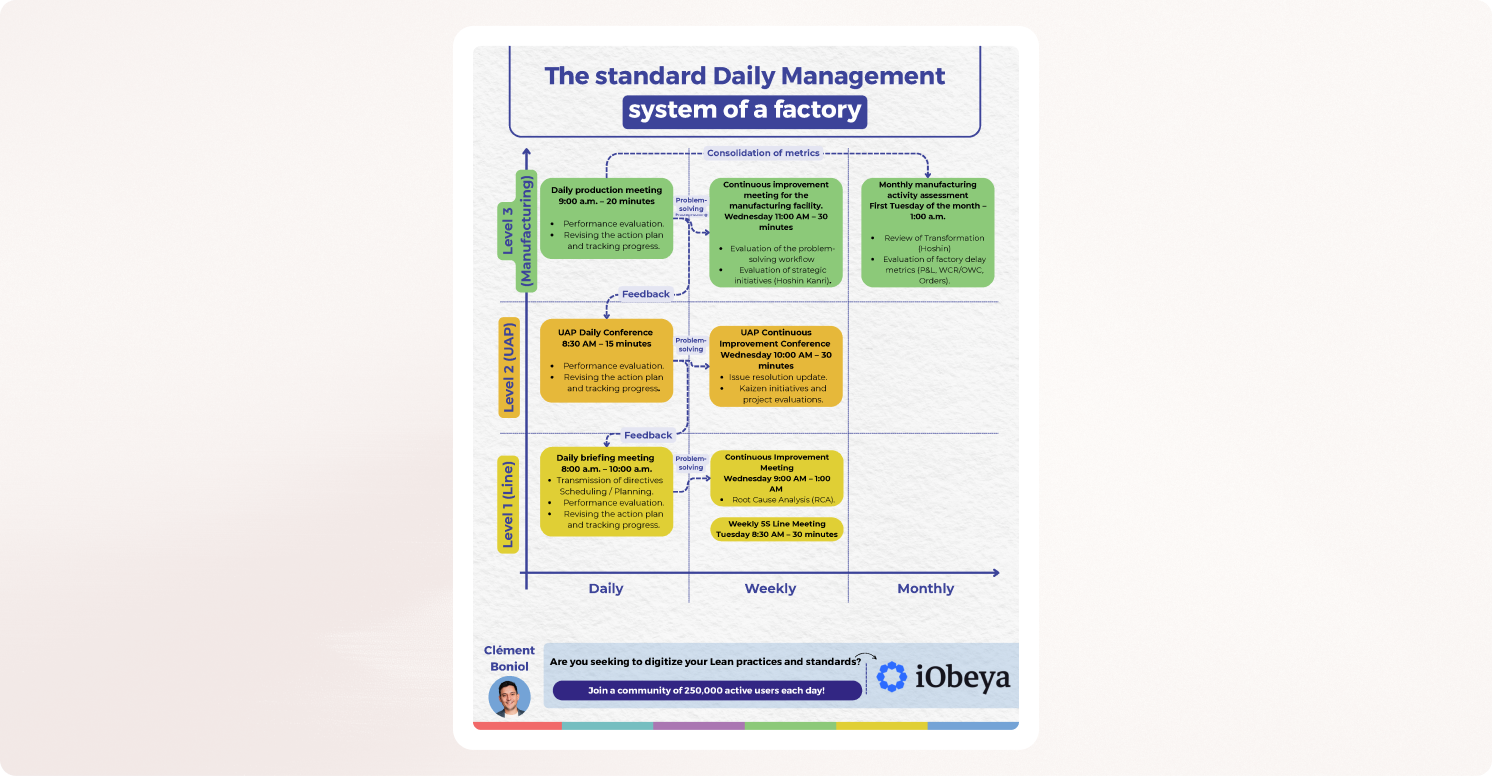
A Daily Management System (DMS) is a structured set of rituals, visual supports, and escalation rules that lets an organization detect a performance deviation, push it up to the right level, and decide on an action the same day it occurs. It is neither a dashboard nor a standalone meeting: it is the system that links the two over time, day after day.
The most common confusion is mistaking one piece for the whole. A dashboard is passive: it displays numbers, but doesn’t decide anything on its own. A meeting is a one-off event: without a continuously updated board or follow-through, it produces nothing more than an exchange of observations. A reporting system looks backward: it documents what happened last week or last month, not what’s happening this morning. A DMS, by contrast, is an active, recurring system: it exists to move information fast enough to act before a problem gets worse.
| DMS | Dashboard | Meeting Room | |
|---|---|---|---|
| Nature | Active, recurring system | Passive display | One-off event |
| Frequency | Daily, at a fixed time | Checked on demand | Scheduled, often spaced out |
| Function | Detect, escalate, decide | Inform | Discuss |
| Without the other elements | Cannot exist on its own | Triggers no action | Captures nothing over time |
A DMS that works rests on four components. None of them is sufficient on its own; it’s how they fit together that produces the intended effect.
The tier principle is what sets a DMS apart from a simple team meeting. At tier 1, the operator or team leader handles whatever can be resolved that same day, with the resources already on hand. At tier 2, the continuous improvement manager or site supervisor decides on anything that requires an extra resource or affects multiple lines. At tier 3, the plant or site director rules on anything that involves an investment, a change in priority, or that extends beyond a single site.
What flows between tiers doesn’t move in just one direction. Problems flow up; decisions and rulings flow back down. A DMS that only pushes information upward, without ever sending a response back down, eventually loses the trust of tier-1 teams: why keep flagging a problem if the answer never comes?
This is exactly where multi-site architecture changes the picture. As long as a DMS stays confined to a single site, pushing information up to tier 3 remains manageable with simple tools. As soon as a manufacturing leadership team oversees multiple plants, comparing tier-3 status across sites using the same reading grid, in real time, becomes considerably harder without a connected digital support. This is one of the points where a platform like iObeya provides a structural answer that paper tools cannot offer beyond a single site.
A paper-based DMS works perfectly well for a single line or a single site: the cost is low, and the physical presence of the board helps anchor visual discipline at the start. Its limit shows up as soon as you need to compare multiple sites, connect data to existing systems, or keep a reliable record of decisions over several months: paper wears out, gets lost, or simply never gets re-entered anywhere else.
Going digital changes four things in practice:
No escalation beyond tier 1: A DMS where problems escalate up to the team leader and then stop is just a team meeting in disguise. The fix is to set, from the design stage, an explicit deadline rule for each tier, and to check, in the first few weeks, that it’s actually applied rather than quietly skipped out of habit.
Data entry burden kills adoption: If filling out the board takes longer than the meeting itself, teams eventually neglect it, then quietly abandon it. The fix almost always involves connecting to existing data rather than relying on manual entry: a digital DMS that still requires daily re-entry has only solved half the problem.
iObeya transposes the four components of a DMS (the SQCDP visual board, the tiered meeting ritual, the escalation path, the decision log) into a digital workspace shared across every site in an organization. The visual board stays organized using the same logic as a paper support, which limits the adjustment time for teams used to the traditional format, while connecting directly to existing production data.
The escalation path becomes automatic: a deviation left unaddressed within the defined timeframe triggers a visible alert at the next tier, with no manual intervention. The decision log becomes searchable and time-stamped across every site, letting a manufacturing leadership team verify, remotely, that decisions made in meetings are actually being followed through.
Manufacturers like Sanofi, across more than 90 sites, cut the time needed to detect, escalate, and resolve an operational issue by 25% after digitizing their DMS (Forrester TEI study, 2021). ID Logistics runs more than 200 digital management rooms across more than 90 sites, with a reading grid shared across the entire network. Based on iObeya customer deployments, daily management meeting prep time drops by an average of 30 minutes per team per week once the DMS is digitized and connected to existing data.
To assess how this architecture would fit your organization’s tier structure, a personalized demo remains the most direct way to judge what suits your context.
Most DMS efforts that fail don’t die suddenly. They erode: the meeting keeps appearing on the calendar, but it gradually shrinks into a reading of numbers with no real discussion, because tier-3 management has stopped showing up to check that decisions logged are being followed through.
What keeps a DMS running over time is almost never a matter of tooling. It’s the consistency with which senior management keeps attending the lower-tier ritual, months after launch. It’s also the consistency between what’s asked for in the meeting and what’s actually rewarded: if a team is judged solely on short-term production volume, it quickly learns that flagging a problem in the meeting changes nothing about its evaluation, and the DMS becomes a formality rather than a steering tool.
One last point, often overlooked at launch: a DMS is never finished. The tiers, the escalation rules, and the indicators displayed need to evolve as the organization matures: a DMS frozen in its original configuration for three years is almost always a DMS that has stopped being genuinely used.