


- Home
- Lean Corner
- KPI Tree: How to structure your indicators for better performance management?
KPI Tree: How to structure your indicators for better performance management?
Why is it so difficult to define the right KPIs?
In many organizations, defining KPIs often resembles a messy brainstorming session.
Everyone comes up with their own favorite indicator, often influenced by their own role, tools or local priorities.
The result? A multitude of indicators, poorly connected to strategic objectives, with no clear hierarchy or logical link.
The KPI Tree is a structured, visual and collaborative approach to connecting strategic objectives to operational indicators, through intermediate performance levers. In this article, I’ll explain why and how to implement it.
What is a KPI Tree ?
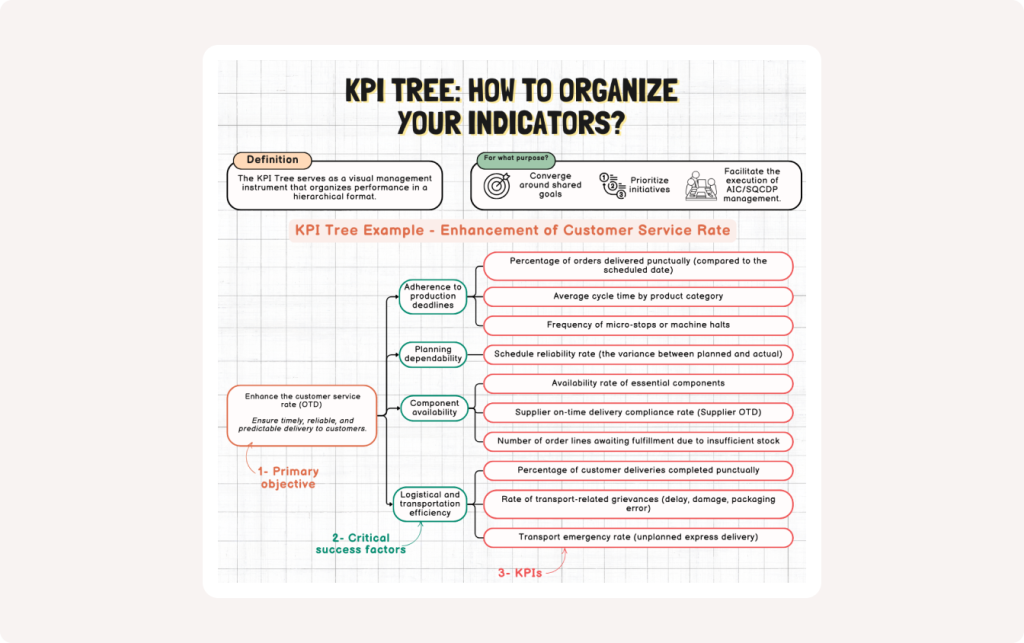
The KPI Tree is a visual management tool that structures performance hierarchically:
- Top: the organization’s strategic objectives
- In the middle: key success factors (CSFs – Critical Success Factors)
- Bottom: operational indicators (KPIs)
Each level is connected through a cause-and-effect logic. This framework helps teams understand performance levers as a whole and identify priority areas for action.The trees then clearly show how lower-level KPIs, such as workstation efficiency or machine downtime, have a direct impact on higher-level objectives, such as production volume and profitability.
Please note: The KPI Tree should not be confused with a Metrics Tree, which is more process-oriented than goal-oriented. The KPI Tree answers “Where are we going?” whereas the Metrics Tree answers “How does it work?”.
Why build a KPI Tree?
Give Meaning to Measurement
Align Teams Around Common Objectives
Prioritize Actions
Facilitate the implementation of an AIC / SQCDP system
How to build a KPI Tree? The 6 key steps
Step 1 - Formulate your strategic objective
Step 2 - Identify intermediate results (CSFs)
- Reduce delivery times
- mproving perceived quality
- Optimizing after-sales service responsiveness
Step 3 - Associate measurable indicators with each CSF
- Logistics service rate
- Machine availability rate
- Preparation conformity rate
Step 4 - Represent the links visually
Step 5 - Identify conflicts or synergies
Step 6 - Select key KPIs to monitor
Use case: KPI Tree applied to a customer delivery objective
Strategic objective: “Improve the customer service rate (OTD)”.
Simplified tree :
-
Objective: Improve OTD
→ CSF 1 : Reduce production disruptions→ CSF 2 : Optimize planning
→ CSF 3 : Improve transport reliability
Associated KPIs :
- Breakdown rate
- Rate of schedule adherence
- Logistics delay rate
- Safety stock level
-
% of orders delivered on time (OTD)
This KPI Tree enables the company to identify the real levers for improving customer satisfaction, and to structure its daily reviews around the right indicators.
Why digitalize your KPI Trees with iObeya?
Building a KPI Tree is the first step. Managing it effectively over time is another. My advice: digitalize the process.
Digitizing the KPI Tree makes it possible to :
- Visually centralize strategic and operational data
- Connect indicators to real-time data (via ERP/MES/BI integrations)
- Facilitate SIMexchanges, particularly in a multi-site or hybrid environment
- Align performance reviews, from the field to senior management
Conclusion: the KPI Tree, your performance management compass