

Why iObeya
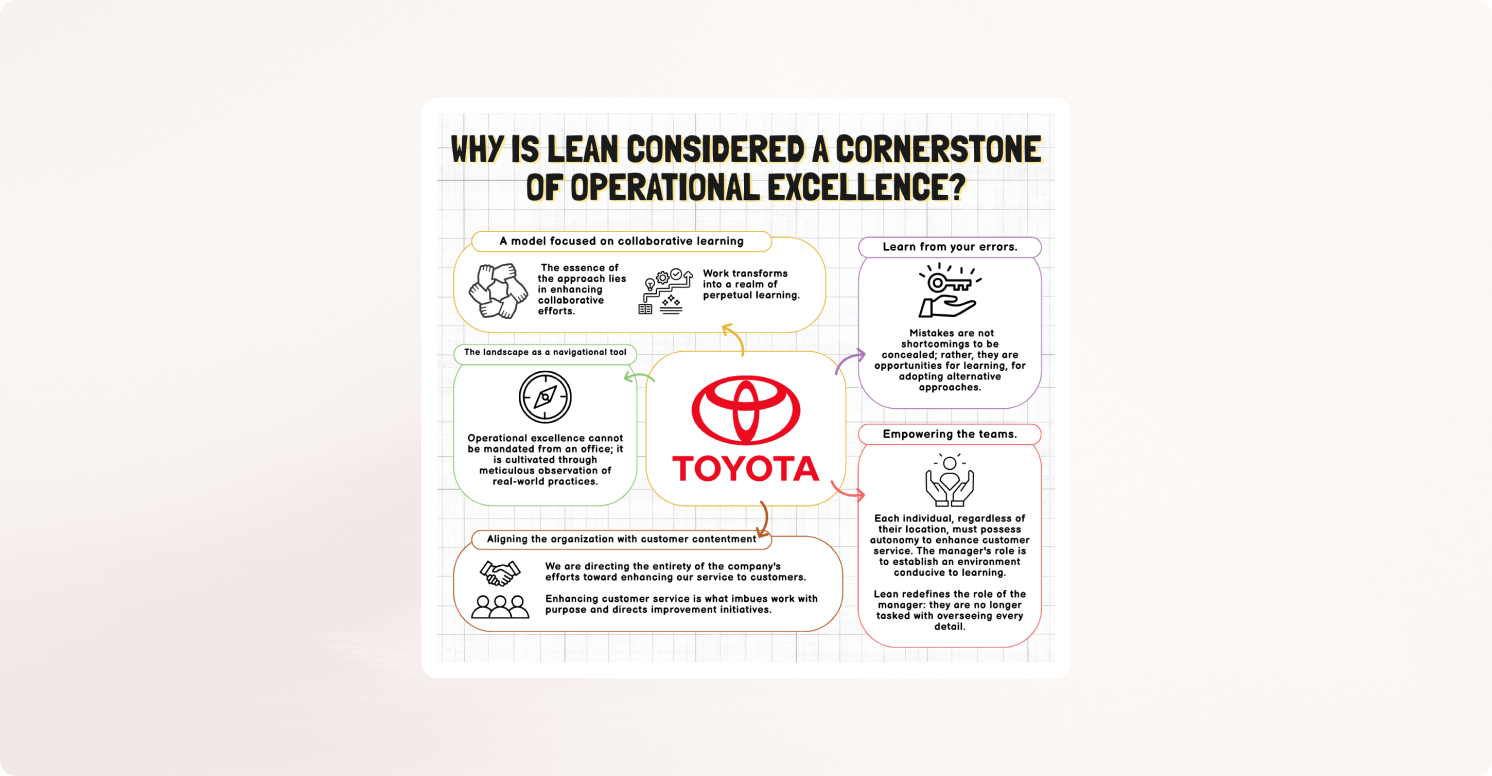
The term Lean appeared in the late 1980s, when a group of MIT researchers set out to understand how Toyota managed to outperform American car manufacturers. At the time, the Japanese company displayed remarkable performance: shorter lead times, much lower defect rates, higher profit per vehicle… all while using less inventory, less waste, and fewer hierarchical layers.
Intrigued, the researchers studied Toyota’s production system in depth. What they discovered went far beyond a manufacturing method. Lean was not a fixed set of tools, but the study of a living system rooted in a culture of continuous improvement, collaboration, and learning at work.
In other words, Lean is simply the attentive observation of how Toyota learns to work better together, and what other companies can learn from it to grow in turn.
Lean is a shared learning system that helps managers grow faster. At its core, Lean is about learning to work better, together.
This means improvement starts with a team’s ability to reflect on how they work, and to draw lessons from it to do better tomorrow. It represents a radical shift in mindset: work becomes a space for ongoing learning.
What makes the difference is going to the gemba, the actual place of work, to understand what we don’t yet understand.
Operational excellence can’t be decreed from an office. It is built through close observation of real work, real problems, and the learning opportunities they create. It’s on the ground, close to action, that we learn what must be changed to improve.
Every mistake or defect is a symptom of flawed reasoning that needs to be addressed.
This is a culture where people are encouraged to say “I don’t know” without fear. Mistakes aren’t failures to be hidden, they are opportunities to learn, to adapt, and to better understand the system.
Operators have the right to say “I don’t know how to do this,” and that right is respected. Everyone, at every level, should be empowered to act to better serve the customer. The manager’s role is to set up the right conditions for learning.
By increasing autonomy and decision-making capabilities across the board, organizations can accelerate improvement cycles and boost efficiency. Lean redefines the manager’s role , not as someone who controls, but as someone who helps others grow.
All of the organization’s energy should be focused on how to better serve the customer. That’s what gives work its meaning and guides improvement efforts.
A Lean strategy only works if it’s understood at every level of the organization. When everyone understands the purpose of their work, they can adjust their actions independently, in service of a shared goal.
Lean starts with oneself. If I don’t change my own perspective… how can I ask others to change? Progress is not made against people, but with them.
Operational excellence involves a deep shift in mindset: teams are no longer just asked to execute, but to think, experiment, and learn. It’s a move from exploitation to exploration.
Lean isn’t a method for cutting costs. It’s a method for understanding and avoiding the reasoning errors that lead to waste.
It’s not about doing more with less. It’s about doing better with what we have, by tapping into collective intelligence. Improvements don’t come from putting pressure on teams, but from involving them in solving the right problems.
Lean is not just one method among many. It is a deeply human way of working, one that enables an organization to grow through learning.
By learning together , through direct observation, through questioning, and through adjustment , operational excellence becomes possible.
In the end, it’s not the processes that make the difference. It’s the people who, every day, strive to do their work better, together.


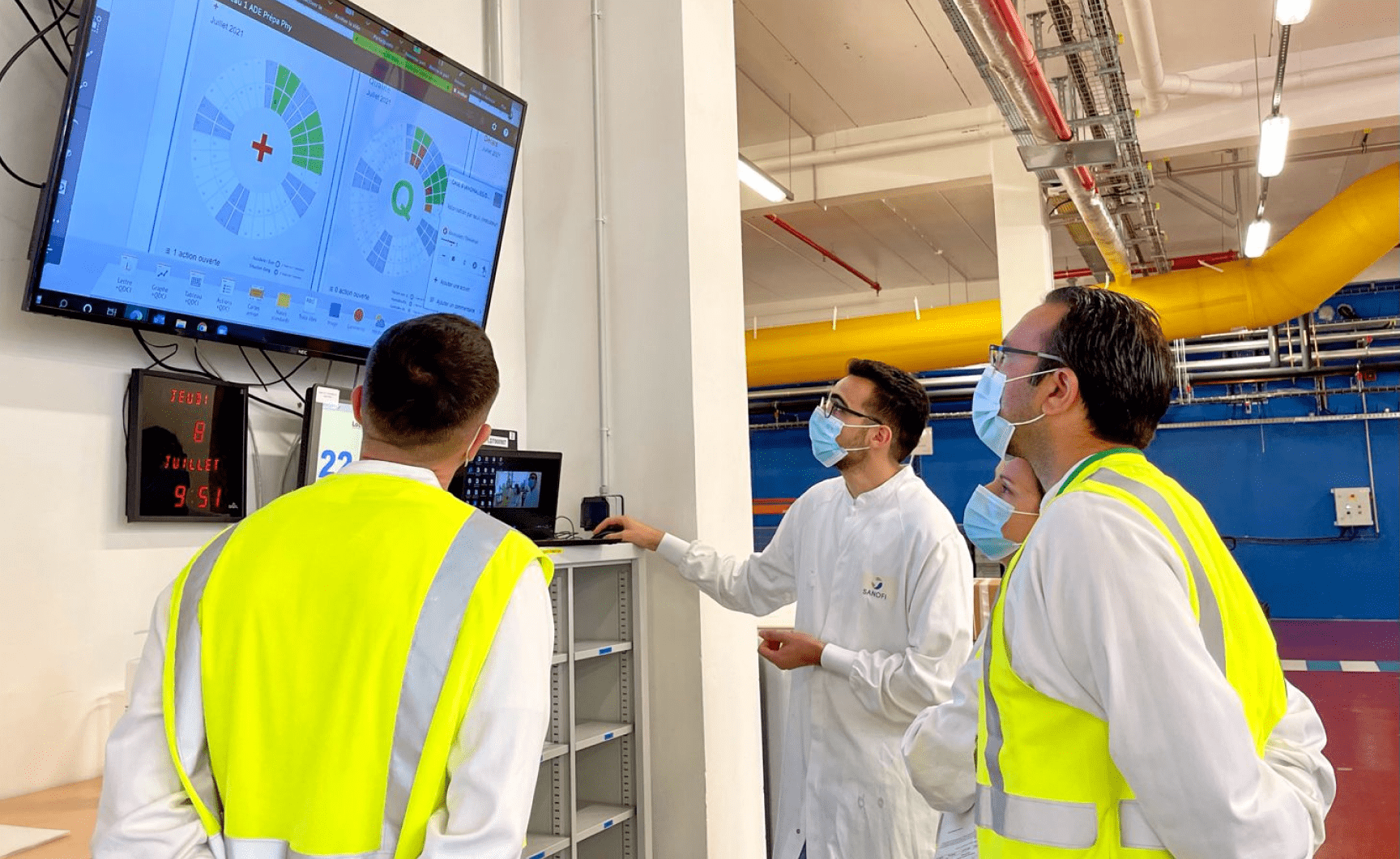

It began as a physical space in Lean practices, and today physical and digital rooms blend together.
In the Obeya, goals, progress, and challenges are made visible so leaders and teams can align, share insights, and act quickly.
This clarity speeds up decisions and helps strategy turn into results.
It builds trust, focus, and collaboration
It connects leaders with teams in real time.
Everyone sees the bigger picture, moves in the same direction, and contributes to shared success.