Lean Corner

What Is Operational Excellence? The Complete Guide

Most manufacturers don’t lack lean tools. They have a 5S program, Kaizen events, KPI dashboards, and even a strategic plan signed off by the executive committee. What they lack is the link between that strategy and what actually happens on the shop floor every morning. Leadership says “improve quality by 15%.” The team leader has never heard of it. This is exactly the gap operational excellence is designed to close.

If I had to define operational excellence, I’d put it this way:

Operational excellence (or OpEx) is a management system that aligns strategy, processes, and teams, so that every level of the organization makes day-to-day decisions that create value for the customer, reduce waste, and reinforce the company’s long-term objectives.

This guide details what operational excellence actually means, the five pillars that structure it, what it looks like in real plants, the management rituals that keep it alive, and a four-step approach for starting to build it in your own organization.

Operational excellence is often reduced to “being efficient.” In practice, it is more specific than that. It describes a state (and an ongoing effort) where the organization’s strategy is visible and actionable at every level, where problems are escalated and solved as close as possible to where they occur, and where improvement is part of daily work rather than being treated as a separate project.

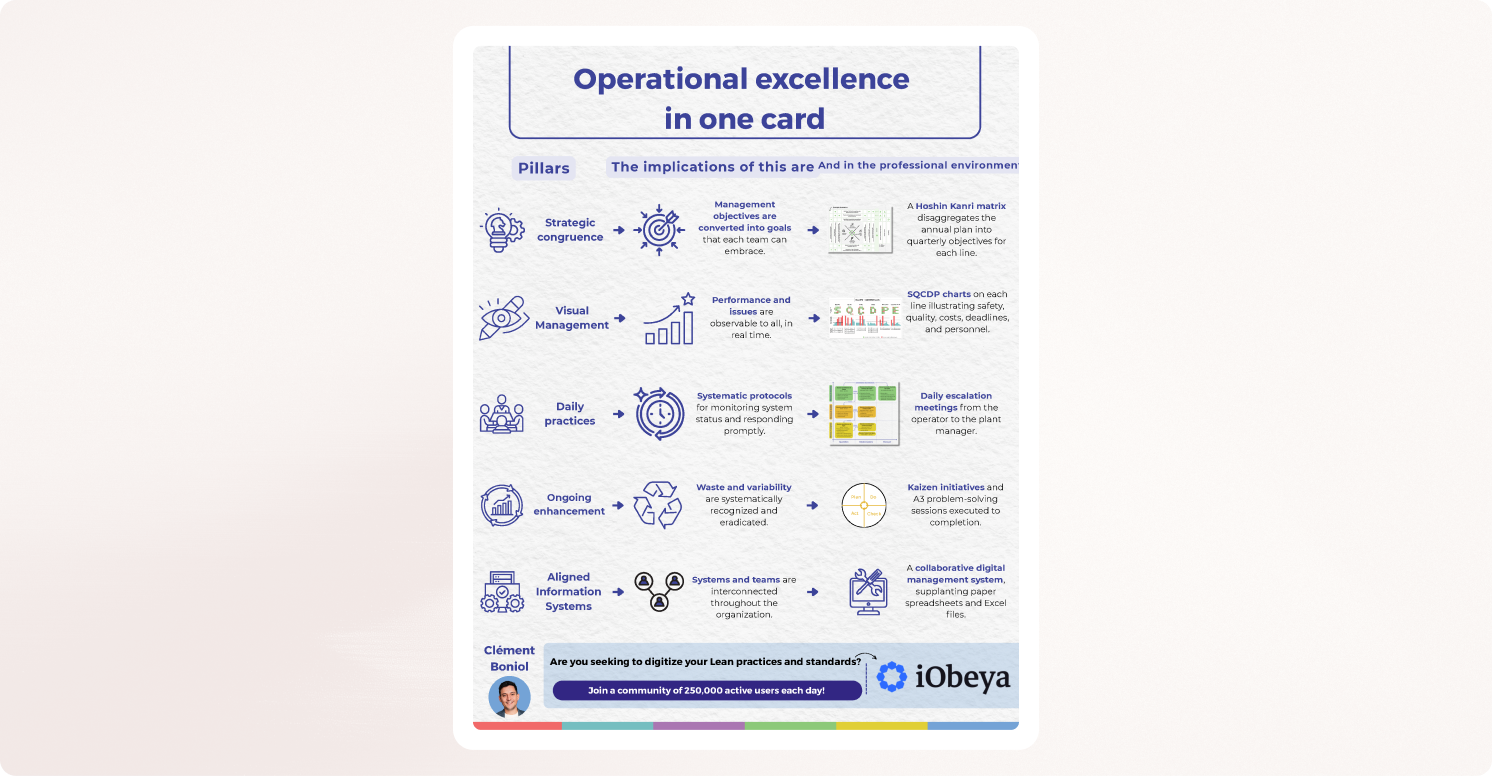
The table below breaks the definition down into its core components, and what each one looks like once it’s actually in place on the shop floor.

Concept What it means What it looks like on the shop floor
Strategic alignment Leadership objectives are translated into goals every team can own A Hoshin Kanri board breaks the annual plan down into quarterly targets by line
Visual management Performance and problems are visible to everyone, in real time SQCDP boards on every line showing safety, quality, cost, delivery, and people
Daily rituals Structured routines to check the system's status and react quickly Escalation meetings every morning, from the operator up to the plant manager
Continuous improvement Waste and variability are systematically identified and removed Kaizen events and problem-solving A3s tracked through to closure
Digital foundation Systems and teams are connected across the organization A shared digital management system, replacing paper boards and spreadsheets

Put together, these five components are what distinguishes a plant that talks about excellence from a plant that practices it.

Most operational excellence frameworks converge on the same five pillars. Each one answers a different question about how the organization creates and protects its value.

  • Customer focus: Every process, every metric, every improvement effort should tie back to what the customer actually values: on-time delivery, product quality, responsiveness.
  • Strategic alignment: Operational excellence only works if the shop floor understands what the company is trying to achieve, and why. This means cascading strategic objectives all the way down to each team, but also, just as importantly, letting shop-floor signals flow back up to feed the strategy. Alignment runs both ways.
  • Continuous improvement: This is the engine: a permanent capability. Teams are trained to spot the gap between standard and reality, trace it to its root cause, and close it. This is what keeps an operational excellence program alive once the initial enthusiasm has worn off.
  • People development: Tools don’t solve problems, trained people do. This pillar covers skill-building, problem-solving capability, and a shift in management posture, from controlling to coaching teams so they can solve their own problems. Programs that neglect this pillar produce compliance, not ownership.
  • Process excellence: Standardized, stable, well-documented processes are what makes problems visible in the first place. Without a standard, you can’t define a deviation, and without a deviation, there’s nothing to improve. Process excellence is the foundation the other four pillars rest on. It is also the most commonly underestimated pillar: teams rush into problem-solving tools before the underlying process is even stable enough to be measured reliably, which produces noisy data and false signals.

A company can roll out tools without ever reaching operational excellence (tools installed with no alignment or lasting behavior change), and a company can practice continuous improvement without formally adopting the lean mindset (problem-solving habits without the specific toolkit).

Conceptual frameworks are useful, but operational excellence is ultimately judged by what changes on the shop floor. Three examples from iObeya customers illustrate what this looks like, at different scales.

  • Sanofi: 25% faster decisions Across Sanofi’s production sites, structured visual management and the digitization of daily routines reduced the time teams need to detect, escalate, and resolve operational issues, speeding up decision-making by 25%. The gain didn’t come from a single new tool in isolation; it came from connecting shop-floor signals to the right decision-makers, fast enough for it to matter.
  • Stellantis: 33,500 users group-wide. Operational excellence at this scale isn’t a single model plant; it’s consistency across dozens of sites and tens of thousands of people using the same visual standards, the same escalation logic, and the same digital foundation. Stellantis’s rollout shows that OpEx principles hold up at scale when it’s the underlying system, not just the tools, that gets standardized.
  • ID Logistics: 80+ sites with shared SIC and Gemba rituals. For a logistics operator running dozens of warehouses with different teams and local constraints, the challenge is keeping daily management rituals consistent without becoming rigid. ID Logistics digitized its short-interval control (SIC) and Gemba routines across more than 80 sites, giving leadership a comparable, real-time view of performance everywhere.

The common thread across these three examples: operational excellence shows up as faster, more consistent decisions, not as a poster on a wall.

A conceptual framework stays theoretical until it’s embodied in routines that teams actually practice. These five rituals are how operational excellence principles become a daily practice.

  1. SQCDP boards: Safety, Quality, Cost, Delivery, People, tracked visually, updated every day, discussed at the start of shift. SQCDP is the most common entry point into structured visual management, because it’s simple to set up and immediately surfaces where performance is drifting.
  2. Multi-level escalation: A short daily meeting at the team level (often called a Top 5 or SIC), feeding into a slightly longer meeting at the supervisor level, which in turn feeds a site-level review. Each level resolves what it can and escalates what it can’t, within hours rather than weeks.
  3. Gemba walks: Structured visits to the actual place where the work happens, led by management, to observe directly rather than rely on reported numbers. A well-run Gemba walk isn’t an inspection; it’s a chance to ask “what’s blocking you?” and act on the answer.
  4. Hoshin Kanri: The mechanism that cascades annual strategic objectives down to each team, and lets execution data flow back up to feed the next planning cycle. Without Hoshin Kanri, strategic alignment (the second pillar) stays a slogan rather than a system that actually works.
  5. The problem-solving A3: A structured, one-page format for diagnosing a problem, testing countermeasures, and confirming results, used to make root-cause analysis rigorous and visible rather than informal. A3s are what lets continuous improvement (the third pillar) be documented and shared, instead of staying in a single engineer’s head.

Organizations that succeed with operational excellence rarely start by rolling out every pillar and every ritual at once. They build progressively, roughly in this order.

  1. Take stock of where you stand:Before changing anything, measure where you actually are: the maturity of your existing visual management, the frequency and effectiveness of current rituals, and how well teams understand the strategic objectives. Without this step, there’s no way to tell whether later changes are having any effect.
  2. Pilot on a single line or site: Pick one team or production line to set up the essential rituals (SQCDP, a multi-level daily meeting, a basic problem-solving routine) and run it long enough to work out the kinks. A pilot’s job is to reveal what won’t work at scale before that costs you during a multi-site rollout.
  3. Move to a digital daily management system:Paper boards and spreadsheets cap how far a program can scale, and make comparing sites nearly impossible. Digitizing rituals by connecting them to real data from the ERP, MES, or quality systems is what makes the next step realistic.
  4. Scale company-wide, with shared standards: Extend the validated rituals and digital foundation across all sites, while keeping enough local flexibility for each team to adapt to its own constraints. The goal at this stage isn’t uniformity for its own sake; it’s giving every site the same visibility and the same speed of decision-making.

It’s also worth noting that these four steps rarely unfold in a strictly linear fashion. In reality, programs loop back: a pilot reveals that the initial assessment missed a key constraint, or a company-wide rollout surfaces a site whose process maturity is too low for the standard rituals to take root. Treat this sequence as a cycle to revisit, not a checklist to tick off once and for all.

Many organizations launch an operational excellence effort with good intentions and a sizable budget, then watch the momentum fade within twelve to eighteen months. The pattern is almost always the same: tools get rolled out, training gets delivered, early wins get highlighted, and then, without renewed management attention, the rituals gradually empty out. Meetings still happen, but without real discussion. Boards still get updated, but no one really looks at them anymore.

What separates efforts that last from those that don’t is rarely the sophistication of the framework chosen. It’s management consistency: leaders who keep showing up on the shop floor months, even years, after the initial launch; standards that evolve based on feedback rather than being frozen once and for all; and a genuine tolerance for mistakes when they serve collective learning. Conversely, the moment problems raised in a meeting stop getting a concrete response, team trust collapses, and the whole system goes with it.

There’s also a dimension that often gets overlooked: consistency between what’s said and what’s rewarded. If an organization presents continuous improvement as a priority but keeps judging teams solely on short-term volume metrics, the message sent on the shop floor contradicts the official line. Operational excellence requires that recognition systems, individual objectives, and management rituals all tell the same story.

Lean Corner Sheets
Lean Corner

What Is Operational Excellence? The Complete Guide

Lean
Discover how Gemba Walks revitalize organizational culture and enhance operations. Explore their benefits, tips, and practical uses.
Lean
Explore the 8 wastes of Lean. Brian shares insights into the world of Lean methodology and waste elimination.
Lean
Discover how the PDCA cycle drives continuous improvement and operational efficiency in this Podcast episode.

See how they trusted us and achieved success with iObeya

Provide your information to download the lean corner fact sheets