Lean Corner

How (and Why) Should You Digitalize Your Short Interval Meetings (SIMs)?

Short Interval Meeting (SIM) is one of the cornerstones of operational excellence.
Whether on a production line, in a support department, or at the executive level, SIMs help track key performance indicators, escalate issues quickly, and trigger concrete actions.

But in some organizations, SIMs may not be run effectively: indicators are not always up to date, visual supports are static, and conversations often lack depth.

Even when starting with physical tools , which often makes sense to test and anchor the routines it quickly becomes necessary to access data from other departments, or even from other sites or factories.

And in this context, a question arises: what if digitalization could actually address these limitations and restore the full managerial power of SIMs?

For a long time, SIMs relied on physical boards, post-its, printed documents, or shared Excel files. These formats have the benefit of simplicity, but they quickly show their limits:
  • Hard to maintain a reliable record of decisions and actions
  • Difficult to synchronize multiple SIM levels (shop floor, department, leadership)
  • Limited remote access , not compatible with hybrid work environments
  • Risk of confusion or errors in the indicators

The result: teams spend more time preparing the supports than actually reflecting together, problems are not explored in depth, and actions are not properly followed up.

Digitalization transforms SIMs into a real-time management system that supports action and learning.

In my experience, here are the main benefits observed:

  • Reliable data: indicators are connected to existing systems (ERP, MES, BI…) and automatically updated
  • Traceability of actions: every deviation, every decision, every action plan is logged
  • Multi-level synchronization: from the shop floor to the executive board, each SIM level feeds into the next.
    Escalations become visible, and decisions are made faster
  • Accessibility: even remotely, teams can actively participate in daily rituals


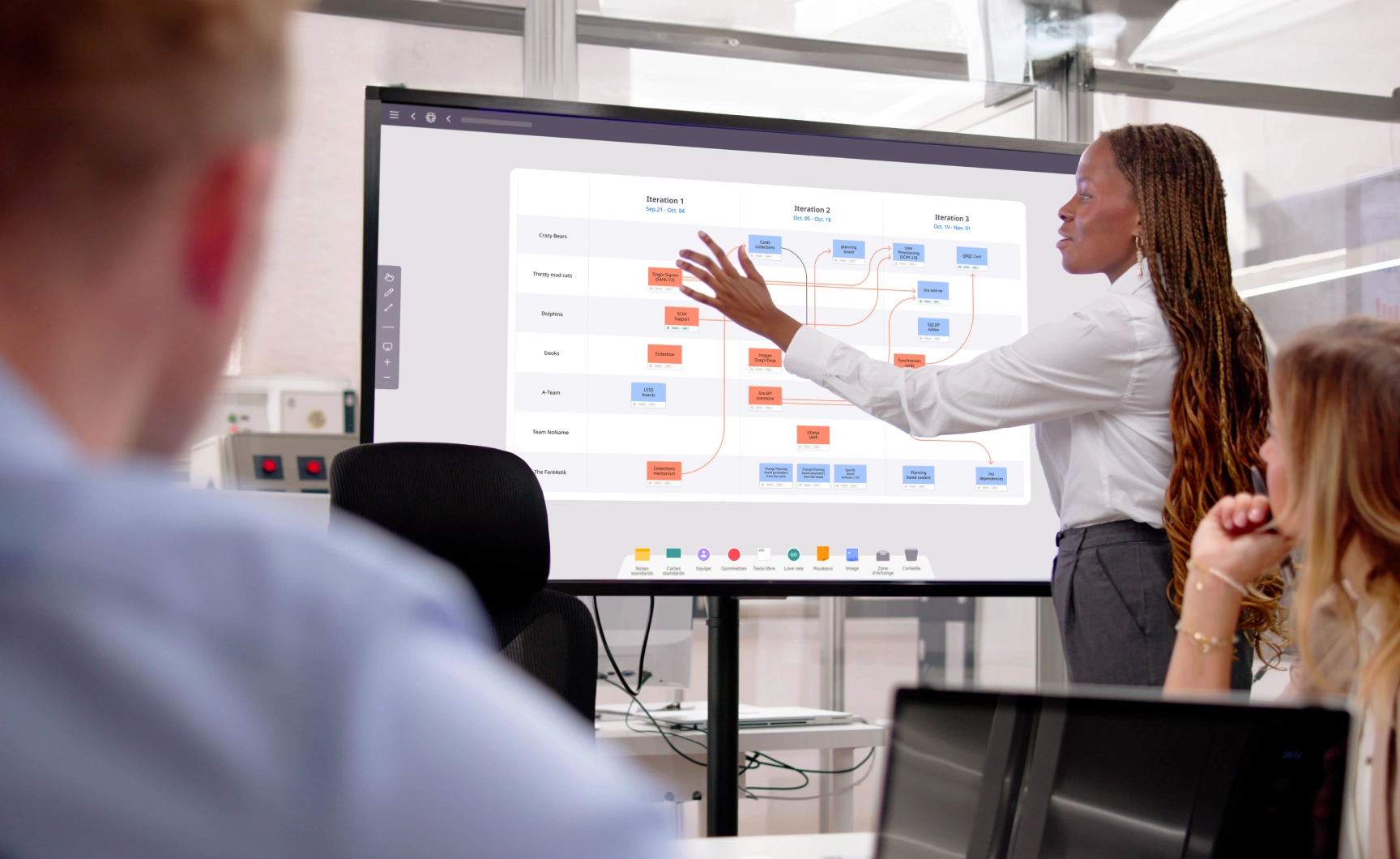
A platform like iObeya enables this digitalization at scale while staying true to Lean principles.

It allows you to structure a network of interconnected SIMs, tailored to each management level,
with standardized visual supports and reliable data.

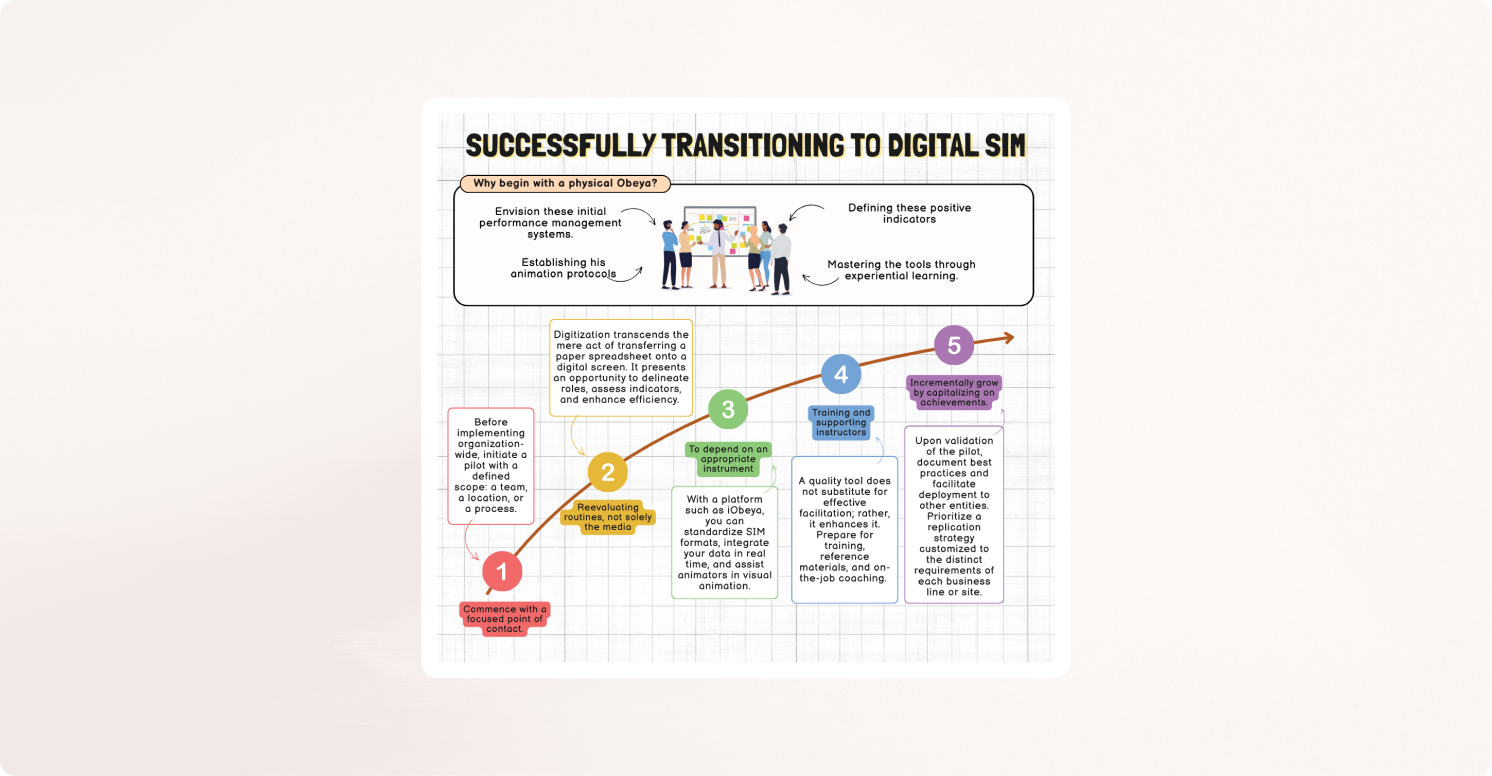
Digitalizing your SIMs is a progressive transformation that requires a structured approach. Here are some key success factors:

1. Start with a Focused POC

Before rolling out organization-wide, begin with a pilot on a clearly defined scope: one team, one site, one process.
This allows you to test the visual boards, engage managers, and validate real use cases. This Proof of Concept becomes a reference for future expansion.

2. Rethink the Routines, Not Just the Tools

Digitalization is not about copy-pasting the paper board onto a screen. It’s an opportunity to clarify roles, review indicators, and strengthen cadence. The ritual must remain dynamic , focused on action and learning.

3. Use the Right Tool

With a platform like iObeya, you can standardize your SIM formats, connect your real-time data, and support facilitators with visual management. The tool becomes a catalyst for your management dynamics.

4. Train and Support the Facilitators

A great tool doesn’t replace great facilitation , it enhances it. Plan for training sessions, reference materials, and on-the-ground coaching. Support your teams in learning how to make the most of the tool.

5. Scale Gradually by Leveraging Success

Once your pilot is validated, document best practices and support the rollout across other teams and sites. Adopt a replication mindset that adapts to each business unit’s or site’s specific context.

Digitalizing your SIMs is not just about modernizing visual displays.
It’s about building a performance management system that is more fluid, more reliable, and more responsive.
It’s about giving teams the means to track their work, surface roadblocks, and align their actions.

With the right approach, the right tools, and tailored support, digital SIMs become a powerful lever for strengthening operational excellence.

The implementation of Just-in-Time often involves significant changes in the organization of work. To ensure that the decisions made during the implementation are sound and to facilitate this transition, it is essential to involve the relevant employees from the beginning of the process.
Quick tip: Using the RACI matrix can help clarify everyone’s roles and responsibilities.
Lean Corner Sheets
Lean Corner

How (and Why) Should You Digitalize Your Short Interval Meetings (SIMs)?

AgileLean
Integrate Obeya with Lean and Agile for enhanced collaboration, visualization of work, improved decision-making, rapid problem-solving, and more.
Lean
Are you looking to dive into Lean Manufacturing but unsure where to start? Here are the first 5 essential steps to get it up and running.
Lean
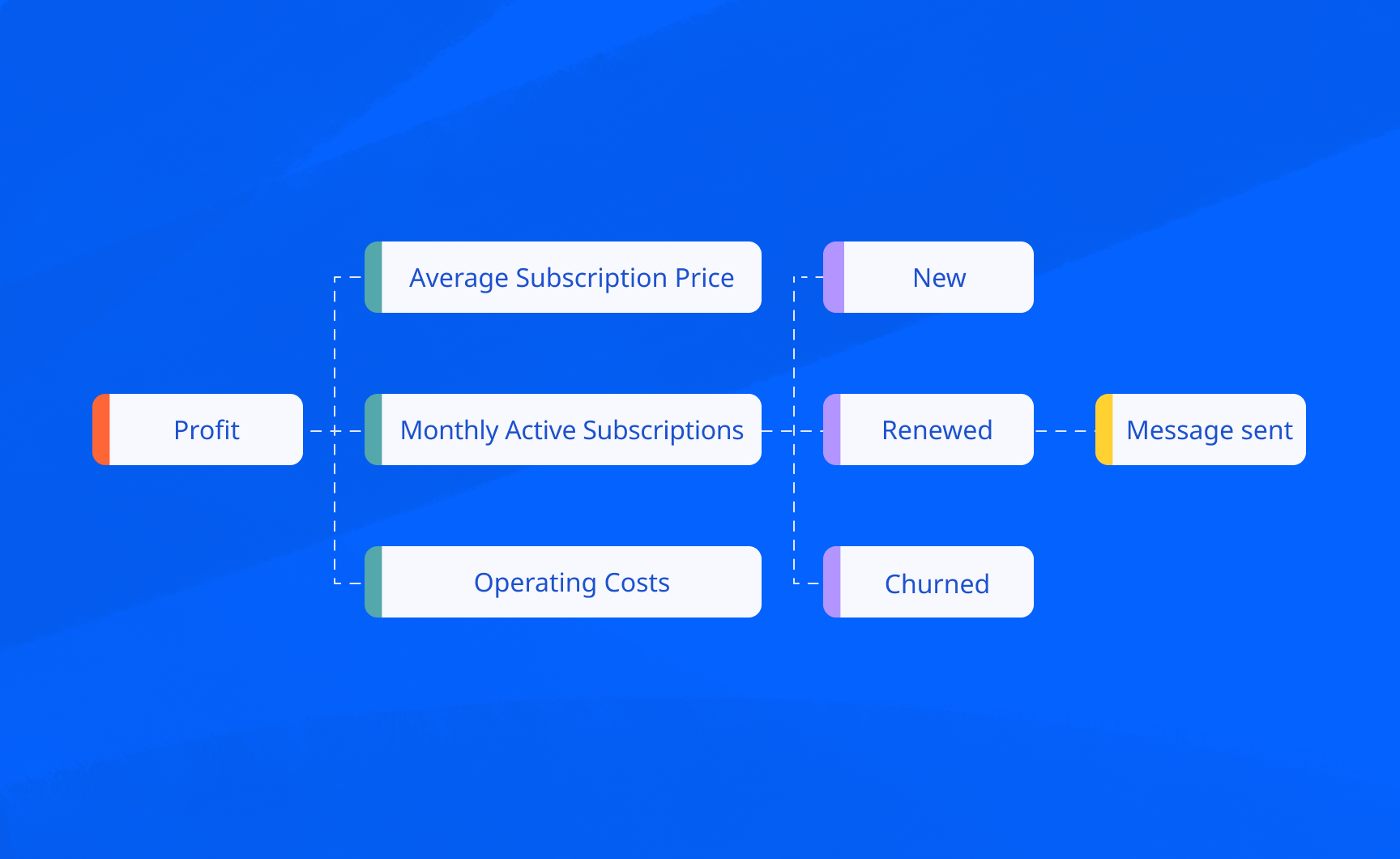
Learn how KPI Trees drive efficiency in Lean Manufacturing. Discover key metrics like OEE, Cycle Time & tips for implementing effective KPI Trees.

See how they trusted us and achieved success with iObeya