



In multi-site industrial groups, the digitalization of Lean practices has become essential to maintain consistent management rituals at group level.
While traditional Lean management tools (physical boards, daily rituals, visual management) have proven their effectiveness, they show their limits when teams are geographically dispersed, work is hybrid, and performance must be managed at group scale.
In this context, the industrial leadership of Vaillant Group (5,500 employees across 11 plants, in 7 countries and 7 languages) needed to ensure homogeneous management rituals while preserving local decision-making capabilities.
How can a coherent continuous improvement system be deployed across multiple plants? How can shopfloor responsiveness be maintained while ensuring strategic alignment at group level? These challenges have structured the operational transformation undertaken by Vaillant Group for more than ten years.
How did an industrial leader transform its Lean rituals in the digital era? This article is based on concrete feedback from the deployment of iObeya at Vaillant Group, a European leader in heating and air-conditioning solutions. The objective is to share practical, field-tested lessons for executives and managers leading similar initiatives.
Lesson 1: Lean digitalization starts with management practices, not technology
The first pitfall of Lean digitalization is believing that the tool will solve management problems. At Vaillant Group, the approach followed the opposite logic: the digital Obeya was introduced only after Lean rituals were firmly embedded at shopfloor level.
As a manager from the Belper site explains:
“The first real lever is engagement. And succeeding at level 1. For us, it was essential to collect feedback from the shopfloor at the lowest level and then ensure it was escalated.”
This feedback highlights a key point: a digital tool only creates value when it is built on management practices that are already established and mastered. In Vaillant’s case, this meant having structured shopfloor management, daily performance reviews, and problem escalation rituals in place.
Digitalization then acts as an accelerator, not a substitute. It facilitates the collection of shopfloor data, its structured escalation, and its use across different management levels. However, it does not replace ritual discipline, the quality of facilitation, or the rigor of action follow-up.
One Vaillant manager summarizes this progression clearly:
“When we reviewed the first steps of our shopfloor management 2.0, where everything was still done on paper in a pilot plant, the second step was digitalization, which was a major help.”
This strong foundation of shopfloor practices enabled rapid deployment: 2 months for the pilot phase, followed by 4 to 10 months for the rollout, depending on site size and maturity.
Lesson 2: Standardization enables scaling, provided local autonomy is preserved
A multi-site industrial group faces a constant tension: how to share best practices and align methods while respecting each plant’s operational specificities.
At Vaillant Group, the launch of the VPS (Vaillant Production System) in 2012 directly addressed this need.
“A new industrial director arrived with the need to share best practices and align certain continuous improvement methods”
The approach is based on a clear balance: a common group-level management framework combined with freedom for local teams to adapt.
In practical terms, this means standardizing key indicators, the structure of management rituals, and problem escalation methods, while allowing sites to adjust data granularity, visual board organization, or the frequency of certain synchronization meetings.
This approach resulted in the deployment of 130 operational QCD management boards (around 150 planned) and 40 coordination boards for support functions (target of 50), while leaving sites free to adapt usage to their context.
This flexibility is not a concession, it is a condition for adoption. As one manager notes:
The impact is twofold. On the one hand, standardization enables genuine performance comparability between sites, facilitating benchmarking and knowledge sharing. On the other hand, it strengthens cross-functional collaboration, as all stakeholders speak the same operational language while retaining execution autonomy.
Beyond the QCD module, iObeya usage has progressively expanded to other dimensions of the VPS: 5S tracking, suggestion management, shopfloor walks, problem-solving management, and maturity coaching.
Lesson 3: Leadership engagement determines adoption and business impact
The success of a digital deployment is not measured by the number of connected users, but by the quality of managerial usage. If the digital Obeya becomes a simple reporting tool, it loses all its value.
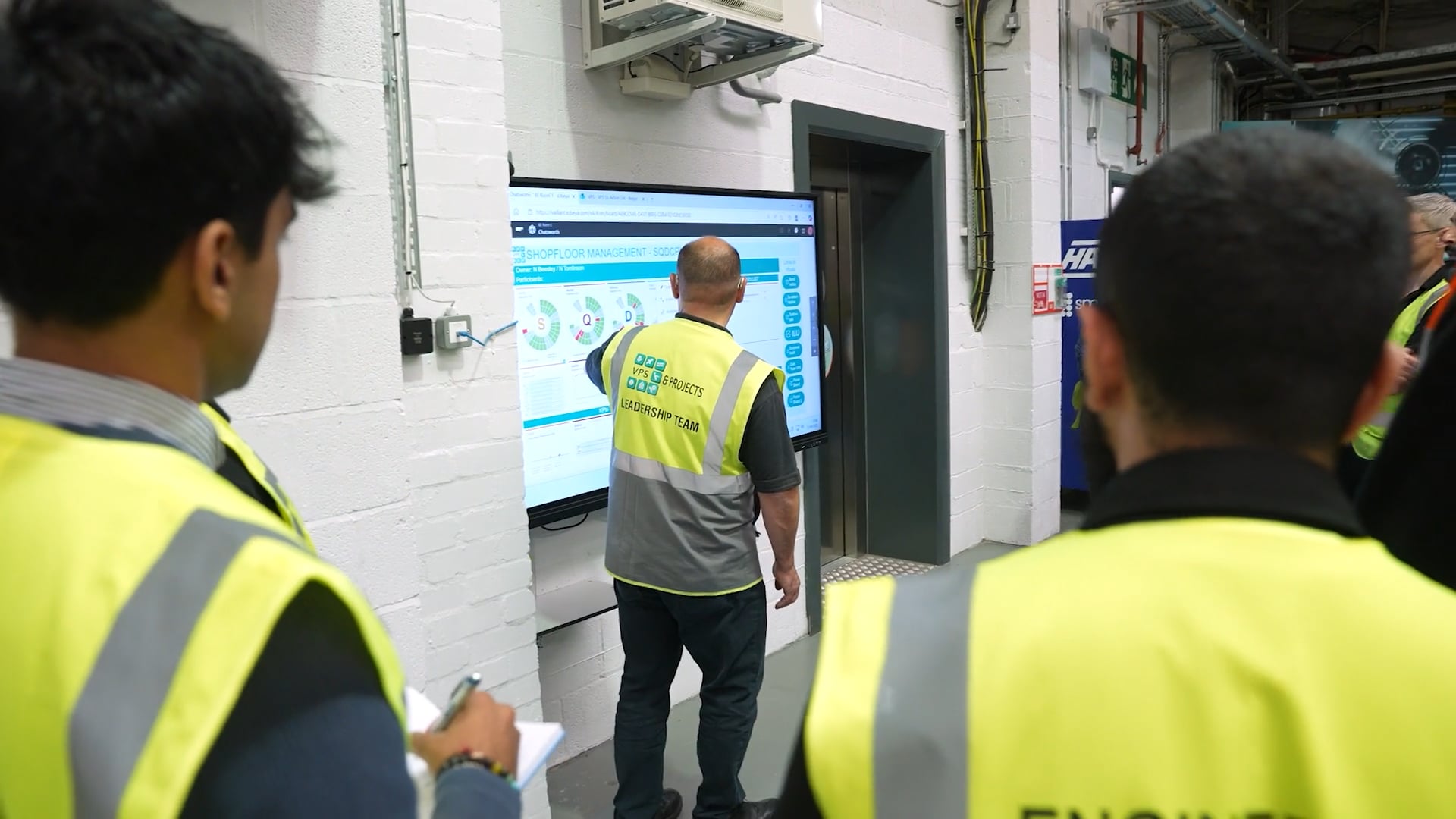
At Vaillant Group, the positioning is clear: the Obeya is a decision-making space, not a passive dashboard. Managers at all levels use the tool not to consult data, but to steer operations, prioritize actions, and remove obstacles.
This managerial posture has direct effects on teams: by structuring rituals around concrete decisions, managers gain anticipation and responsiveness.

By making information available in real time and structuring decision-making rituals, the digital Obeya frees up analytical time and shortens reaction cycles.
Leadership engagement is also reflected in active sponsorship of the deployment. The support from iObeya, joint development, and the involvement of a central VPS referent within the organization were decisive, emphasizes a manager. This pairing of a strong internal sponsor and expert external support creates the conditions for sustainable adoption.
Finally, the daily use of the Obeya by senior leaders sends a powerful cultural signal: transparency, accountability, and collaboration are not theoretical values but concrete, measurable practices.

Key results observed at Vaillant Group
Increased visibility on performance and priorities
Stronger alignment between strategy and execution
Faster, more fact-based decision-making
Stronger team engagement
By making problems visible and structuring collective problem-solving, the digital Obeya fosters engagement at all levels.
“Continuously engaging teams to solve problems and perform better,” summarizes this dynamic.
Transparency becomes a driver of engagement rather than a source of control. Every day, 350 to 400 frontline managers, from team leaders to plant directors, participate in at least one SQDCP ritual, including support functions.
Lean digitalization as a lever for sustainable performance
The Vaillant Group experience highlights three key levers for successful Lean digitalization.
First, technology only creates value when it builds on solid management practices. Digitalizing nonexistent or weak management will produce no results.
Second, standardization does not mean rigidity. A common group-level framework must be combined with local flexibility to ensure adoption and operational effectiveness.
Finally, leadership engagement is the decisive factor. The digital Obeya must not be a reporting tool, but a true steering and decision-making space used daily by managers.
“The mission of the VPS is to create and sustain a continuous improvement system. And I think it is a success,” concludes a team member. After 13 years of deployment, the cultural transformation is tangible: “When you enter an industrial environment at Vaillant, you immediately feel that you are at Vaillant.”
Lean digitalization is part of a long-term managerial journey, not a one-off project. When driven by management practices, it becomes a sustainable lever for operational excellence.