

Why iObeya
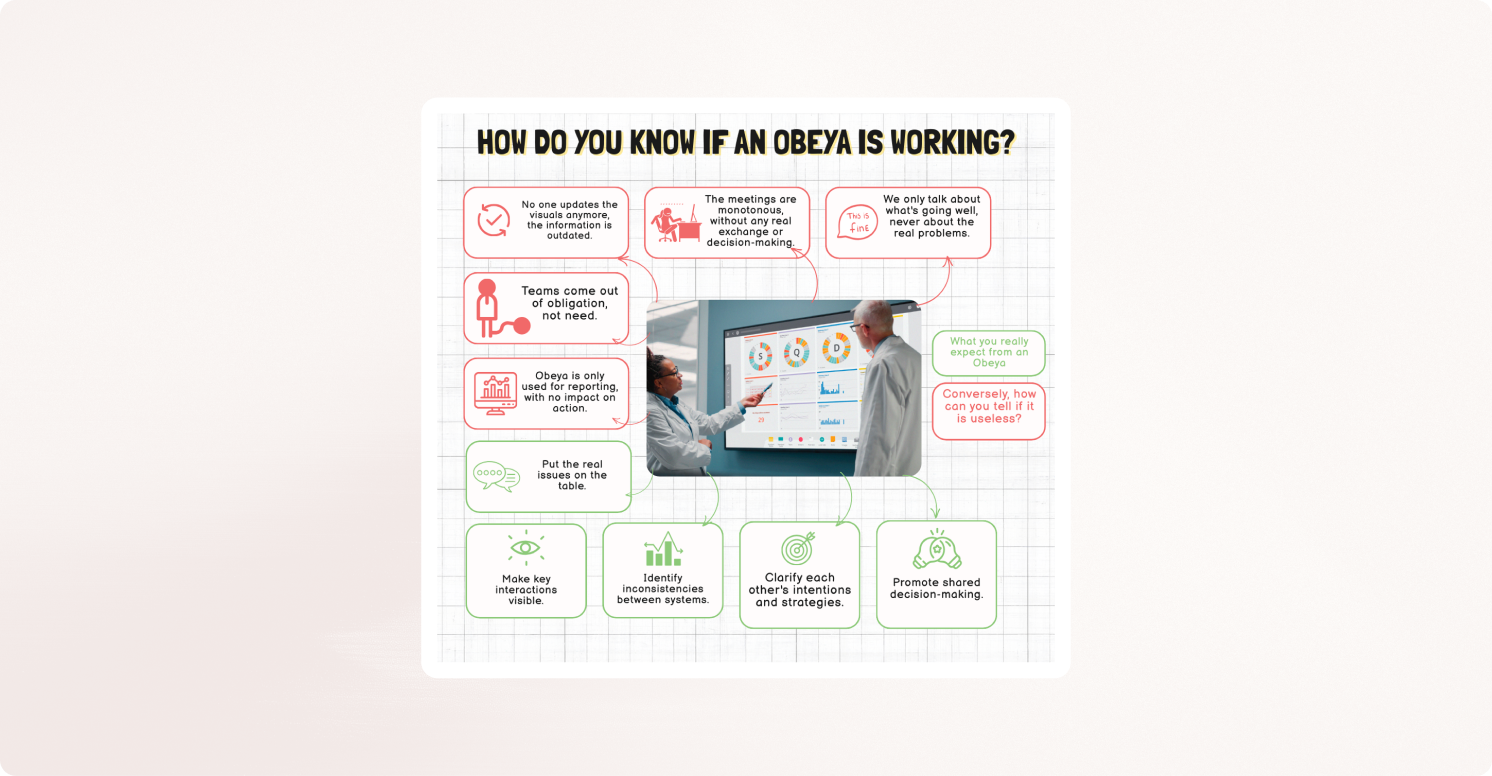
When people hear “Obeya” , they often picture a room covered in post-its, charts, and timelines. And too often, that’s exactly what you find: a nicely decorated space… but devoid of meaning. Information is outdated, conversations are nonexistent, and nobody really stops to use it.
We mistake the tool for the purpose. We think Obeya is about showing, when it’s actually about thinking. We project a logic of control onto it, when it’s designed to foster dialogue, alignment, and shared understanding. Obeya is not a control center. It’s a space for structured collaboration.
Obeya was born from a simple realization: organizations are too siloed. Everyone optimizes their own area without always seeing how their choices affect the rest of the system. Obeya is here to restore horizontality in a world that pushes for vertical fragmentation.
Its role is to reveal the connections between teams, make interdependencies visible, and uncover inconsistencies. Whether at the level of a project, a product, or the executive committee, it creates a shared framework to surface problems, understand them together, and think collectively about good decisions.
It’s a space where perspectives are confronted. Where intentions are made visible. Where friction points are explored. In short, Obeya is a space for shared thinking much more than a monitoring tool.
An effective Obeya feels alive. It’s not a place where people show up out of duty, it’s where progress happens. Here are a few tangible indicators that it’s doing its job:
A well-designed Obeya doesn’t just show deliverables. It makes the reasoning behind them visible. It reveals how systems interact or get in each other’s way. It reflects the real dynamics of the organization.
An Obeya only has value if it improves the quality of collective thinking. It’s here to:
It acts like a stethoscope for the organization. It picks up weak signals, misalignments between words and actions, misunderstandings that quietly erode cooperation and it provides the tools to address them.
That’s what makes it valuable: it enables a different way of leading. Not with more control, but with more clarity and purpose. It brings coherence to organizations that are becoming increasingly fragmented.
You don’t measure the effectiveness of an Obeya by its wall décor, but by how well it aligns, provokes thought, guides adjustments, and supports decision-making. If it helps surface the right issues, improves the way teams interact, and leads to better collective choices then it works. Otherwise, it’s time to go back to the original intention: to create a space for real collaboration in service of a shared goal.