

Une Obeya est une « grande salle » où la stratégie prend vie.

Illustration Obeya

À l’origine, il s’agissait d’un espace physique dans les pratiques Lean, et aujourd’hui les espaces physiques et numériques se combinent.

Dans l’Obeya, les objectifs, les progrès et les défis sont rendus visibles afin que les dirigeants et les équipes puissent s’aligner, partager des informations et agir rapidement.

Cette clarté accélère la prise de décision et permet de transformer la stratégie en résultats.

Plus qu’une simple salle, l’Obeya est une manière de travailler.

Elle renforce la confiance, la concentration et la collaboration.

Elle connecte les dirigeants aux équipes en temps réel.

Chacun voit la vision globale, avance dans la même direction et contribue au succès commun.

An Obeya is a "big room" where strategy comes to life.

Illustration Obeya

It began as a physical space in Lean practices, and today physical and digital rooms blend together.

In the Obeya, goals, progress, and challenges are made visible so leaders and teams can align, share insights, and act quickly.

This clarity speeds up decisions and helps strategy turn into results.

More than a room, the Obeya is a way of working.

It builds trust, focus, and collaboration

It connects leaders with teams in real time.

Everyone sees the bigger picture, moves in the same direction, and contributes to shared success.

Lean Corner

No Lean Transformation Without Cultural Transformation

We often hear about strategic ambitions: becoming more agile, more competitive, more responsible… But how many strategic plans fail not because of a lack of ideas or resources but because of a lack of real involvement from employees?

Lean is a perfect example. Many think it’s enough to train teams on the tools or launch a few Kaizen workshops to transform an organization. But without a deep shift in behaviors, habits, and beliefs… it simply doesn’t stick.

Why? Because Lean is a culture before it is a method.

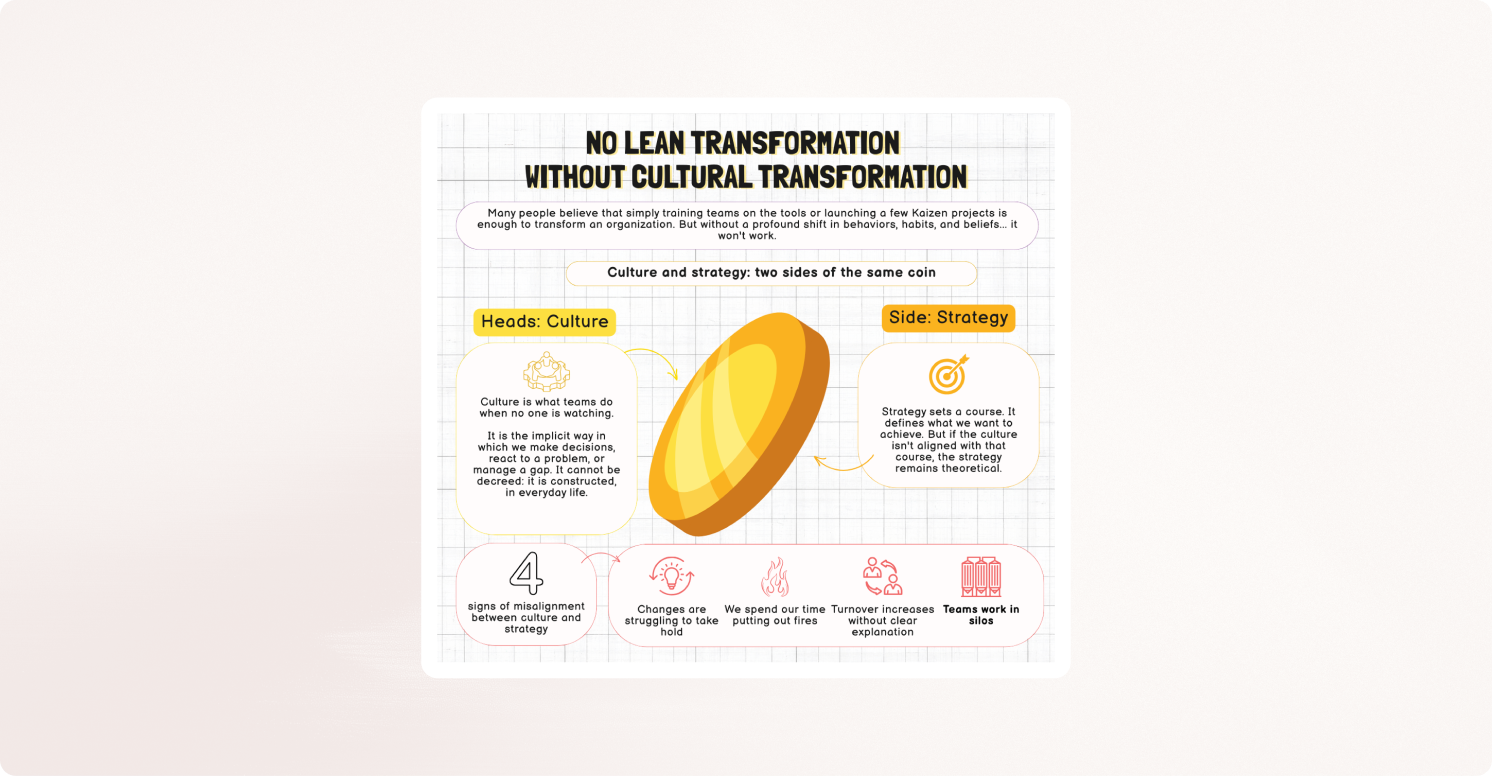
Culture is what teams do when no one is watching. It’s the implicit way decisions are made, problems are handled, or deviations are addressed. It cannot be mandated; it must be built through daily practice.

Strategy sets the direction. It defines what we aim to achieve. But if the culture isn’t aligned with that direction, strategy remains theoretical.

Take a simple example: a company wants to foster a culture of innovation. It allocates a budget, builds a dedicated team, lays out an action plan. But in reality, managers penalize mistakes, new ideas are seen as risky, and teams don’t have time to step back. Result? Nothing changes.

Adopting Lean is not just about learning how to do 5S. It’s about fundamentally transforming the way teams collaborate, make decisions, and solve problems.

Here are a few markers of a genuine Lean culture:

  • Problems are visible and addressed without blame.
  • Standards are co-created, understood, and respected.
  • Continuous improvement is part of everyday work.
  • The shop floor is listened to and valued in decision-making.
  • The manager acts as a coach, not a controller.

This transformation takes time. It requires a real alignment between what is said and what is done.

Many organizations launch Lean initiatives… that don’t last. Why? Because the cultural foundation is missing.

Here are a few common signs:

  • Rituals happen, but without conviction.
  • Indicators are tracked, but never challenged.
  • Improvement ideas go up… but never come back down.
  • Teams talk about excellence but operate under short-term pressure.
In these cases, Lean becomes a façade. Boxes are ticked, methods are followed, but results plateau.

Let’s look at Toyota. What makes its strength isn’t just the method, it’s a culture of respect, problem-solving, and continuous improvement embedded at every level.

Same at Danaher, where the DBS (Danaher Business System) is much more than a tool: it’s a living system, driven by culture and daily behaviors. This philosophy has enabled Danaher to turn even newly acquired companies into market leaders.

In these companies, strategy becomes clear, understandable, and most importantly translated into coherent daily actions. No need to constantly re-ignite motivation; teams naturally align.

We’ve seen it: a strategy only works if it’s supported by the right culture. But on the ground, how do you know if both are truly aligned?

Here are 4 concrete signs to watch for:

  1. Changes struggle to take hold
    If every new method, tool, or project faces resistance, it might not be a content issue but a cultural one. An open culture welcomes change. A rigid one shuts it down.
  2. You’re constantly putting out fires
    If your teams spend their time handling emergencies, while long-term projects stall, you might have a reactive culture when strategy calls for a structured, forward-thinking approach.
  3. Turnover is rising without clear reason
    A high rate of absences or departures could signal deeper disconnection. People might no longer relate to the company’s values or direction.
  4. Teams work in silos
    Poor communication or coordination between departments may reflect a lack of shared vision. Strategy should create connections, not deepen internal divides.

Spotting these signals is a first step toward realignment. The next? Opening up dialogue, listening to what’s really slowing things down, and working on culture as a lever, not a blocker for your strategy.

Here are a few concrete ideas to get things moving (or speed them up):

  • Clarify the values you expect not in an HR charter, but with real examples of behaviors.
  • Train managers to be cultural ambassadors; they’re the daily bridge between vision and the shop floor.
  • Celebrate the right behaviors as much as the results.
  • Listen sincerely to the field, especially when it’s uncomfortable.

  • Give teams time to learn an organization that never allows space for growth ends up going in circles.

There is no Lean transformation without cultural transformation. Tools alone won’t transform an organization. It’s the beliefs, behaviors, and habits in a word, the culture that make all the difference.

So instead of asking “what tool should we deploy next?”, let’s ask: “what culture do we want to build?”

Because in the end, it’s the teams who bring the transformation to life. And their culture is their engine.

Lean Corner Sheets
Lean Corner

No Lean Transformation Without Cultural Transformation

Lean
Discover how the PDCA cycle drives continuous improvement and operational efficiency in this Podcast episode.
LeanOperational Excellence
Digitizing Shop Floor Management can propel businesses into a new era of productivity, quality, and competitiveness.
Lean
Explore the nuances of Kaizen as a strategic tool for enhancing operational efficiency.

See how they trusted us and achieved success with iObeya

Provide your information to download the lean corner fact sheets