

Why iObeya
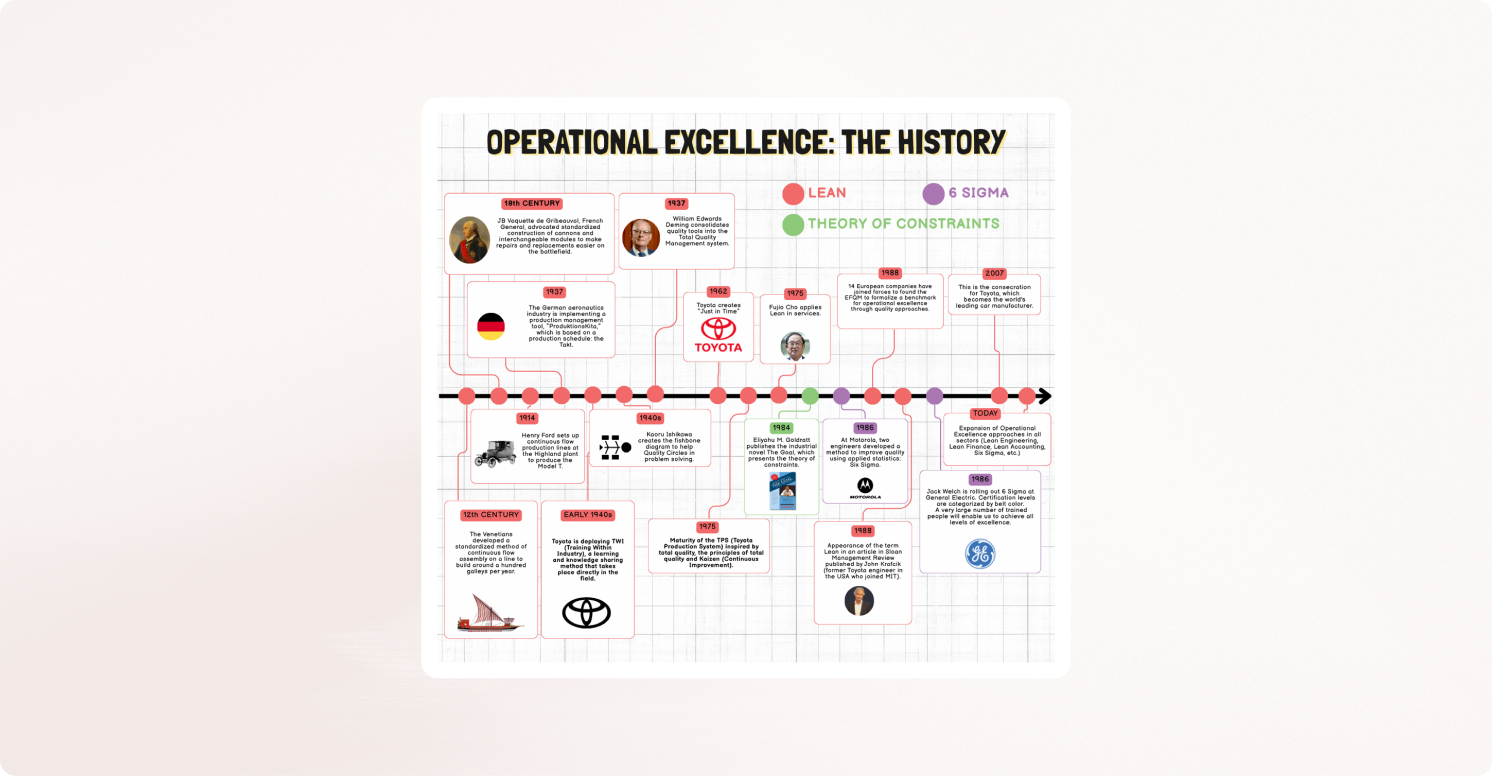
So, I’m not going to go all the way back to 1720, the beginning of the industrial era, but rather to the start of the 20th century. We find Ford, manufacturing cars from 1903, and the Model T in 1908.
Ford introduced the concept of standardized parts and work optimization. Just for the anecdote: if you wanted a Model T, it was best to order it in black otherwise, you had to expect some delay.
Then comes Taylor, who focuses on planning methods and time studies. This leads to the moving assembly line in 1913, which multiplies the production of the Model T by eight.
This line brings in the concepts of time balancing and reduced movement. It marks the end of the craft era. We move from craftsmanship to a logic where the customer receives a stable product, with stable production and lead times.
By 1923, Ford was already producing over 2 million vehicles.
Next comes the saga of the Toyota family. Sakichi Toyoda, who manufactured weaving looms, began automating them by asking: “To be more productive, wouldn’t it be better if they didn’t stop?”
He laid the groundwork for what would become SMED. And incidentally, if you’ve ever seen industrial weaving looms with hundreds of thread spools, you’ll know that a single broken thread turns a weaving machine into a scrap machine.
So, systems were put in place to stop the machines if a thread broke. This is where we begin to see the principles of SMED and a focus on quality.
Note: It’s worth reminding ourselves that the first pillar of productivity is and remains quality.
Before the war, in 1937, Kiichiro Toyoda launched the automotive division, introducing the first principles of Just-In-Time. That is, making sure the right parts are produced with the available materials, at the right time, and in the right place.
After the war, Toyota like the rest of Japan, had to be rebuilt. There was a production need, but with far less labor and far fewer raw materials. They began to question what a new kind of production system could look like.
As part of war reparations, the Americans provided Japan with the Ford method. Toyota was intrigued but building production lines to make 2 million cars didn’t suit Japanese standards or consumer needs.
So, they chose to build their organization differently. Instead of pushing products onto customers, they decided to look at what customers actually needed and produce only that.
After 1950, Taiichi Ohno entered the scene. He implemented the concepts of Kanban, takt time, and Andon giving operators the ability (or even the obligation) to stop production when a defect occurred.
This is where we see the major principles of the Toyota Production System taking shape, formalized in the 1950s.
In the 1980s, General Motors was overtaken by Toyota in production volume. The Americans thought, “We should really go see what’s happening in Japan.”
James Womack and a few colleagues from MIT went to observe firsthand how Toyota managed to get back on track in just three years.
That’s when the concept of Lean began to take shape with the publication of the book The Machine That Changed the World.
In 2007, Toyota became the world’s largest automaker.
And the principles of the TPS began to spread into all sectors: services, construction, IT… What we’ll develop next is the idea that TPS isn’t a method for the automotive industry it’s, above all, a philosophy of work.