
Lean Corner

What Is an Obeya in the Era of Industry 4.0?

Too often, the Obeya is mistaken for a giant dashboard. You walk into a room filled with charts, post-its, and frozen KPIs… but with no real discussion happening. It’s the classic trap of “command and control” disguised as visual collaboration . Information is displayed to prove that things are being managed, but without asking the right questions or addressing the real problems.

Yet the Obeya was never meant to be a reporting tool. It was born within Toyota’s Lean system to create collective intelligence, structure dialogue across teams, and enable cross-learning. Its purpose is to make visible what is normally invisible in daily operations: the forgotten connections, the underlying tensions, the gaps between strategy and reality. In short, it helps teams think together in service of the customer.

  • Aligning around a common intention:
  • an Obeya only makes sense if it constantly reminds everyone what they are trying to achieve. What is the primary objective? What value do we want to create for the customer? This initial framing must be clear, shared, visible and cascaded at every level (project, department, executive).
  • Collaborating around decisions:
  • In uncertain environments, teams must be able to share critical information, discuss risks, and challenge options. The Obeya is a managerial agora where functions exchange in real time on key decisions. It does not replace the Gemba, but it helps direct efforts where they will have the most impact.
  • Sustaining learning loops:
  • Through SQCDP indicators and the cadence of rituals, the Obeya helps escalate blocking issues, raise them when necessary, and structure collective responses. It is not a problem‑solving room, but a place to identify what is preventing progress and activate the right resources..

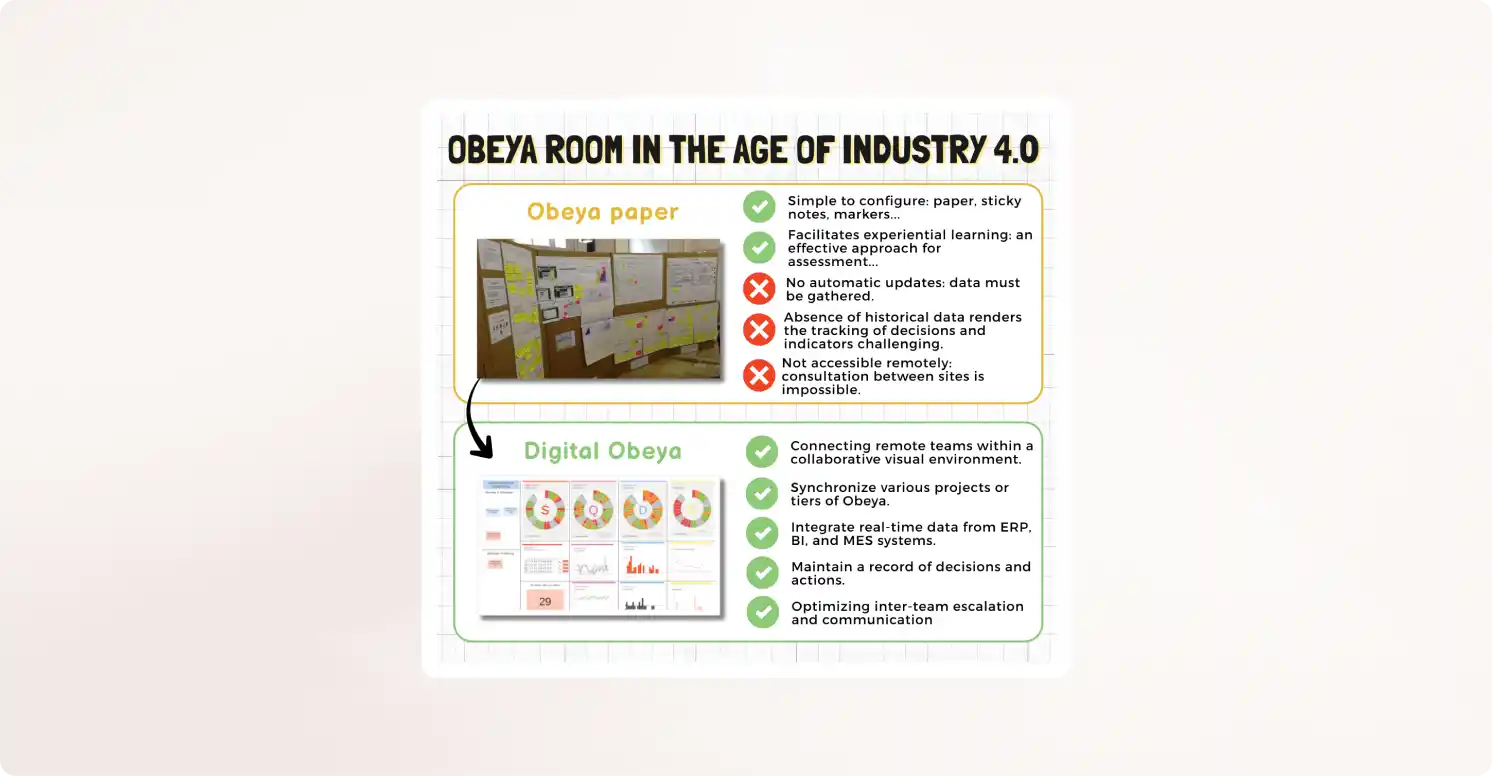
Visual management first emerged through physical tools: paper, post-its, markers, magnetic boards. This physicality is extremely valuable during the learning phase you test, adjust, manipulate, and iterate. But as organizations grow, globalize, and shift to hybrid ways of working… physical tools reach their limits.

Digitalizing the Obeya makes it possible to:
  • Connect teams remotely within a shared visual space
  • Synchronize multiple projects or levels of Obeya
  • Integrate real-time data (ERP, BI, MES…)
  • Preserve the history of decisions and actions
  • Streamline escalations and cross-team interactions

But remember: digitalizing is not “copying paper onto a screen”. It’s an evolution of the practice that must remain faithful to Lean principles.

To ensure a digital Obeya keeps its managerial impact, it is essential to:
  • Keep the visual spirit: clear boards, readable layouts, simple signals
  • Start simple:avoid unnecessary functional complexity
  • Train facilitators: the tool cannot replace good animation
  • Equip rooms properly: reliable video, large screens, tactile interaction
  • Adapt rituals: whether digital or physical, impact comes from rhythm and consistency
A successful digital Obeya does not replace managerial culture, it enhances it by making it more fluid, more accessible, and more connected to real operations.
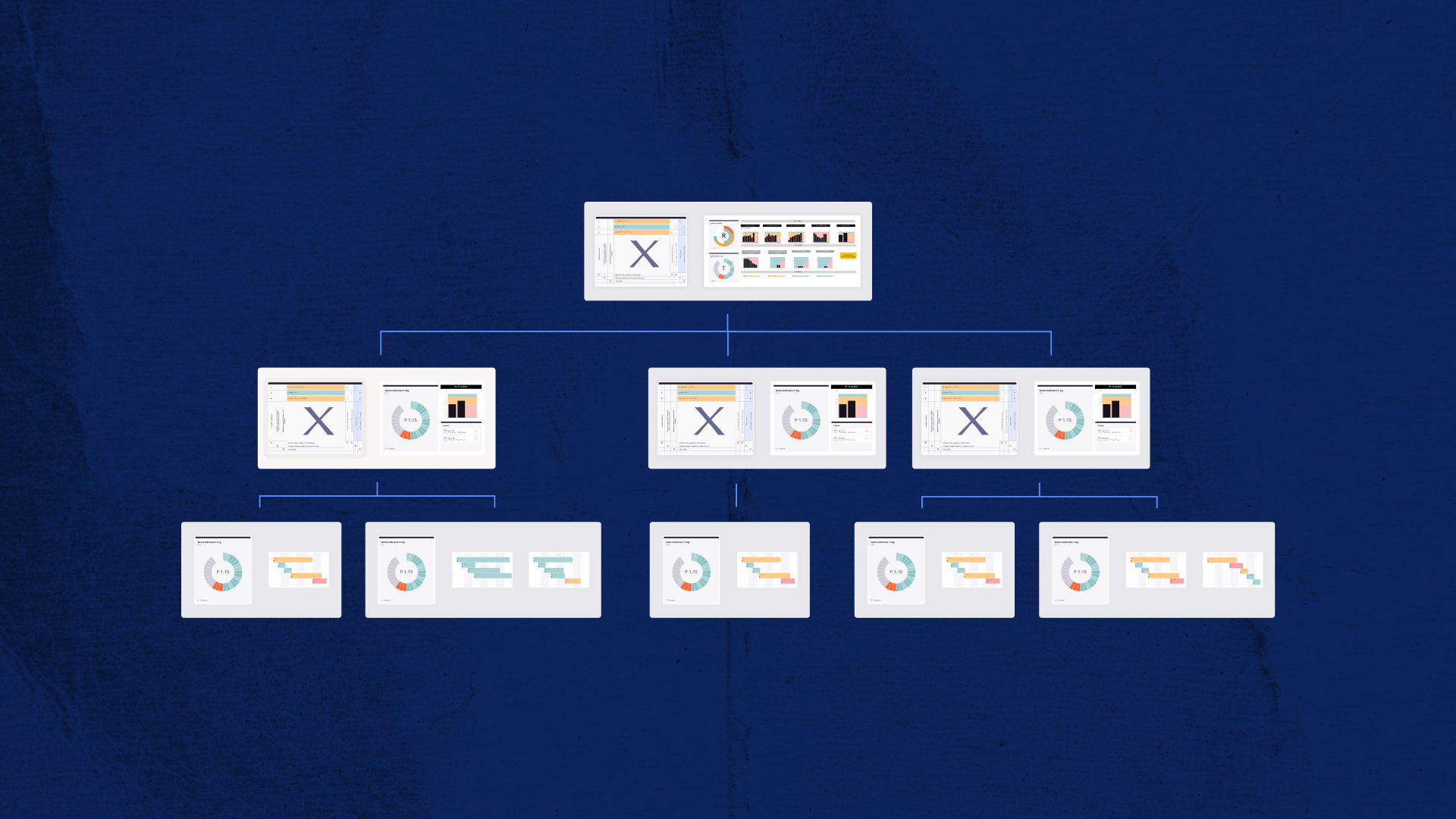
Digitalization also makes it possible to structure a fully interconnected system of Obeyas:
  • A team Obeya to manage daily operations
  • A department Obeya for support functions and transversal projects
  • A managerial Obeya for consolidated performance and arbitration
Each level does not replicate the previous one, it extends it. The intention is for each room to keep its own dynamic while contributing to a coherent global view. This ensures that local decisions stay aligned with broader strategic goals, while empowering each actor at their level.

The Obeya is not a miracle tool. It is a demanding practice requiring rigor, clarity, listening, and managerial courage. But when used correctly, it radically transforms the quality of discussions and decisions. It helps teams move past political games, blind management, and siloed responsibilities.

Digitalizing the Obeya is a lever in service of a larger intention: creating the conditions for strong alignment, collective reactivity, and continuous learning. In that sense, it remains more than ever a core pillar of Lean in the era of Industry 4.0.


Lean Corner Sheets
Lean Corner

What Is an Obeya in the Era of Industry 4.0?

LeanOperational Excellence
Explore the 5S Framework which offers a practical and universal methodology for organizations seeking operational excellence.
Lean
Learn about the 4 stages of Lean maturity and position your company on this evolutionary journey.
Lean
Achieve operational excellence with Short Interval Management (SIM). Learn how to optimize your processes for increased productivity and excellence.

See how they trusted us and achieved success with iObeya