

Why iObeya
In many companies, problems are analyzed from a meeting room. People gather around dashboards, charts, and reports. Indicators are commented on, hypotheses exchanged, action plans drafted… without always knowing whether what is being discussed reflects what is truly happening.
And that is precisely the issue.
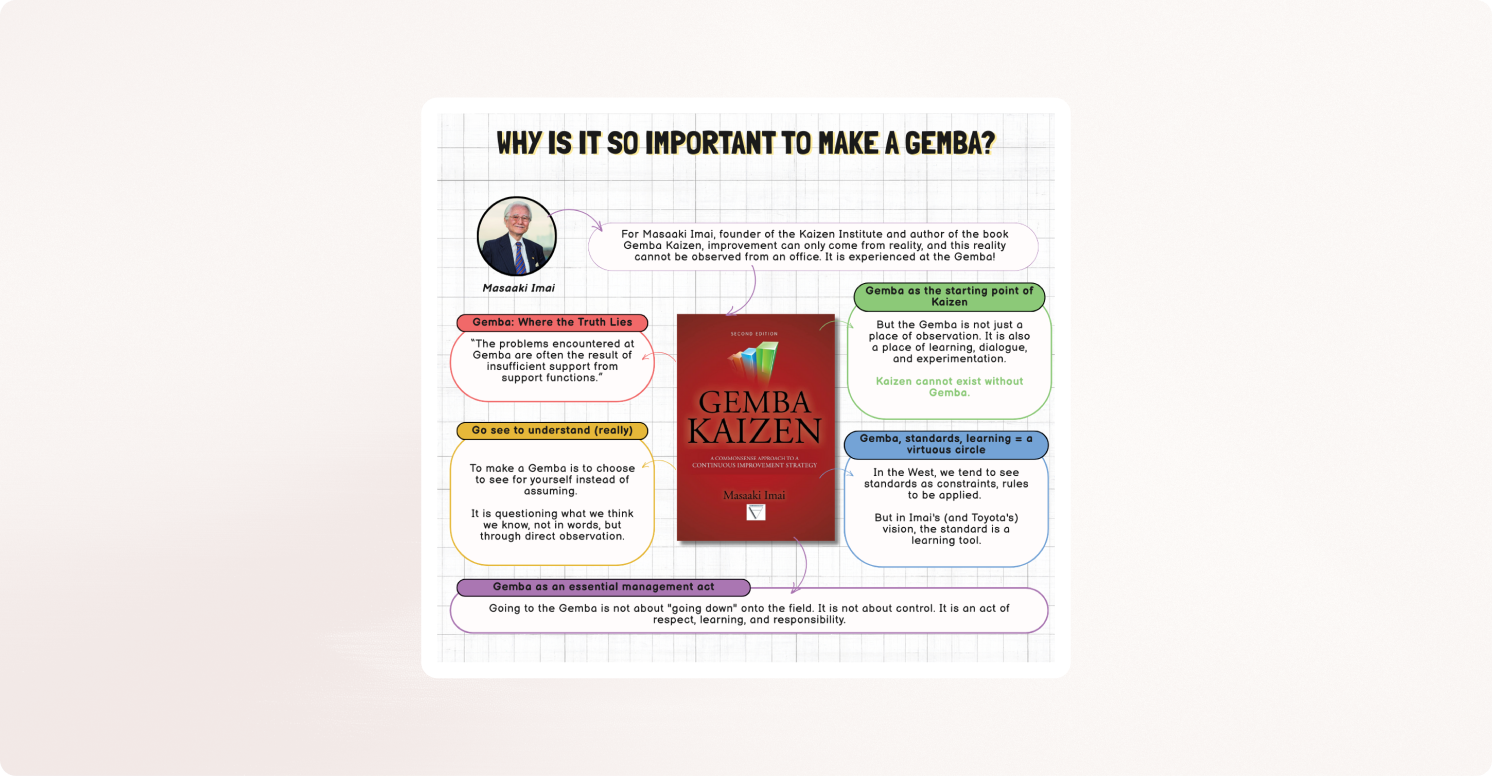
For Masaaki Imai, founder of the Kaizen Institute and author of Gemba Kaizen, improvement can only come from reality. And that reality is not observed from behind a desk. It happens at the Gemba, the place where things actually happen, where value is created, where problems arise.
The word Gemba literally means “the real place” in Japanese. In industry, it refers to the shop floor: a workshop, a production line, a customer service point, a warehouse, a hospital…
It’s where products are made, services are delivered, and issues are encountered.
In his book, Imai insists: the Gemba is a mirror. It reflects the real capabilities of the organization, its strengths, its weaknesses, its dysfunctions. What happens there reveals the true nature of the company’s management systems, processes, decisions or lack thereof.
“Problems at the Gemba are often the result of insufficient support from staff departments.” Masaaki Imai
In other words: what goes wrong on the shop floor is rarely the operators’ fault. It’s almost always a consequence of what’s been decided or not decided elsewhere.
Doing a Gemba means choosing to see for yourself rather than assume. It means questioning what you think you know not through words, but through direct observation.
Imai shares a story: he’s waiting for a fax at a hotel. The receptionist tells him nothing has arrived. Instead of accepting that answer, he goes to check. He discovers there’s no standard procedure; each receptionist handles things their own way. The fax had arrived, but no one saw it.
It’s a simple example, but it says everything: if you don’t go and see, you don’t understand.
And that’s exactly what the best managers do. They’re not trying to control people, they’re trying to understand systems. And to do that, you must go where the system reveals itself.
In Lean philosophy, we often talk about Genchi Genbutsu: go and see for yourself.
But the Gemba is more than a place of observation. It’s a space for learning, dialogue, and experimentation.
Kaizen cannot exist without Gemba.
It’s on the ground that the right questions are asked, hypotheses tested, root causes identified. That’s where you see how quality is really built, how standards function (or not), and how organizations either enable or constrain performance.
Once you understand, improvement comes naturally because you’re working on the real causes, not the symptoms.
In Gemba Kaizen, Imai flips the traditional management pyramid on its head. He argues that value is created by the people on the front lines, and the role of management is to support that value creation.
It’s a radical philosophy: managers aren’t there to “direct” they’re there to help. To remove obstacles, clarify priorities, and enable the teams to succeed.
This is how high-performing industrial organizations operate. In some Japanese factories, executives reportedly do 30 Gemba walks a day. Not to monitor, but to listen, to learn, to unblock issues, to encourage.
So doing a Gemba isn’t just another tool. It’s a leadership posture.
Another major point Imai develops is how standards fit into this logic.
In the West, standards are often seen as constraining rules to be enforced. But in Imai’s (and Toyota’s) view, a standard is a learning tool. It’s the best known way of doing something at a given time. Not a constraint, but a starting point.
And it’s the frontline teams, through Kaizen, who evolve the standard over time.
You observe at the Gemba, you experiment, you learn, you update the standard then you repeat.
Avoiding the Gemba means cutting yourself off from reality.
It means risking investment in the wrong priorities, building disconnected organizations, and multiplying meetings that lack impact.
As Imai puts it: problems that are not seen cannot be understood. And problems that are not understood cannot be solved.
Doing a Gemba ensures that you are working on the right issues, with the right people, in the right sequence.Going to the Gemba is not about “going down” to the field. It’s not about control. It’s an act of respect, of learning, and of responsibility.
It’s acknowledging that those who create value need managers who are present, engaged, and capable of listening.It’s recognizing that organizational intelligence is not declared in meeting rooms, it’s built on the ground, one problem at a time.
And more simply: it’s the most reliable way to make progress.
Because to see is to understand.And to understand is to act wisely.