
Why iObeya
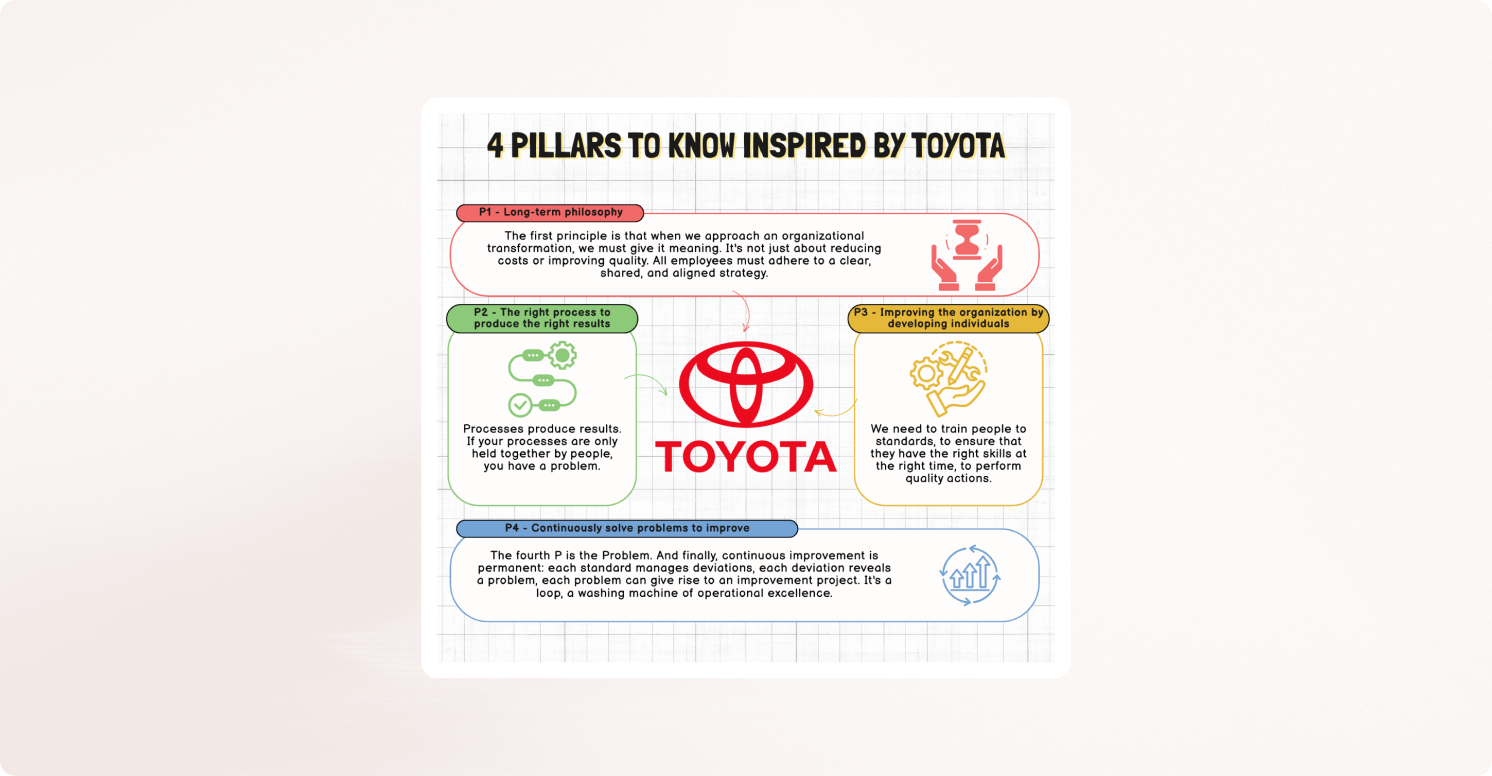
Continuous improvement is first and foremost a mindset, a philosophy, a belief… let’s even say a spirituality. It is a real principle of business organization, grounded in concepts, values, and philosophies. It’s symbolized by the 4Ps: Philosophy, Process, People, and Problem.
The first P is Philosophy.
The second is Process: because if we don’t have efficient processes in our organizations across sales, production, finance, and all other domains we can’t reduce waste. But processes alone are worth nothing without the men and women who carry them. At Toyota, they say: “The one who does the work is the one who knows.” There is a strong emphasis on developing people.
Which brings us to the fourth P: Problems. Some lean thinkers say and I share this view that Lean is also a way to solve problems by developing people. A learning system, in short. Let’s now explore the 4Ps in more detail: Philosophy (strategy), Process (methods), People (the ones on the ground), and Problems (collective problem-solving).
The first principle is that when undertaking an organizational transformation, you must give it meaning. It’s not just about cutting costs or improving quality. All employees must buy into a strategy that is clear, shared, and aligned.
We must move away from short-term financial thinking focused only on return on equity. It’s not that profitability is bad but rather, we must reconcile economic and social objectives. A short-term mindset can hinder transformation.
We often speak of SQDCP: Safety, Quality, Delivery, Cost, and People. And cost comes last, because reducing costs is the consequence of improvement actions not the objective.
Having a shared vision, stability within the organization, and sending clear signals is essential.
The second P: Process. It’s the processes that produce results. If your processes only work because people compensate for them, you have a problem.
We must aim for flow: reduce batch sizes, avoid large production runs, whether in industry or in services. Example: if I place all my orders on Friday afternoon, I create a wave in the system, generating stock and work-in-progress, which hide dysfunctions.
This highlights the need for pull flow: producing only what the customer demands. Pull flow reveals flaws. Producing just-in-time forces us to be good, because any variability destabilizes the system.
Production leveling (heijunka) is key: send stable signals to the operators, create a reliable environment. It’s a real challenge.
But for pull flow to work, quality must be addressed and variability reduced. Otherwise, we compensate with stock and people running everywhere.
One metaphor I like: the boat and the rocks. The company is the boat, the water level is the inventory. The rocks are the defects. If you lower the level without addressing the rocks, you crash.
The third P is People. We talk about leaders and skills development.
There are leaders who don’t necessarily have a formal managerial role but are responsible for maintaining and passing on standards. People must be trained in the standards, ensuring they have the right skills at the right time to perform quality work.
Development also includes a culture of continuous improvement, sharing, and support.
And it includes partners too: respecting partners and suppliers is fundamental for long-term vision. Excessive pressure on suppliers can drive them into bankruptcy.
We speak of partnership, co-engineering, upstream integration even including the customer in some cases. It’s about mutual respect, sustainability, without being naïvely idealistic.
The fourth P is Problem. And the first principle here is: go and see for yourself, with your own feet. “Show me the problem.” You need something concrete, factual. Don’t just hear about the problem and see it yourself.
There’s also a coaching aspect: don’t provide the solution immediately, help the person find it themselves.
Make decisions through consensus: take time to think together, but once aligned, act quickly. Consensus is not a waste of time, it’s collective construction of the standard.
Finally, continuous improvement is permanent: every standard manages deviations, every deviation reveals a problem, every problem can lead to an improvement project. It’s a cycle washing machine of operational excellence.