

- Home
- Lean Corner
- 3 factors for a successful improvement project
We often talk about operational excellence, Lean, and transformation… But on the ground, it all starts with a workshop. A well-run improvement workshop is the concrete anchor point for a culture of continuous improvement. And yet, many fail. Why? Because the success of a Kaizen event doesn’t rely solely on tools or Post-its. It first depends on three fundamental conditions consistently found in lasting successes. In this article, I’ll share with you the 3 essential success factors that make the difference between a basic working session and a real transformation on the groundconcrete criteria observed and tested across many industrial and logistics companies.
A Clear Commitment from Management
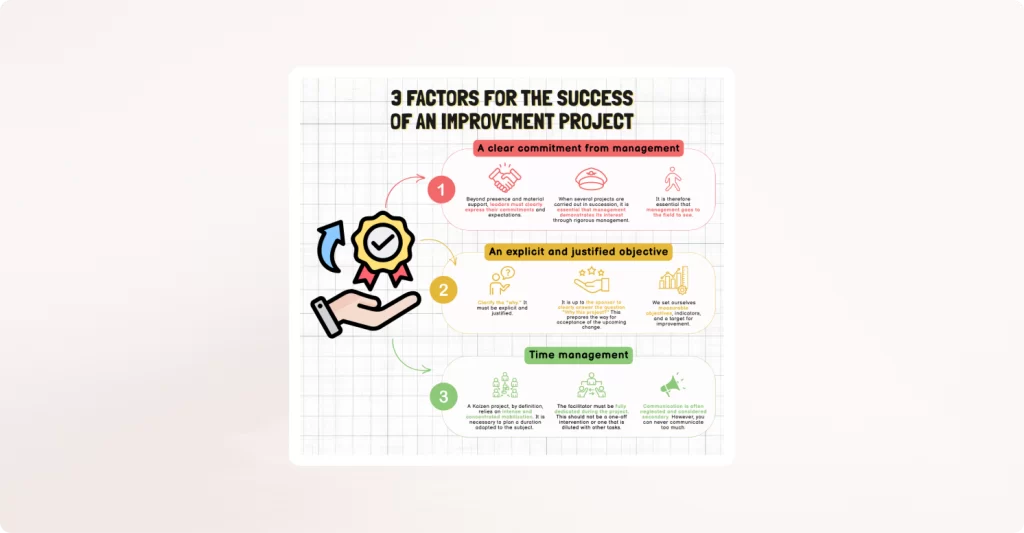
The first condition for success is a clear commitment from management.
Depending on the size of the company and the level at which the workshop is implemented, whether strategic or very operational”management” refers to the relevant layers of hierarchy.
Management (or its delegates) must:
- Define the workshop topic (in a roadmap or through a bottom-up approach),
- Allocate the necessary resources,
- Validate the proposed actions,
- Participate in the opening and closing of the workshop.
This shows a clear commitment from those playing the role of sponsors.
Visible and Explicit Commitment
Beyond presence and material support, leaders must clearly express their commitments and expectations. This clarity is essential to motivate and engage the working group and explain the purpose of their involvement.
Regular Steering
When multiple workshops are running, management must demonstrate interest through rigorous follow-up.
This includes regular reviews, ideally via short-interval management with Obeya rooms meetings where management is present and actively engaged.
Presence on the Ground
Kaizen-based transformations happen on the ground. Therefore, management must go (gemba) , observe the concrete effects of implemented actions and reinforce alignment with Kaizen logic.
A Clear and Justified Objective
Clarify the "Why"
- Explicit: clearly explained and detailed,
- Justified: factual and indisputable.
- The purpose: why is this workshop launched?
- The current situation: how do things currently work?
- Clear objectives: measurable and factual targets for improvement.
The Sponsor’s Role
It’s the sponsor’s responsibility to answer “why this workshop?” This helps the project team focus and supports broader change acceptance.
The workshop charter should also clearly highlight:
- Issues (breakdowns, irritants),
- Impacts on quality (interruptions, errors, oversights),
- Lead time disruptions,
- Profitability losses.
This fact-based framing removes ambiguity and fosters participant buy-in.
At this stage, we also define measurable goals, key indicators, and improvement targets, this is the foundation of the workshop.
Time Management
The third success factor is managing the time resource. Dedicating 1 to 5 days with a focused project team is often hard to schedule but it’s essential.
By definition, a Kaizen event relies on intense, concentrated effort.
The timeframe must be adapted to the topic:
- 3 days is a good benchmark for an effective workshop,
- 4 or 5 days may be needed for more significant changes.
The goal is to avoid revisiting the issue and to reach:
- Problem definition,
- Control implementation,
- Standardization.
Dedicated Facilitation
The facilitator must be fully dedicated throughout the event. This is not a side task, it’s a central role. Respect for methodology, tools, and preparation discipline is critical to success.
Integrated Communication
Communication is often overlooked or seen as secondary. But in reality, you can never over-communicate. It must be:
- Planned in advance,
- Allocated dedicated time in the schedule,
- Structured to explain, align, and motivate..
Conclusion
- A clear commitment from management at all levels,
- A clear and justified objective, shared by all,
- Rigorous time and communication management, from framing to follow-up. and arbitration