


- Home
- Lean Corner
- The 3 Components of Short Interval Management That Lasts
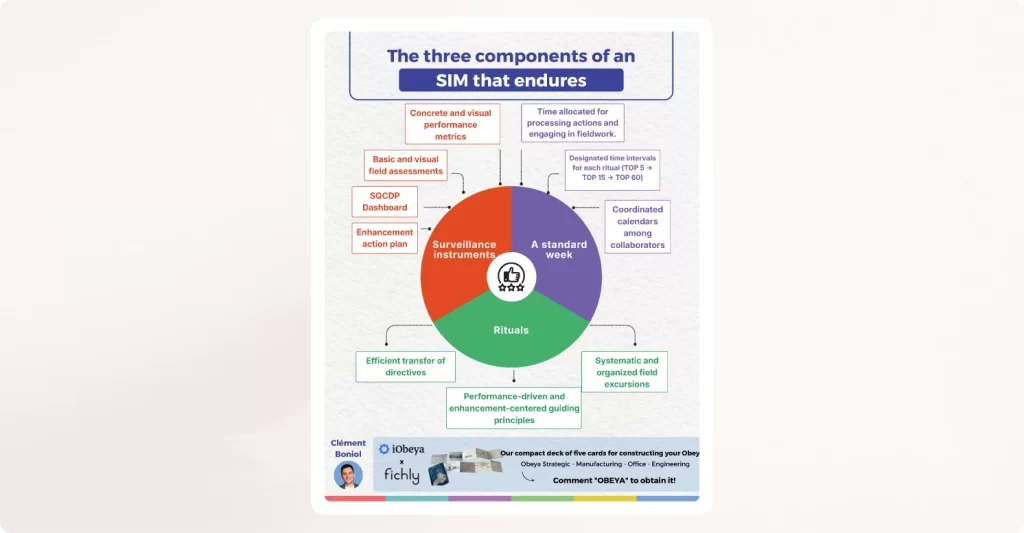
What Is Short Interval Management?
Short interval management is a system of short, frequent routines that connects the shop floor to management. Every day, teams review their performance, detect gaps and react before they grow. Issues they cannot resolve are escalated to the next level: from the team huddle to the area meeting, then to the management review.
The idea is simple: the shorter the interval between a gap and its detection, the faster the reaction and the less the problem costs. But the simplicity of the principle hides a difficulty: short interval management is not a meeting, it is a system. And a system holds together through its components.
Component 1: Simple, Visual Tracking Tools
The first component is what the team looks at. Without a support, a routine becomes a discussion with no thread, where everyone talks about what struck them rather than what matters.
Four tools form the foundation.
Concrete, visual steering indicators: few in number, understood by everyone, and linked to what the team can influence during its day.
Simple, visual shop floor records: a record that takes ten minutes to fill in will not be filled in a month from now. A ticked box, a cross on a grid, a cell coloured green or red is enough.
An SQCDP board: Safety, Quality, Cost, Delivery, People. The same structure at every level lets anyone read any board, and lets issues move up without being rephrased.
An improvement action plan: every gap that cannot be resolved on the spot becomes an action, with an owner and a due date. This is what turns observation into progress.
The same rule applies to all four: if a tool takes more effort to maintain than the value it brings, it will be abandoned. Simplicity is not a comfort, it is a condition for survival.
Component 2: A Standard Week in Which Every Routine Has Its Slot
The second component is the one most often forgotten. Routines are defined, boards are drawn, but nobody touches the calendars. The result: the area meeting clashes with a project meeting, the production manager has to choose every week, and the routine ends up being skipped.
A standard week sets three things.
Fixed slots for each routine, organised in cascade: the team huddle at the start of the shift, the area meeting right after, the management review at a fixed time in the week. The order matters: each level needs the information from the level before to make decisions.
Synchronised calendars across team members: a routine that half the participants cannot attend is not a routine. Slots are set once and for all, and protected.
Reserved time to work on actions and go to the shop floor: this is the most often neglected point. If the week is completely filled with meetings, the actions decided during routines have no slot to be carried out. The action plan grows longer, and confidence in the system drops. Planning this time tells teams that improvement is part of the job, not something added on top of it.
Component 3: Well-Run Routines
The third component brings the other two to life. The best tools and a perfect calendar are useless if the routine boils down to reading out numbers.
Three routines structure short interval management.
The shift handover: at every shift change, what happened, what is still in progress, what needs watching. An effective handover is short, structured and always in the same order. Without it, each shift rediscovers the problems of the previous one.
Steering meetings focused on performance and improvement: the goal is not to comment on yesterday’s result, but to answer three questions: where are the gaps, what slowed us down, who does what and by when? A meeting that ends without a decision has not done its job.
Regular, structured gemba walks: what is said around the board and what actually happens on the shop floor always end up diverging. The gemba walk lets managers see for themselves, check that actions are progressing and show teams that their feedback is taken seriously. Without structure, it becomes a stroll. With a set format and frequency, it becomes a management tool.
A well-run routine is recognisable by its rhythm: it starts on time, lasts the planned time, always follows the same sequence and ends with clear actions.
Take Away Just One, and the System Runs Out of Steam
The three components do not simply add up, they hold each other up. That is why the absence of one does not show right away, but always ends up costing something.
Without tracking tools, routines turn into exchanges of opinions. People talk a lot, decide little, and nobody knows whether the situation is improving.
Without a standard week, routines are skipped as soon as activity gets tight, precisely when they would be most useful. And the actions decided remain on hold, for lack of time to work on them.
Without good facilitation, the tools become reporting. Boards are filled in, meetings take place, but nothing moves. The team ends up filling in boxes for the sake of it.
Diagnosing short interval management that is running out of steam therefore starts with three questions. Are our tools simple enough to be updated every day? Does each routine have a protected slot, and is there time left to work on actions? Do our routines end with decisions? A single “no” is enough to explain why the system is slowing down. And it shows where to restart it.
See how iObeya structures short interval management, from every team’s SQCDP board up to the management review, so the system lasts over time.