

Use case: Daily Management System
Use case: DMS
Updated • August 2026
Run your daily management system
on one live, connected board
Tired of running your morning stand-up based on a paper board that wasn’t updated just before the meeting? iObeya keeps every tier board current between huddles and across sites, so a deviation raised on the shop floor reaches the next tier that can clear it instantly. Shop floor management on the Digital Obeya Platform™.
Updated • August 2026
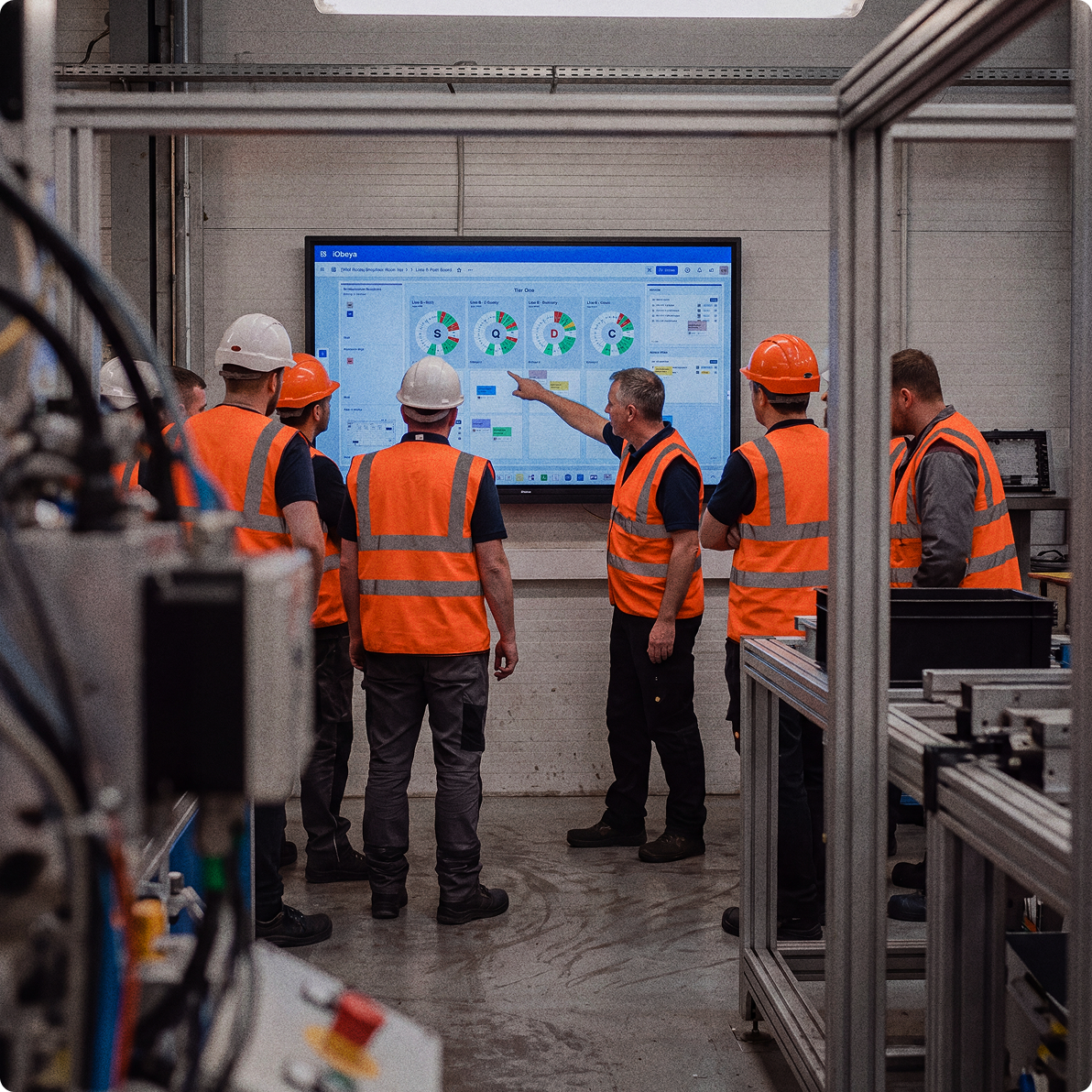
Global manufacturers escalate 25% faster, running daily management across their sites
30 min of meeting preparation saved, per team, per week.
Shift boards, tiered stand-ups, escalation: one daily management system
A daily management system is the set of routines a site runs every day to see performance, surface deviations, and assign the work that corrects them: shift boards at the line, tiered roll-ups and escalations, issue and action cards, floor observations, and the routines that connects the operating rhythm together.
Digital daily management runs those routines on boards that stay current between meetings.
What the boards hold
Tier 1 shift boards, tiered stand-ups from the line to site leadership, issue and action cards, shop floor observations, and leader routines. Live KPIs, connected to the work that raised them.
Connecting shifts to site leadership
Shift supervisors, area and plant managers, site leadership, and the operational excellence team that owns the method all in one system. Excellent for running manufacturing plants, logistics sites, engineering programmes, and multi-site groups.
Better than just a dashboard
A dashboard tells you a KPI went red. A daily management system is where the team decides who works it, by when, and what has been tried already. It is not a reporting layer, it is an action management system.
How daily management works in iObeya
Daily management usually breaks inbetween the gaps: between the board and the meeting, between the tier that finds a problem and the tier that can clear it. Critical parts of your DMS run as a connected system in iObeya, so nothing has to be rebuilt at the handover.
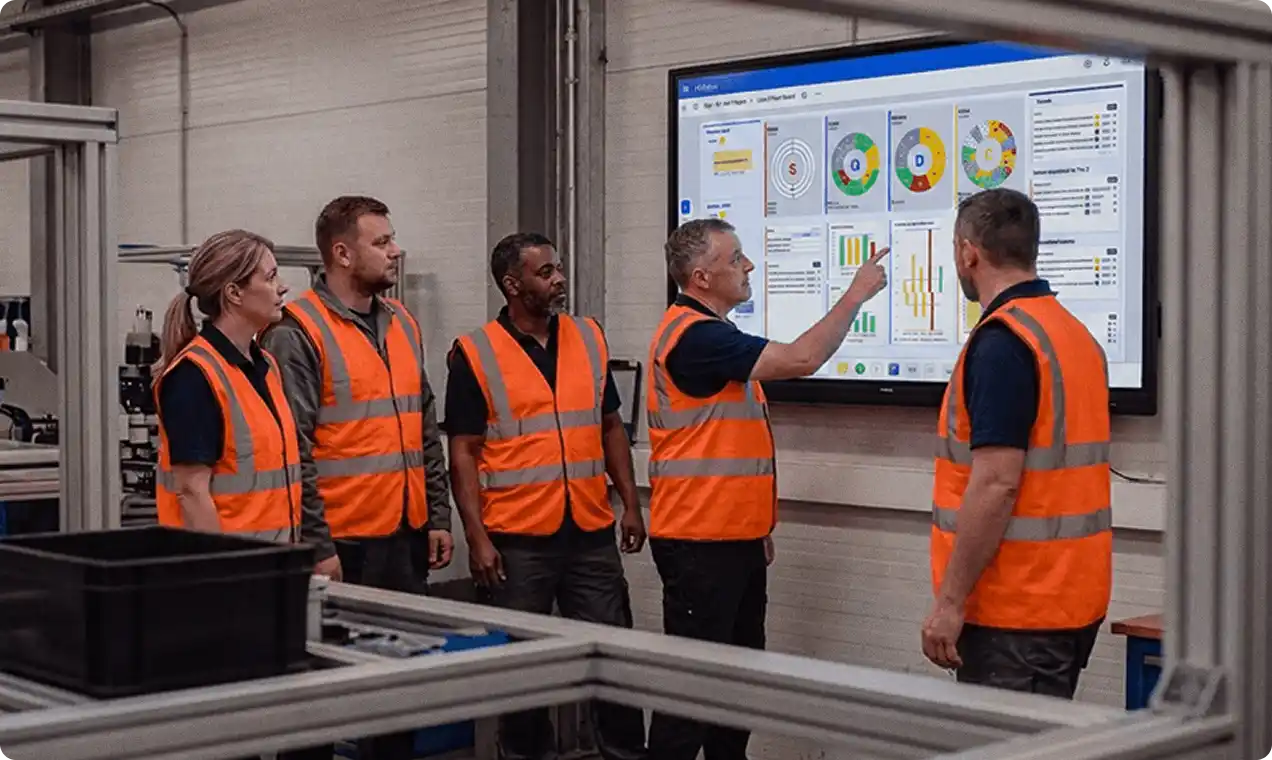
Every Letter live all the time
In iObeya, each Safety, Quality, Cost, Delivery and People letter on the Tier 1 board carries its current figure, its target, and the deviation attached to it. Moving a letter to red during the huddle opens an issue card with a named owner.
The shift reviews the actual current state of the line rather than on an outdated update, and a red KPI raised at the previous shift already has an owner before Tier 2 starts.
A hand-drawn board cannot do automated updates. Someone needs to print the results for the letters before the shift meeting. And by the time Tier 2 reviews them, nobody can say whether the numbers are still accurately describing the current state.
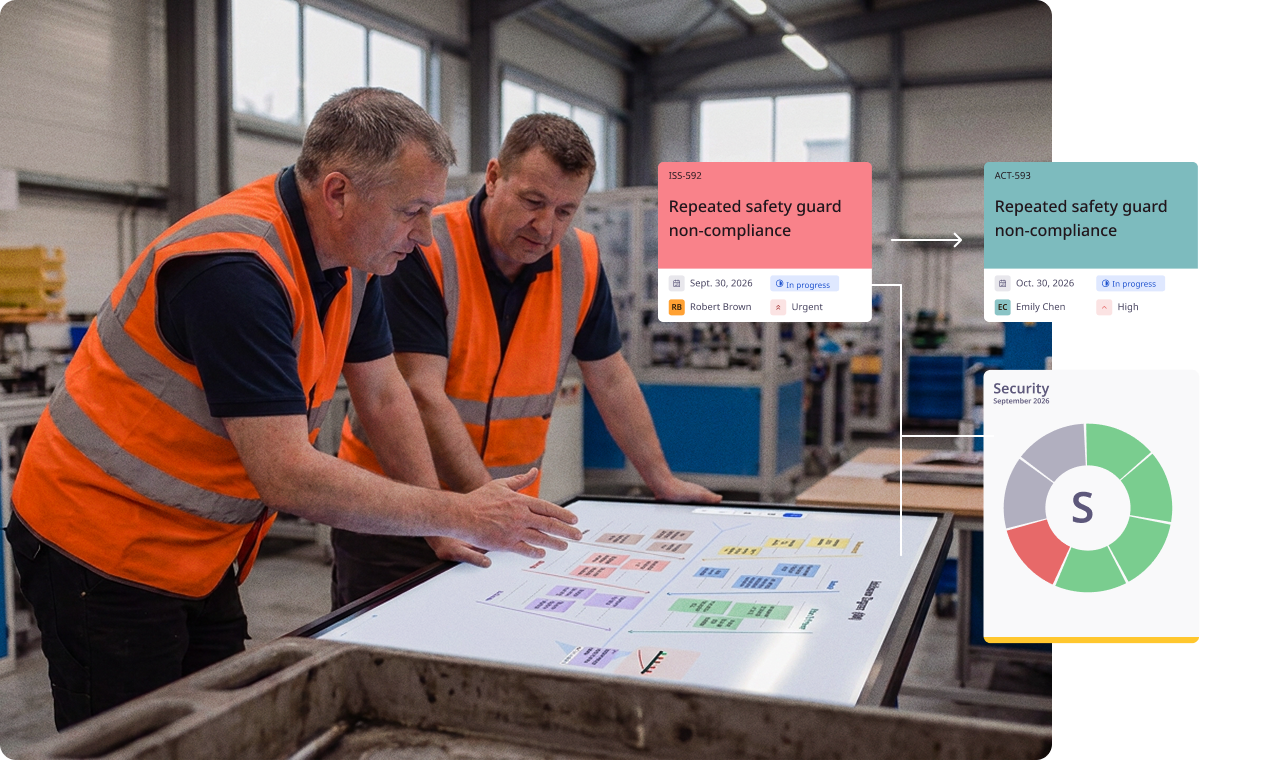
From deviation to countermeasure, on the same board
An issue card records the deviation at the point it is raised. Working the issue produces an action card holding the owner, the due date, and the countermeasure. And the PDCA or A3 to help resolve it is connected to the KPI that triggered it.
Problem-solving happens where the huddle happens, and the link between a red KPI and the work that clears it stays visible until it closes.
Without a digital DMS teams split the recording of the deviation and the action. The deviation goes on the board and the follow-up goes into a spreadsheet, an inbox, and somebody’s notebook, so actions risk resurfacing weeks later with ownership still unclear.
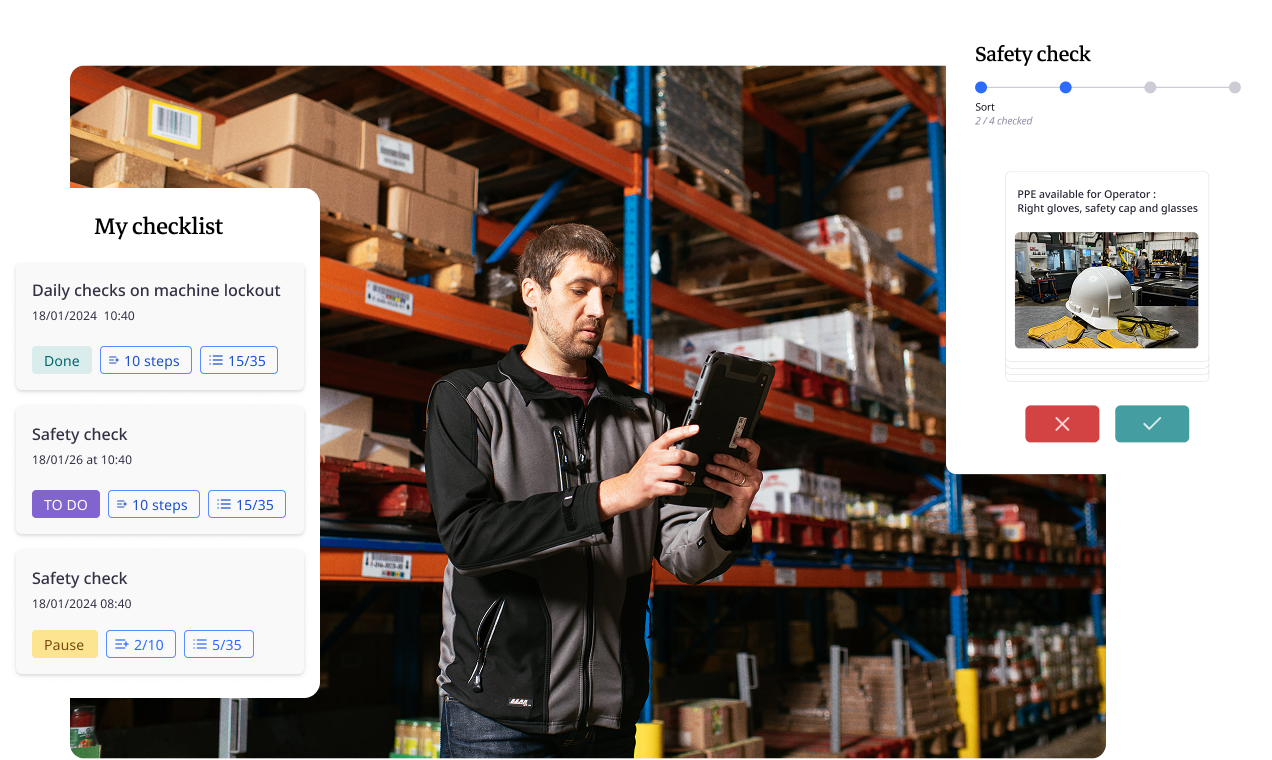
What the walk finds lands on the board, not in a notebook
An observation is captured on a tablet at the point it is made with a photo of the situation included. It gets added to the board of the right team that needs to know about this observation.
Before your walk ends your findings are already visible to the people who have to act on it. Each observation enters the same action flow as the other actions on the board without a need to be copied or interpreted.
Doing a Gemba walk with a physical clipboard adds an unneccessary step. You record the findings on the clipboard and then they are only there until someone types them into a system.
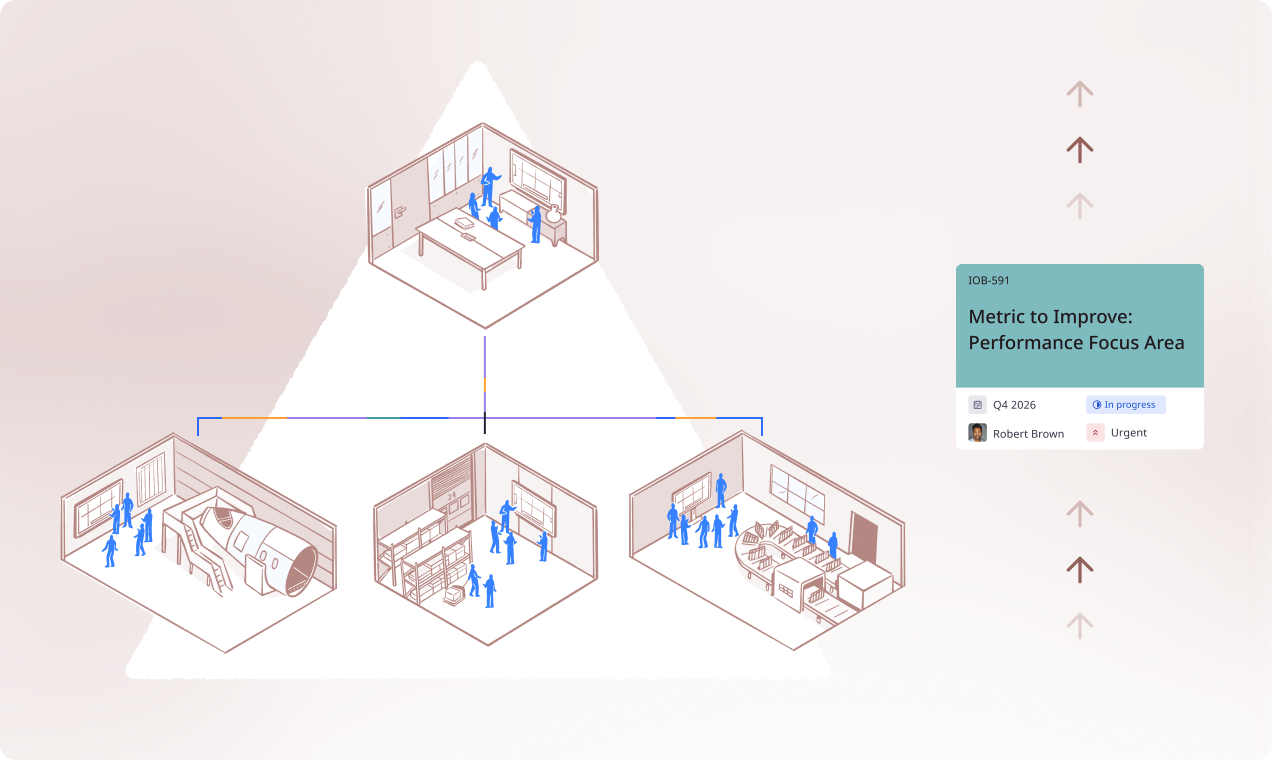
Tier 1 to Tier 3 on connected boards
Tier boards are linked. An issue that cannot be closed at Tier 1 gets escalated to the Tier 2 review. The issue has its history, its owner, and the countermeasures already attempted.
This connected system allows meetings to spend its time deciding instead of rebuilding context, and nobody rewrites information to move a problem upward.
Separate boards without automated data sharing force the same information being retold, copied, and reinterpreted and in each retelling details get lost. The version that reaches site leadership risks losing the details that could have helped solve it.

VPS Coach
Vaillant · Belper plant shop floor management
All the flexibility of paper, with the data behind it
Shop floor management software usually asks the team to work its way: fields, forms, and a training session before anyone touches the board. Paper never needed any of that. In iObeya a supervisor walks up to the screen, updates the KPI, writes on the card, and drags the issue to where it belongs, without someone explaining the interface first.
What paper could not do, is remember. Every card in iObeya holds its owner, its due date, its history, and the KPI it belongs to, so the board keeps the flexibility of paper and adds the trail underneath it. Nothing is re-entered after the huddle, because everything was captured and linked.
Not a shared whiteboard, and not an after-meeting write-up
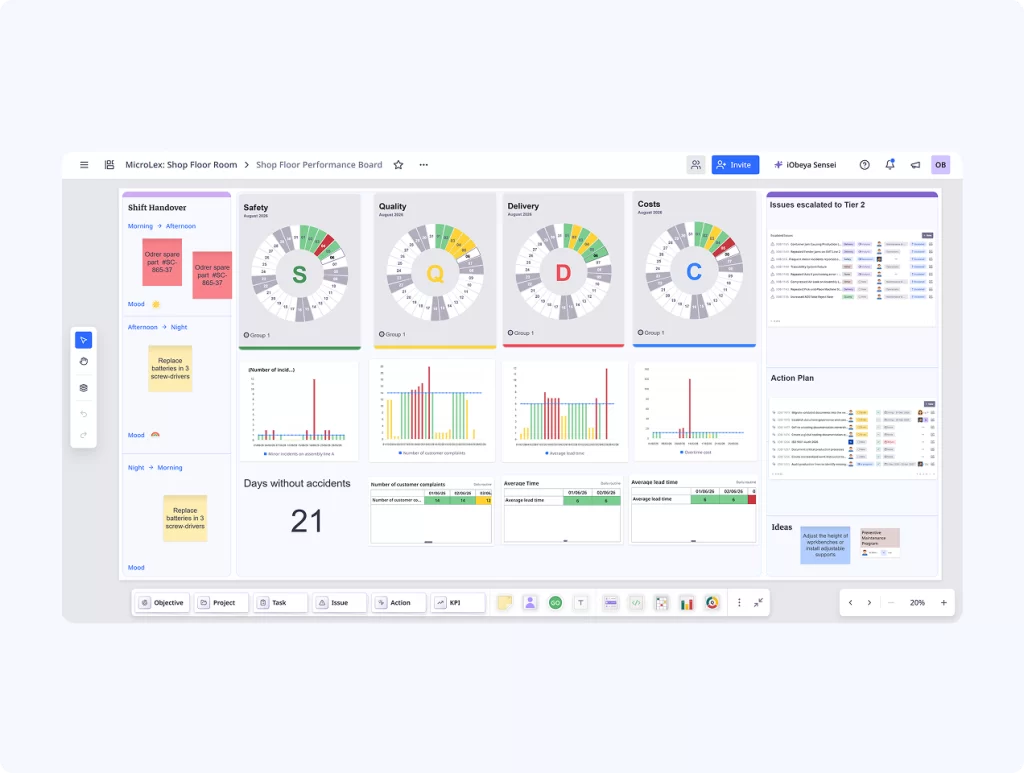
Your KPIs land on the board, nobody retypes them
In a digital daily management system the numbers are on the board before the team arrives. iObeya connects the board to the systems that hold the data, so the numbers reviewed are the numbers of record. Nobody spends the first ten minutes of the shift copying numbers between applications. Thresholds sit on the KPIs, so a breach raises a signal to capture the issue including the board it came from, the specific KPI, and any actions already taken.
A standalone BI dashboard cannot do that. A reporting layer or a KPI scoreboard shows the number turning red, but without an integrated system the leader has to open multiple other systems to find out whether anyone is on it.
Not a BI dashboard, and not a KPI scoreboard
The same routine at every site, adapted locally
Digital shop floor management works when a plant manager can walk into another site and read the board on sight. iObeya deploys your routines: board structure, KPI definitions, and the escalation path are governed centrally, while each site keeps the local practices that make the routine fit their own floor.
Because the structure is governed instead of copied, boards stay comparable across sites. A group lead can read one site's Tier 2 board and know what the same letters mean everywhere else. Each site still adapts what is genuinely local: line names, shift patterns, and the KPIs its own floor owns.
Not a template library, and not a rollout kit
Time back in every meeting,
and a payback you can put in the business case
30 minutes
13 months
20,000
“It is much easier to share a screen or room, it is much more transparent. Everyone knows information will be seen by leaders. Overall, escalation is 25% faster because we are able to include finance, supply chain, or others quickly and easily into the meeting, rather than emailing.”
“This board functions 24 hours a day, seven days a week. You can look at it at any point from your desktop.”

Operational Excellence Leader, Sanofi
Sanofi iObeya testimony video
“It gives visibility to managers and operators alike.”

Chantiers de l'Atlantique
Customer testimony, shipbuilding
Where to go next on daily management
SQCDP Board Software
Digital Gemba Walk software
Digital daily management system guide
Questions people ask about daily management systems
It is the set of routines a site runs every day to see performance, surface deviations, and assign the work that corrects them. In practice that means shift boards at the line, tiered stand-ups, issue and action cards, floor observations, and the leader routines that hold the rhythm together.
The stand-ups are not usually the gap. The board is. A paper board stops being true when the shift ends, so the next tier reviews yesterday. Digital daily management keeps the board current between huddles and identical across shifts and sites.
A dashboard reports that a KPI went red. Shop floor management software is where the team works it: the deviation becomes an issue card with an owner and a due date, moves to the tier that can clear it, and closes in the same place the huddle happens.
Yes. The shift board, the tiered stand-ups above it, floor observations, and escalation run on connected boards in iObeya, so an issue raised at a line huddle reaches the tier that can resolve it without being typed in again.
It does. Boards stay current around the clock and can be opened from any desk, so the picture is the same whether you are standing at the line, sitting in a tier review, or checking from another site before your own meeting starts.
You deploy the routine, not a template pack. Board structure, KPI definitions, and the escalation path are governed centrally while each site keeps its local practices, so a second plant is readable to a visiting manager on sight.
Shift supervisors and team leaders at Tier 1, area and plant managers at the tiers above, site leadership in the daily review, and the operational excellence team that owns the method and checks that the routine is being run as designed.
looks like on live boards