

- Home
- Lean Corner
- The 10 Key Indicators to Track in Your Warehouse to Achieve Operational Excellence
Lean Corner
The 10 Key Indicators to Track in Your Warehouse to Achieve Operational Excellence
What Does It Mean to Be High-Performing? Understanding SQCDP
Let’s start by understanding what it really means to be high-performing.
Does it mean shipping products quickly? Being ultra-productive? Having a safe warehouse?
The answer is: all of the above!
As you can see, warehouse performance isn’t limited to productivity or meeting deadlines.
To be high-performing is to strike the right balance between several fundamental dimensions.
Traditionally, this is described by the QDC triangle: Quality, Delivery, Cost.
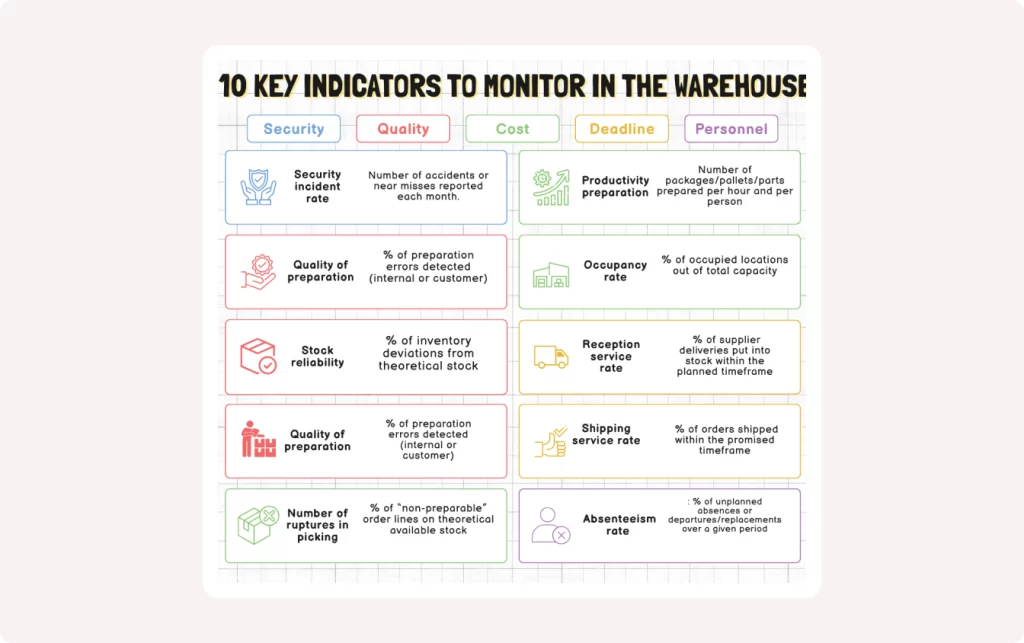
Over time, this model has evolved into SQCDP, with two additional dimensions: Safety and People.
Does it mean shipping products quickly? Being ultra-productive? Having a safe warehouse?
The answer is: all of the above!
As you can see, warehouse performance isn’t limited to productivity or meeting deadlines.
To be high-performing is to strike the right balance between several fundamental dimensions.
Traditionally, this is described by the QDC triangle: Quality, Delivery, Cost.
Over time, this model has evolved into SQCDP, with two additional dimensions: Safety and People.
- Safety: because no performance is worth endangering your teams.
- Quality: delivering right the first time.
- Cost: managing efficiency, avoiding waste.
- Delivery: keeping customer promises.
- People: developing, retaining, and motivating teams.
Quality & Delivery Service (Q + D)
-
Inbound Service Rate
Definition: % of supplier deliveries stocked within planned lead times.
Why it matters: late receptions disrupt the entire supply chain. This is, in my opinion, the most critical KPI.
-
Picking Accuracy
Definition: % of picking errors detected (internal or customer).
Why it matters: Quality first! In Lean, quality always comes first. Every error is costly and hurts customer satisfaction.
-
Inventory Accuracy
Definition: % of inventory discrepancies versus theoretical stock.
Why it matters: without accuracy, you can’t prepare or serve properly. This is a core operational KPI.
-
Outbound Service Rate
Definition: % of orders shipped within promised lead times.
Why it matters: this is the ultimate performance indicator for your warehouse.
Activity Optimization (C)
-
Picking Shortages
Definition: % of order lines “unpickable” despite theoretical stock availability.
Why it matters: this reveals a mismatch between stock data and reality, or poor replenishment planning.
-
Picking Productivity
Definition: number of parcels/pallets/pieces picked per hour and per person.
Why it matters: a classic efficiency indicator.
-
Space Utilization Rate
Definition: % of occupied locations vs total capacity.
Why it matters: a low rate suggests poor allocation; a high rate signals congestion.
-
Loading/Unloading Productivity
Definition: number of pallets loaded/unloaded per hour and per person.
Why it matters: often overlooked, this reflects end-of-line performance.
Resources and Safety (S + P)
-
Safety Incident Rate
Definition: number of incidents or accidents reported per month.
Why it matters: safety is a pillar of sustainable performance.
-
Absenteeism or Turnover Rate
Definition: % of absenteeism or staff turnover.
Why it matters: often correlated with management quality.
Don’t Just Measure—Embed Indicators in a Continuous Improvement Routine
Measuring is good. Steering is better. For these KPIs to become true levers of progress, they must be part of a regular management routine:
- Daily or weekly Short Interval Management (DMS)
- Team performance rituals
- Monthly performance reviews
- Continuous improvement roadmap reviews
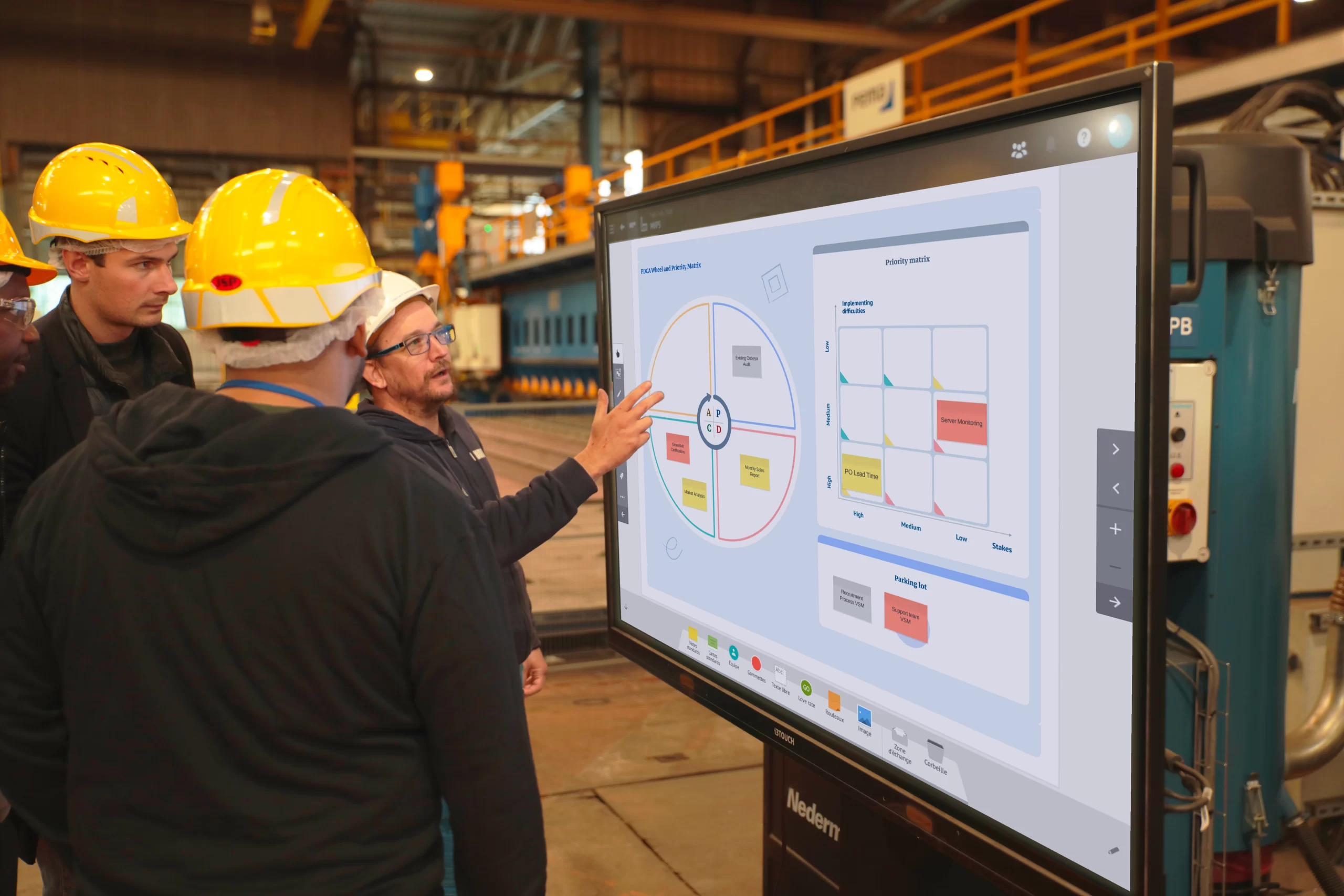
One solution: A digital Obeya is an online visual workspace that helps structure your routines and centralize KPIs in real time.
With tools like iObeya, you can:
- Automatically consolidate your indicators
- Quickly visualize trends and deviations
- Engage teams in problem-solving
- Align actions across all levels of the organization
The result? Smoother, more responsive, more collaborative governance.
Conclusion
Managing warehouse performance isn’t about stacking Excel sheets. It’s about choosing the right KPIs, tracking them consistently, making them visible, and using them as a springboard for improvement.
And above all, it’s about involving teams in monitoring and solution-finding. Because operational excellence isn’t something you declare—it’s something you build, KPI by KPI, routine by routine.
And above all, it’s about involving teams in monitoring and solution-finding. Because operational excellence isn’t something you declare—it’s something you build, KPI by KPI, routine by routine.

Lean Corner