

- Home
- Lean Corner
- Your A3 Is Complete and the Problem Came Back: Why Countermeasures Fail to Stick
Your A3 Is Complete and the Problem Came Back: Why Countermeasures Fail to Stick
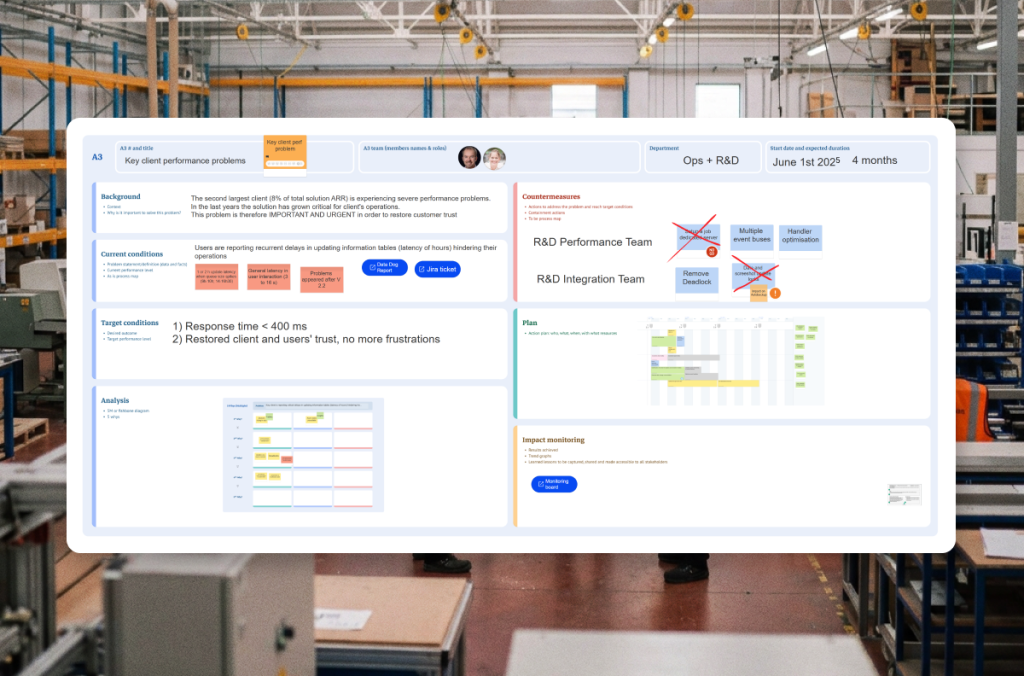
Your teams are working on a problem using an A3. The root cause is identified in the measurement system. The countermeasure is implemented. The defect disappears for 90 days. Then a new non-conformance report arrives: the same problem, described differently, on a new ticket, assigned to a different team. The A3 did not fail. What failed is everything nobody designed for after it closed.
The Symptom: the A3 Is Closed and the Problem Has a New Name
Three months after the A3 was signed off, the same defect reappears, slightly reworded, logged under a different ticket, assigned to a different team. If you put the two reports side by side, you can see immediately that it is the same problem. In the system, they are two distinct problems. The first is resolved. The second is open.
The A3 was completed correctly: the root cause was identified, the countermeasure was validated, the action plan was followed. And yet the problem comes back. The relevant question is not ‘why did the A3 fail?’ It is: ‘what happened after the A3 closed that nobody planned for?’
The Actual Root Cause: the Countermeasure Fixed the Instance, Not the Standard
The most common reason I see A3 countermeasures fail to stick: the countermeasure was applied to the current situation but never updated the standard that governs the process. The operator on the next shift, the team at the neighbouring site, the new hire who arrived two months later: all of them followed the existing standard, the one that still contains the process condition that generated the original problem. The fix was applied. The fix was not institutionalised.
This is a critical distinction. Solving a problem on one occurrence is putting out a fire. Updating the standard is removing the fuel. If you only did the first thing, the fire will reignite as soon as the conditions are right: a different operator, a different product, a slight variation in the process.
Most A3s include a field for ‘effectiveness verification’ but have no field for ‘standard update’.. The A3 and the standard document management system live in two separate systems with no formal link between them. The countermeasure is recorded in a close-out document. The standard continues to run on the old rules. The bridge between the two was never built.
Fix 1: Close the A3 Only When the Standard Is Updated
Add one mandatory field to the close-out checklist: ‘Which standard document was updated, by whom, and where is it located?’ An A3 without a documented standard update is not complete: it is a temporary fix waiting to fail.
This change is simple to implement and hard to forget once it is in place. It forces the question at the right moment: before the close-out signature, not six months later when the problem has returned. Treating the standard update as a closing condition changes the nature of the process. Every closed A3 becomes a durable improvement to the system, not just an episode of crisis management.
Fix 2: Verify the Updated Standard Is Being Followed, Not Just Filed
A standard update that lives in a shared folder and was never communicated to the people who follow that process is not a standard update — it is a document. Distributing a standard is not what makes it stick. The people doing the work need to be trained on it, and the new way of working needs to be seen in place.
Recurrences oftan has nothing to do with a flawed root cause analysis. It traces back to a correctly updated standard that nobody on the floor heard about. If you see this pattern across multiple closed A3s, the problem is not individual: it is the architecture of the close-out process itself. The good news is that this is precisely where a targeted intervention produces the most lasting results.
An A3 that ends at the countermeasure fixes an instance. An A3 that ends at the standard changes the conditions. The difference shows up ninety days later.
Pull your last five closed A3s. For each one, answer three questions: which standard document was updated, by whom, and where is it now? The ones you cannot answer are the ones to watch.
See how iObeya connects problem-solving to standard updates in lean daily management.