

- Home
- Lean Corner
- Operational Excellence: A Strategic Must-Have?
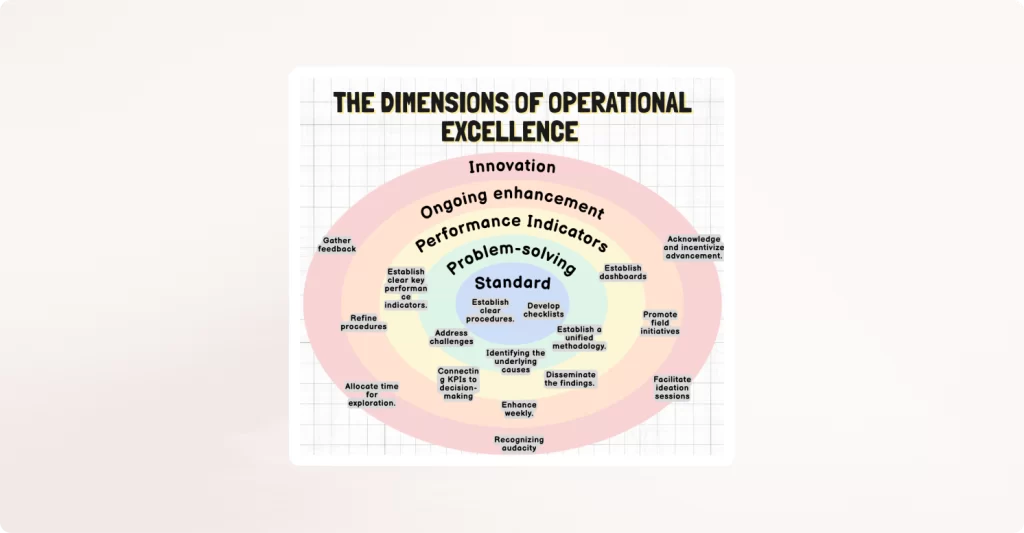
Once seen as a competitive advantage reserved for high-performance industries, operational excellence is undergoing a shift in status. It is no longer just one option among many, nor a program confined to a few model factories. It has become a core, non-negotiable capability, embedded at the heart of business strategy.
Why? Because the context has changed drastically. The world in which organizations now operate is unstable, fragmented, and unpredictable. Traditional planning, execution, and performance models are being put to the test. What made a company strong yesterday is its size, structure, and capital can now become a liability.
In this new landscape, one simple question arises: can a company still thrive long-term without operational excellence?
What VUCA Changes
From Occasional Crisis to Permanent Instability
The term VUCA (Volatility, Uncertainty, Complexity, Ambiguity) is no longer just business jargon. It precisely reflects the operational reality faced by most organizations today:
- Sudden supply chain disruptions
- Unpredictable regulatory shifts
- Cascading geopolitical and social tension
- Volatile and fragmented customer expectations
- Mounting pressure on margins and responsiveness
The implications are clear: decisions must be made faster, with fewer certainties, and often based on incomplete data.
Agility Is No Longer Optional
In such a shifting environment, the key is no longer to predict everything, but to adapt better and faster. Top-performing organizations are not the ones that avoid crises, but the ones that navigate, interpret, and even leverage them.
This requires:
- Short decision-making cycles
- Empowered and accountable teams
- Accessible, up-to-date information
- The ability to test, learn, and adjust quickly
In short: structured agility, built not on improvisation, but on solid foundations. And these foundations are precisely what operational excellence enables.
Operational Excellence as the Foundation of Resilience
From Performance to Resilience
Operational excellence is no longer about doing things faster, better, or cheaper. It’s about designing an organization that knows how to learn under pressure.
The real differentiator is the ability to stabilize what can be stabilized (standards, routines, indicators) while remaining able to adapt rapidly to the unexpected.
Four Essential Pillars
1. Visible, Collaborative Workflows
Silos are outdated. A learning organization operates through value streams, with cross-functional collaboration and alignment around shared goals.
2. Empowered, Equipped, and Accountable Teams
Operational excellence requires local ownership. That means accessible data, shared KPIs, and short, structured team routines for fast, decentralized decision-making.
3. A Problem-Solving Culture
Continuous improvement is not a slogan. It’s a core skill. Every employee should be trained to identify deviations, analyze causes, propose actions, and follow through.
4. Visual and Standardized Management Digitally Enabled When Possible
TOP 5/15/30 meetings, Obeya rooms, daily standups… These routines make weak signals visible, synchronize teams, and allow course correction long before the next strategy review.
A Strategic Lever or a Condition for Survival?
Not long ago, operational excellence was framed as a competitive advantage. Today, it should be seen as a baseline requirement.
It doesn’t guarantee success on its own, but without it, long-term viability is at risk.
The companies that endure, innovate, and engage their people and customers all share one trait: they reinvent themselves operationally without compromising their strategic direction.
They’re not seeking perfection. They’re seeking the capacity to adapt quickly, effectively, and collectively.
Conclusion
In a world where crises overlap and certainties dissolve, operational excellence can no longer be delegated to frontline teams alone. It’s everyone’s business: executives, managers, operators, and support functions.
It is what enables agility to be structured, responsiveness to be secured, and transformation to be sustainable.
So yes, operational excellence is a strategic must-have. And more than that: it is the condition for staying in motion without losing direction.