

- Home
- Lean Corner
- Deploying Your Operational Excellence System Through Visual Management
Deploying Your Operational Excellence System Through Visual Management
- Why Visual Management Is a Core Driver of Operational Excellence
- Reproducing Your Organizational Structure Through a Network of Obeyas
- Deploying Visual Management Routines and Standards
- Synchronizing Teams and Accelerating Data Flows Through Digital Integration
- Conclusion – A Living Visual Management System That Drives Action
Why Visual Management Is a Core Driver of Operational Excellence
An operational excellence system cannot simply be declared—it must be built day by day, at every level of the organization. But to work, it needs structure, clarity, and visibility. This is where visual management comes into play.
By making objectives, gaps, decisions, and results visible, visual management enables everyone to understand where they stand, what they need to do, and how they contribute to collective performance. It creates a shared language that facilitates collaboration and quick decision-making.
Reproducing Your Organizational Structure Through a Network of Obeyas
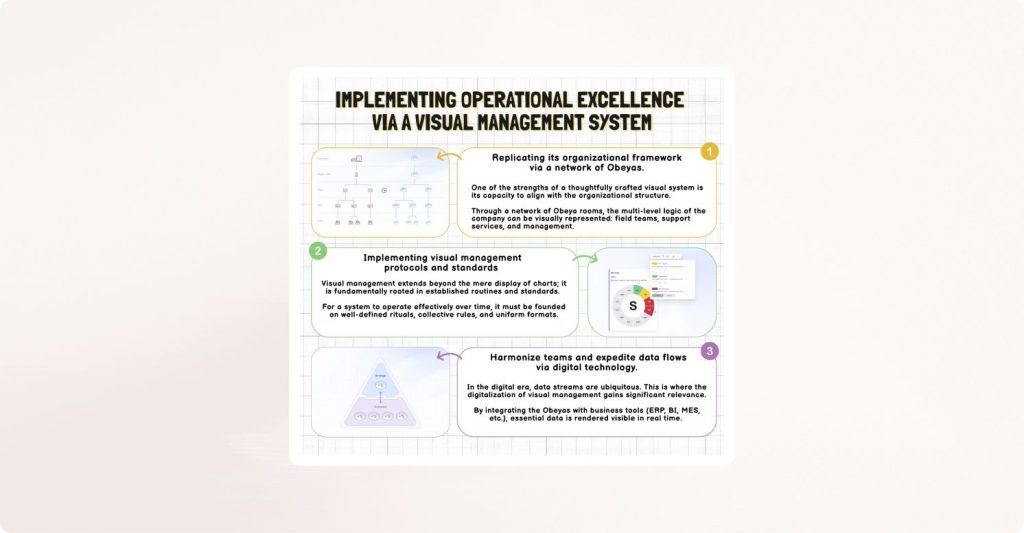
One of the strengths of a well-designed visual system is its ability to reflect the organization’s structure. Through a network of Obeya rooms, it becomes possible to visually reproduce the company’s multi-level logic: shop floor teams, support functions, and management.
Each room serves a specific purpose:
- The team Obeya helps steer daily operations (safety, quality, production, local actions).
- The service Obeya coordinates cross-functional projects and inter-team topics.
- The managerial Obeya provides an overview of key indicators, tensions to address, and decisions to make.
Deploying Visual Management Routines and Standards
Visual management is not just about putting charts on the wall—it relies on routines and standards. For a system to function over time, it must be supported by clear rituals, shared rules, and consistent formats.
These elements are essential to:
- Set the organization’s rhythm (daily, weekly, monthly)
- Structure discussions (agenda, duration, facilitator)
- Improve readability (color codes, statuses, key indicators)
- Ensure ownership by all (simplicity, clarity)
Deploying a visual management system also means training teams, supporting managers, and adapting materials to truly meet operational needs. It’s a living, evolving process that grows with each iteration.
Synchronizing Teams and Accelerating Data Flows Through Digital Integration
In the digital era, data flows are everywhere. But they must be harnessed effectively for steering. That’s where digital visual management truly makes sense.
By connecting Obeya rooms to business tools (ERP, BI, MES, etc.), key data becomes visible in real time. Teams access reliable, shared, automatically updated information. This enables:
- Faster decision-making
- More accurate detection of deviations
- Seamless synchronization across levels (operational, tactical, strategic)
Additionally, this integration improves action tracking, decision traceability, and KPI consolidation across the organization. Visual management then becomes the organization’s central nervous system.
Conclusion – A Living Visual Management System That Drives Action
A good visual management system doesn’t freeze the organization—it makes it more agile, more aligned, more capable of learning. It helps structure collective action, empower teams, and steer performance in a concrete and shared way.
By mirroring the company’s structure, deploying effective routines, and connecting real-time data, the Obeya network becomes a powerful tool for managerial transformation. This is how you deploy a solid, sustainable, and profoundly human operational excellence system.