

- Home
- Lean Corner
- Customer Satisfaction Is Lean’s Number One Objective. So Why Is It Missing From Your Obeya?
Customer Satisfaction Is Lean’s Number One Objective. So Why Is It Missing From Your Obeya?
Walk into an Obeya. You will find the schedule, the milestones, the production indicators, the budget, the action plan, sometimes the skills matrix. Now look for the customer. At best, a service level and a complaint counter. Rarely what the customer actually thinks, in their own words. It is a paradox: in a Lean organisation, customer satisfaction is where everything starts. And it is often what is missing from the very room meant to steer the lean approach.
In a Lean Organisation, Everything Starts With the Customer
Lean does not start with tools. It starts with a question: what has value for the customer? Toyota’s purpose is often summarized in a single line: build cars that customers buy. Everything else follows. A Llean process is one that constantly seeks to create value for the customer. Waste is anything the customer would not pay for if they could see it.
Even the classic Quality, Cost, Delivery indicators are, originally, translations of what the customer expects: a compliant product, at the right price, at the right time. But they are translations. They measure what the company believes the customer wants, from inside the plant or the office.
The Obeya should be the first place where this customer focus shows. An Obeya only makes sense if it keeps the customer in its sights.
Why Customer Satisfaction Is Missing From Most Obeya rooms
The reasons are rarely ideological. They are practical.
First, customer satisfaction is measured somewhere else: an annual survey run by quality or marketing, with results arriving months later, aggregated into a single score. Too slow and too distant for an Obeya that runs on a weekly rhythm.
Second, teams display what they control. Internal indicators are available, reliable, daily. Customer feedback requires a collection effort that nobody formally owns.
Third, internal indicators are reassuring. For example, take a bank convinced it is doing well: more appointments, more sales, a positive recommendation score. Meanwhile, a customer needs two months to get a lost bank card back, after a 45-minute wait at the branch. Every dashboard was green. The customer was waiting.
In service organizations the pattern is well known: with enough internal indicators, the customer disappears inside the process. What remains are files, processing times and steps to validate. An Obeya filled only with these indicators steers the organisation. It does not steer value.
Measure Satisfaction Through Conversation, Not Forms
Bringing the customer back into the Obeya starts with changing how you listen. A questionnaire only collects answers to the questions you thought of asking. In a conversation, customers tell you what really matters to them.
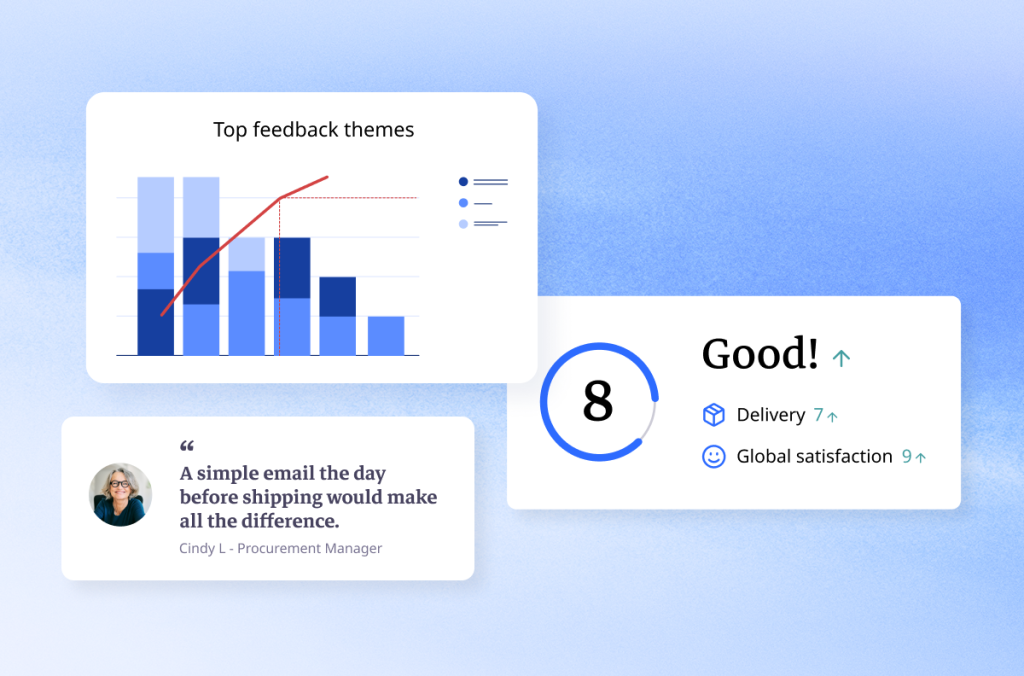
The routine is simple. At short intervals, the person already in contact with the customer (customer service, project manager, sales) holds a 20-minute conversation, by video or phone, ending with a score out of 10. Each conversation produces a customer satisfaction sheet: the score, the key verbatims, a summary. A practical tip: record the video call with the customer’s consent and let AI draft the summary, which the interviewer checks before the sheet is posted. The interviewer stays fully focused on listening during the interview itself.
Example:a medical device distributor runs the routine this way. The head pharmacist of a hospital gives 7.5/10. In his words: “Deliveries arrive incomplete, without anyone warning us.” “A simple email the day before shipping, with the contents of the parcel, would change everything.” And: “The quality of the splints, on the other hand, is flawless.” A questionnaire would have concluded “customer satisfied with the product”. The conversation reveals where the dissatisfaction really lies, and gives a countermeasure formulated by the customer themselves. The sheet is posted in the Obeya the same day.
The Customer Obeya in Three Panels
Listening is only worth something if it feeds decisions. That is the role of the customer Obeya, organised in three panels that form a complete loop.
Panel 1:listening discipline. This panel tracks the routine itself: interviews planned versus completed, share of scores above 8, status of the top 10 customers. It answers a simple question: are we really listening to our customers, and often enough? Listening that is not tracked stops during the first busy month.
Panel 2: every score below 8/10 triggers a countermeasure. The threshold is deliberately demanding. Any score below 8 becomes a red dot, with a countermeasure, an owner and a date. For the hospital: a double check at shipping and an email listing parcel contents, owned by Karim due in two weeks, followed by a call back to the customer 30 days later to check whether the score has moved. This is the lean principle of fast reaction applied to the customer relationship: no dissatisfaction is left waiting for the annual survey.
Panel 3: the quarterly Pareto of recurring verbatims. Every quarter, verbatims are grouped by theme and ranked. This panel no longer looks at one customer, but at all of them. It is the one most organisations do not have.
A Recurring Verbatim Is a Systemic Problem
Handling complaints one at a time without ever counting recurrences means putting out fires one after another without seeing the system that starts them. The Pareto changes the question: no longer “how do we satisfy this customer?” but “why are we hearing the same thing everywhere?”
In our example, “I don’t know when my order will arrive” stays at the top of the Pareto for two quarters in a row, despite local countermeasures. Each countermeasure relieved one customer. None addressed the cause. An A3 is launched on the reliability of delivery information, owned by Karim, sponsored by Elise, and reviewed by the leadership team. The loop is closed: the voice of the customer feeds problem solving directly.
Two questions tell you where your Obeya stands. What do our customers say about our gaps, in their own words? Does every team know who its customer is and what they expect? If the answer fits in an annual score, the customer has not yet entered the room.
Before your next Obeya review, try one thing: hold a single 20-minute customer conversation and post the sheet on the wall. One quote in the room will tell you more than the next quarterly score.
See how iObeya brings a customer Obeya to life across customer service, sales and operations, from satisfaction sheets to A3 problem solving.