

Why iObeya
Hoshin Kanri promises to connect annual strategic objectives to the daily actions of every team. In practice, many organizations buy systems for this purpose, then find that the connection stops halfway: the strategy is well-documented, but it never makes it down to the shop floor. This guide details what good Hoshin Kanri system should do, the capabilities worth checking before choosing a tool, and the most common failure observed on the ground.
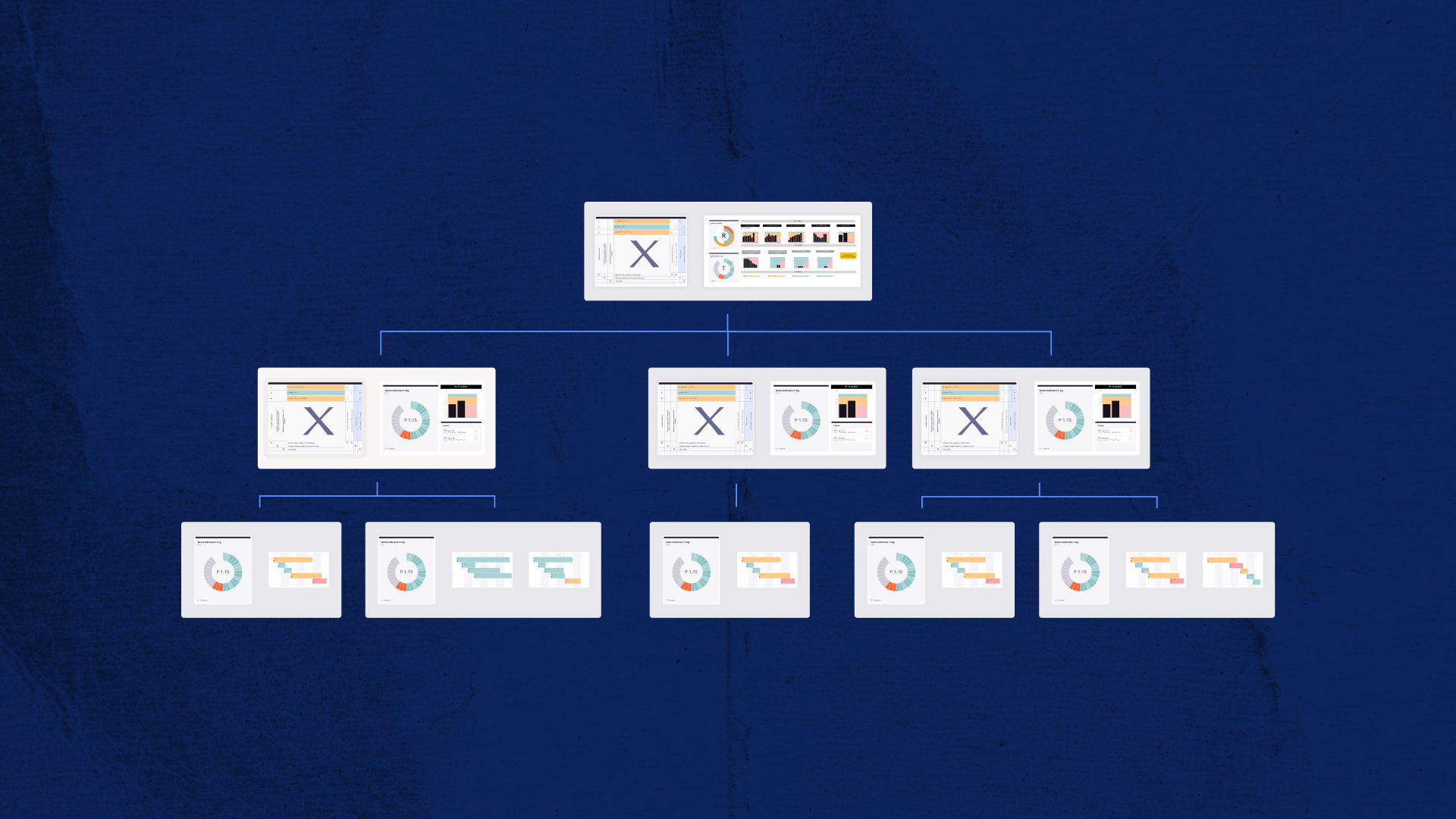
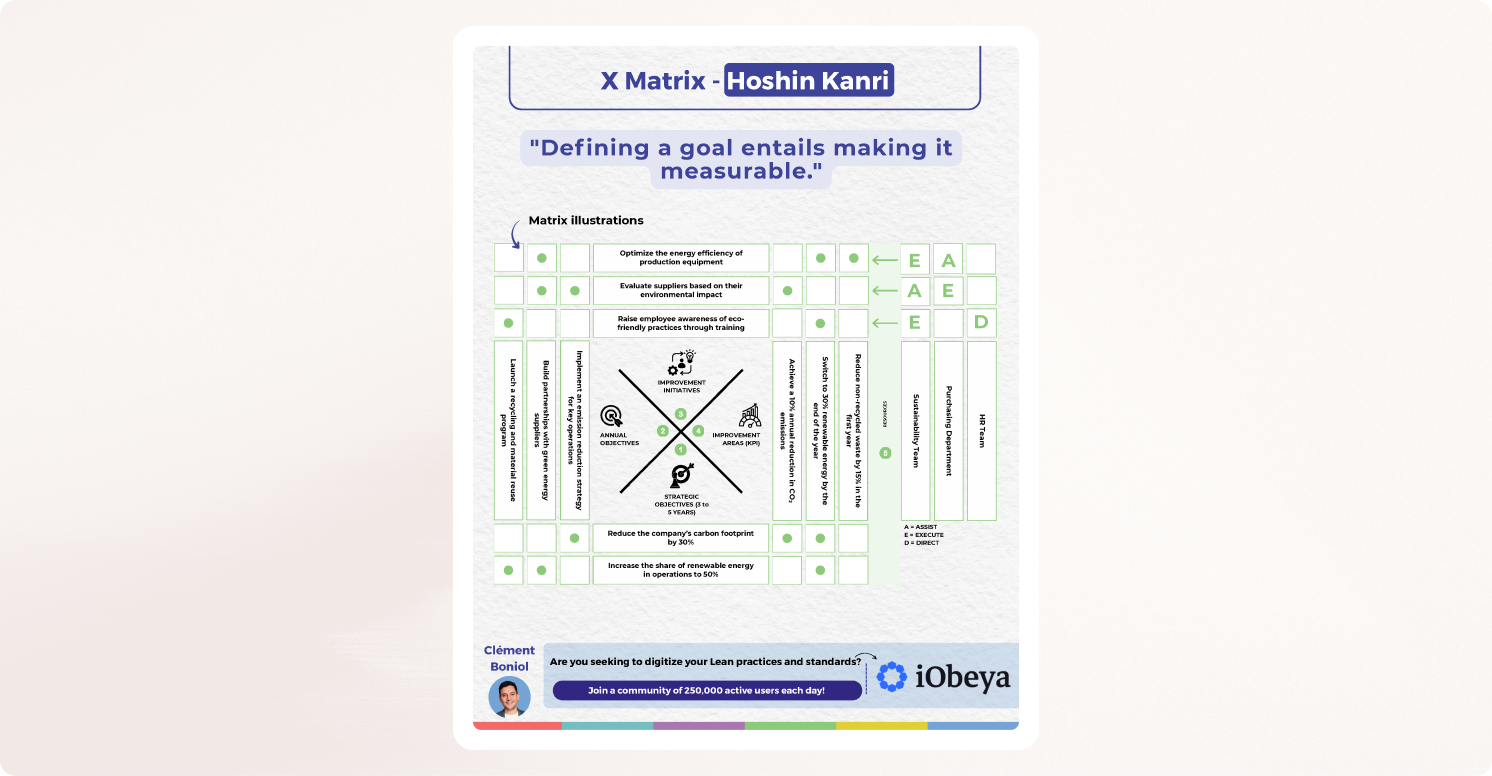
Hoshin Kanri systems have four tasks to fulfill, not just one. The first is structuring the X-matrix, the tool that maps annual objectives against means, indicators, and owners. The second is enabling “catchball” , the back-and-forth between leadership setting an ambition and the teams confirming its feasibility, before the objective is finalized. The third is cascading performance indicators down to the operational level, so a strategic target translates into a measurable target for a line team. The fourth, and the one most often missing, is connecting this cascade to daily management, that is, to SQCDP rituals and the various short-interval control meetings (SIC) that keep the strategy alive day to day.
It is generally common to stop at the first task. A readable, sometimes elegant X-matrix gets produced, and the work is considered done. The result is a quality strategic document, displayed in the executive committee, with no link whatsoever to what gets discussed the next morning in the team meeting. Leadership has done its Hoshin Kanri; the shop floor carries on with daily management as before. The two worlds don’t talk to each other, despite the tool.
This shortcoming is not trivial: it reproduces, inside the system, exactly the problem Hoshin Kanri is meant to solve. The method exists precisely because a strategy decided at the top doesn’t spontaneously translate into a coherent action at the bottom, that is the entire point of the cascade and of the catchball. A tool that digitizes the matrix without digitizing the cascade only makes the document look better; it changes nothing about how information actually flows between levels of the organization. Judging Hoshin Kanri system solely on the quality of its X-matrix amounts to judging a management system on its display alone, without checking that it works once the meeting is over.
The most widespread shortcoming is not a matter of missing features on paper; most tools can build a correct X-matrix. The problem is that the cascade stops at tier 2: leadership sets the objectives, site managers break them down into sub-objectives, and that’s where it ends. The line operator, at tier 1, has never seen this cascade reflected in their daily SQCDP board. To them, Hoshin Kanri remains a leadership initiative, disconnected from what they live through every morning.
This break has a simple structural cause: most Hoshin Kanri systems are designed as a strategic planning tool, built for quarterly use by a few managers. It is not designed to mesh with daily rituals that run at a completely different pace and granularity. The result: two systems coexist without ever syncing up , and it is precisely this gap, between the strategic cascade and the daily ritual, that needs closing.
This shortcoming reveals itself through one precise symptom: if you ask a tier-1 operator to name the current year’s strategic objective, and they can’t answer, the cascade stops well before reaching them , regardless of which system is used at the executive committee level. In an organization where the cascade genuinely works, that same operator can explain, in a single sentence, how the indicator displayed on their morning SQCDP board ties back to a broader objective. This simple test, more than any software demo, reveals whether a Hoshin Kanri tool has actually connected the strategy to the shop floor or merely documented it.
iObeya builds the X-matrix the same way dedicated tools do, but connects it directly to the SQCDP boards and daily management rituals used by shop-floor teams. An objective defined at the executive committee level automatically cascades into a measurable target down to the tier-1 board, with no re-entry and no intermediate document to sync manually.
Catchball stays tracked at every level of the cascade: every objective adjustment between leadership and sites keeps its history visible to every tier involved. For a manufacturing leadership team overseeing multiple sites, as is the case at Sanofi or Stellantis, this architecture makes it possible to compare progress on the same strategic objective across the entire footprint, using the same reading grid everywhere.
The point is not to replace the methodological rigor of Hoshin Kanri, but to ensure it actually translates into visible action at the level where the work happens. An organization that adopts this approach no longer has to choose between a strategic planning tool and a daily management tool: the two become two sides of the same system, fed by the same data and accessible to every level involved, from tier 1 up to the executive committee.
To judge what this actually changes for your own Hoshin Kanri cascade, a demo remains the most direct way to compare this approach against your current tool.