
Why iObeya
In an increasingly uncertain and demanding environment, small and medium-sized enterprises (SMEs) can’t afford waste or inefficiency. That’s exactly why Lean thinking and its tools can become powerful allies to structure performance, engage teams, and build a continuous improvement mindset at every level.
Contrary to what some may think, these tools aren’t reserved for large industrial groups or multinational corporations. In fact, they’re particularly well-suited to the reality of SMEs: limited resources, a lot of common sense, and a strong will to move forward.
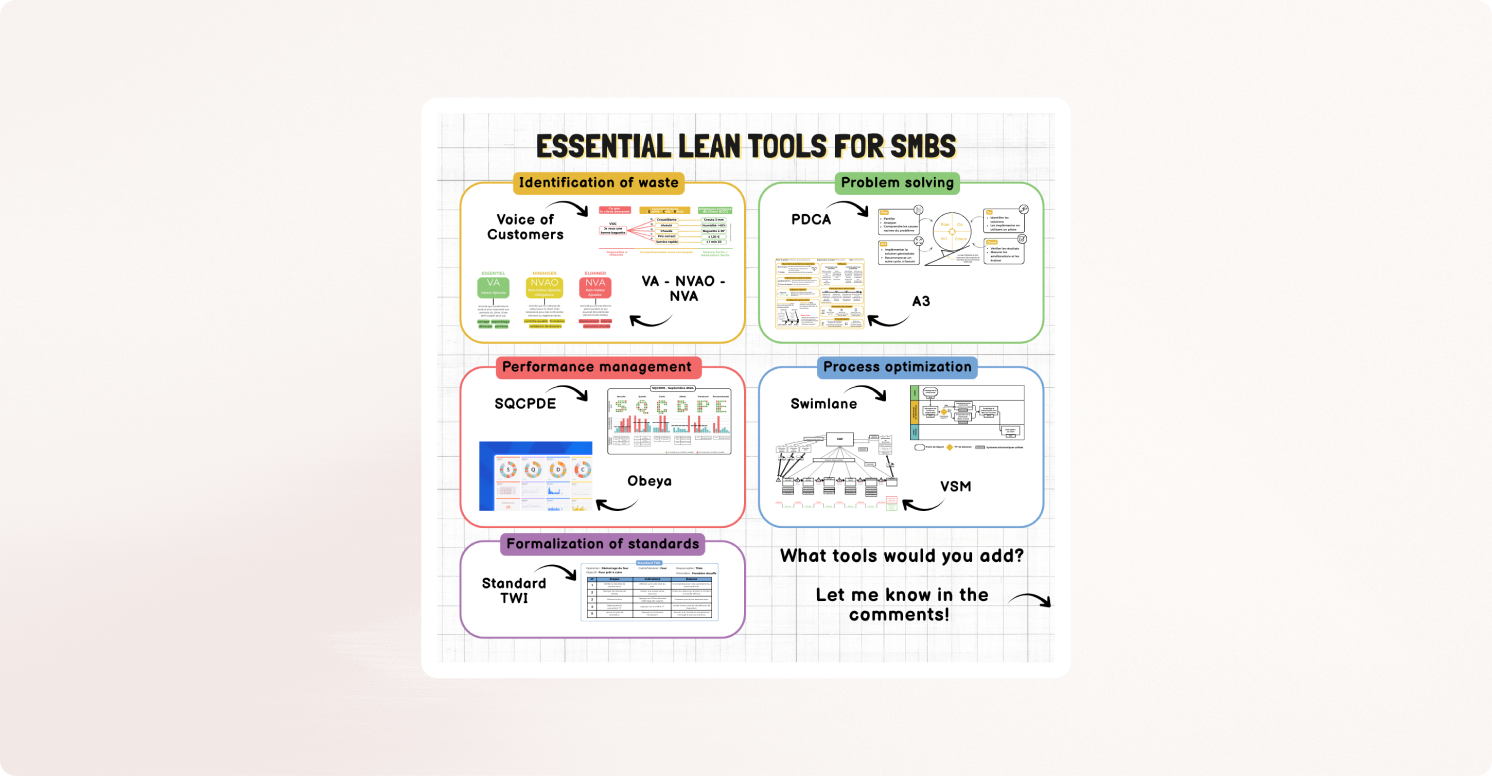
Here are five simple, visual, and pragmatic tools any SME can use to launch or accelerate their Lean transformation and improve operational excellence.
Every Lean initiative starts with a simple but fundamental question: What truly creates value for my customer?
To answer it effectively, one useful framework is the distinction between Value-Added (VA), Non-Value-Added but Obligatory (NVAO), and Non-Value-Added (NVA).
The idea is to map out all the steps in a process and sort them based on their real contribution. VA includes everything that genuinely transforms the product or service in line with customer expectations. NVAO refers to steps that don’t directly add value but are still required, like quality checks or regulatory compliance. NVA is pure waste: unnecessary movement, delays, errors, information hunting, rework… all the things that consume time and resources without bringing any real value.
My advice: film one of your processes for 15 minutes, then rewatch the footage and break it down into VA, NVAO, and NVA. You’ll likely find that a significant portion of time is spent on non-value-added activities. That’s exactly where to focus your efforts.
In SMEs, this framework is especially valuable. It helps make time losses visible and measurable, creates a shared understanding of how things work, and makes it easier to launch focused improvement actions. It’s also a great way to raise team awareness around flow efficiency and to kick off a collective effort to eliminate waste.
At the heart of a Lean approach, it’s not just about doing better. It’s about learning to do better together. The true objective? To solve problems continuously in order to improve processes — and, above all, to develop people. Because at its core, Lean is first and foremost a lever for employee development.
But for continuous improvement to last, it can’t rely solely on good intentions or one-off initiatives. It needs a clear, structured way of thinking about problems, progressing step by step, with learning at every stage.
My advice: build your problem-solving culture around the PDCA + A3 duo. It’s a simple yet powerful combination, perfectly suited to the pace and structure of an SME.
PDCA (Plan-Do-Check-Act) is a practical improvement cycle that guides actions through four phases: plan the solution, try it out, check the results, and adjust if needed. It’s a way of thinking that avoids rushed decisions or short-lived actions.
The A3, meanwhile, is a visual tool that captures this structured approach on a single sheet. It guides the team through the problem: defining it clearly, identifying root causes, building an action plan, tracking outcomes — and, importantly, sharing it. It’s a tool for communication, alignment, and collaborative learning.
My advice: create a simple, standardized A3 format across the entire company. It makes the method easy to adopt, and helps everyone speak the same improvement language, while giving each person space to grow.
In SMEs, where many decisions happen informally, the A3 brings structure. It helps keep track of actions, supports learning over time, and turns every solved problem into an opportunity for individual and collective growth.
Improving operational excellence also means knowing how to steer the business on a daily basis. But first, there’s a key question to clarify: what does “being high-performing” actually mean?
Is it about delivering on time? Being more productive? Cutting energy consumption? Improving workplace safety? In reality, it’s often all of the above.
My advice: use the SQCDPE framework: Safety, Quality, Cost, Delivery, People, Environment. These six dimensions cover the full scope of a business’s performance, going far beyond just financial metrics. SQCDPE allows for a balanced management system that includes customer satisfaction, employee wellbeing, profitability, and environmental responsibility.
In practice, that means choosing a few clear KPIs for each dimension, setting specific targets, and monitoring them daily. Not to fill out spreadsheets — but to spark the right conversations, catch early warning signs, and take timely action.
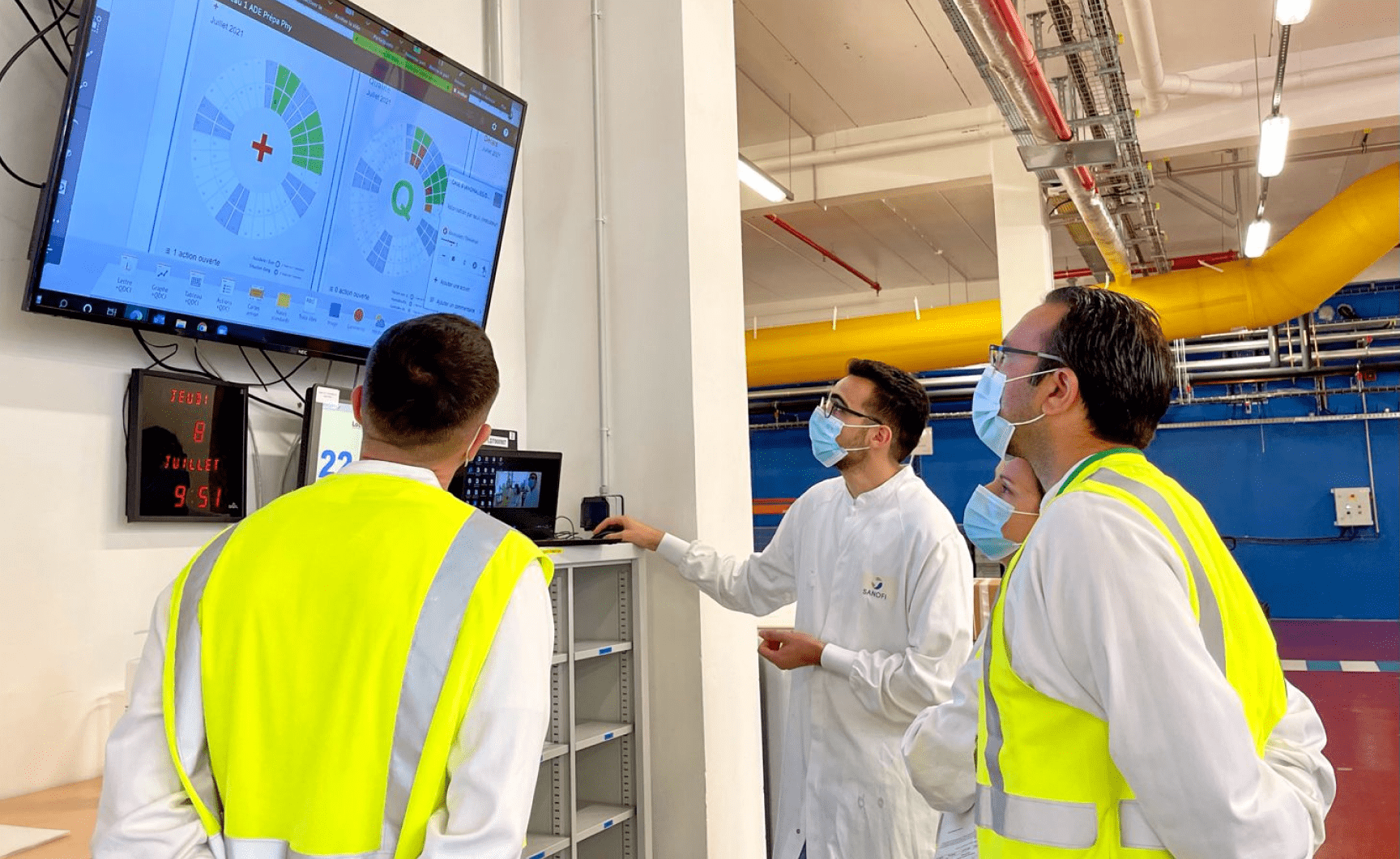
Used within an Obeya ( a visual management room) the SQCDPE framework becomes a powerful engine for team routines, problem escalation, and collective decision-making. The Obeya reveals what’s usually hidden: the gap between strategy and operations, tensions between teams, or pending decisions that block progress.
It turns walls into collaborative spaces, and KPIs into learning opportunities. For an SME, even a modest Obeya setup can kickstart a new rhythm: better alignment, faster responsiveness, and more transparency. In the end, it’s a more concrete and collaborative way to manage performance.
A high-performing organization is first and foremost a smooth-running one. Yet in many SMEs, processes are often poorly formalized. They rely on habits, collective memory, and quite a bit of tacit knowledge. As a result, roles aren’t always clear, handoffs between departments are shaky, and inefficiencies linger without being clearly identified.
To gain better visibility, two tools are particularly effective: the Swimlane diagram and the Value Stream Mapping (VSM).
The Swimlane diagram helps represent a process by breaking it down according to the roles involved, across parallel “swim lanes.” In just a few minutes, it shows who does what, in what order, and where the pain points lie: duplicate steps, grey areas, missed tasks, unnecessary back-and-forth. It’s a simple yet powerful tool for aligning teams, clarifying responsibilities, and improving cross-functional collaboration.
The VSM, on the other hand, gives a big-picture view of a key process from end to end. It maps out steps, information flows, inventory levels, and lead times. It helps identify bottlenecks, waste, unnecessary delays, and points of friction. It serves as a compass to focus improvement efforts where they will have the greatest impact.
My advice: start by mapping your processes using a Swimlane diagram. It’s quick, visual, and highly engaging for teams. Once that foundation is in place, shift your focus to your most critical processes and use a VSM to drive overall performance.
In an SME, these tools help move away from a fragmented perspective. They offer a shared, actionable view of how work really flows. It’s often the first step in moving from reactive firefighting to proactive process control.
The last tool in this selection is often overlooked but absolutely essential: the standard. It’s one of the foundational pillars of Lean. The idea behind a standard is simple — define the best-known way to carry out a task or process. And in reality, many problems stem from either a missing standard or one that’s not being followed.
My recommendation is to rely on the TWI (Training Within Industry) method. It was developed during World War II to rapidly train operators in American factories. It’s based on a very straightforward insight: any skill can be effectively taught if there’s a clear method for doing so.
TWI follows a four-step approach: prepare, present, try out, and follow up. You break the task into key steps, highlight the critical points, and teach it in a structured, hands-on way, while also explaining why each task matters.
It’s a very concrete tool for making operational routines more reliable, avoiding execution drift, and speeding up the onboarding of new employees. And for SMEs that may not have fully developed training departments, TWI provides a simple and robust framework to capture know-how and ensure consistent performance.
Improving operational excellence in an SME doesn’t require heavy investments. It starts with simple, visual, collaborative tools that everyone can adopt and use daily. By using VA/NVA/NVAO to eliminate waste, PDCA and A3 to solve problems, SQCDPE and Obeya to manage performance, Swimlane and VSM to optimize processes, and TWI to reinforce standards, SMEs can build a Lean journey that is both effective and tailored to their reality.