

- Home
- Lean Corner
- Operational Excellence: The Foundations for Improving Efficiency in SMBs
Operational Excellence: The Foundations for Improving Efficiency in SMBs
- Step 1 – Start from the shop floor
- Step 2 – Clarify the company’s vision
- Step 3 – Formalize the company vision and objectives with OKRs
- Step 4 – Train teams in Lean and continuous improvement
- Step 5 – Map and improve your key processes
- Step 6 – Install your first performance routine
- Step 7 – Handle daily issues with structure
- Step 8 – Standardize best practices
- Step 9 – Keep the momentum going
- Step 10 – Spread the mindset throughout the organization
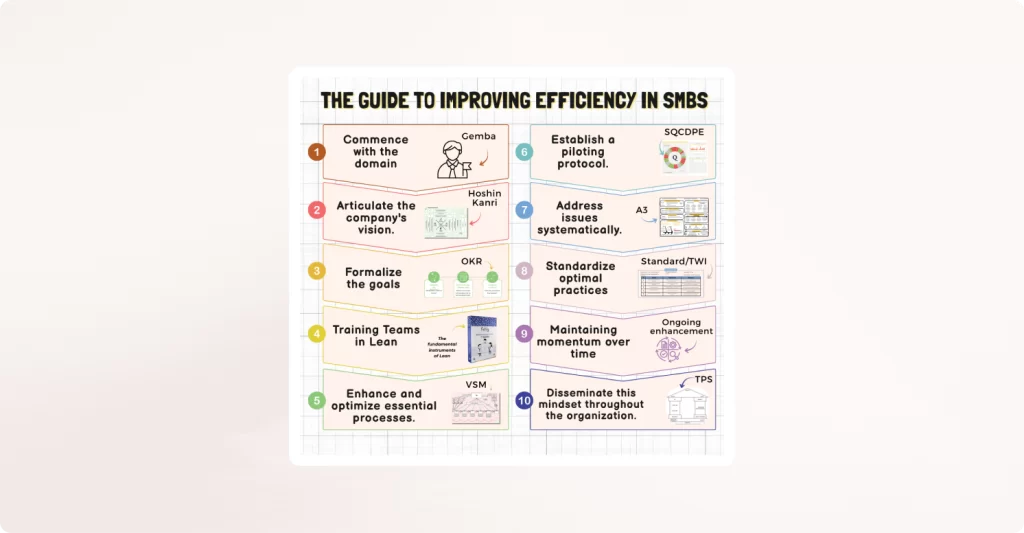
The practical 10-step guide to taking action
Step 1 – Start from the shop floor
The first step doesn’t require tools or training. It requires presence. First, go to the field, observe the workflows, and listen to your teams. Whether it’s in the workshop, customer service, or a back office, take time to follow a complete process: from customer request to delivery or resolution. You’ll quickly see what blocks the flow, what slows things down, or where workarounds are used. The real causes of inefficiency aren’t in spreadsheets , they’re in the everyday.
My advice: Take a notebook, follow a process for one hour without interrupting or correcting. Just observe. That raw look is often what sparks the first desire to change.
Step 2 – Clarify the company’s vision
Before launching actions, you need to agree on what really matters. Too many SMBs scatter their efforts due to a lack of structure or methodology. Sort it out: What are the top 3 to 5 challenges for the coming months? What’s urgent? What opportunities are emerging? This isn’t about building a 5-year strategy, but giving your teams visibility.
My advice: Gather your leadership team and take half a day to align on your challenges and shared priorities.
Step 3 – Formalize the company vision and objectives with OKRs
Many SMBs have a clear vision in the leader’s head , but it’s rarely formalized, shared, or translated into tangible goals. To move forward as a team, you need to set a clear direction. That’s where OKRs (Objectives & Key Results) come in. Popularized by Google, OKRs help define a qualitative ambition (the objective), supported by 2–3 measurable key results to be achieved over a short time period (usually a quarter).
This lightweight format helps clarify expectations, empower teams, and track progress every two weeks. Each result is tied to a clear KPI, with an assigned owner. It keeps focus, highlights gaps, and drives a shared momentum toward progress.
My advice: Start with 1 or 2 OKRs for the leadership team or a pilot team. Test, adapt, then scale. OKRs help align efforts, prioritize, and keep regular focus on what truly matters.
Step 4 – Train teams in Lean and continuous improvement
For routines, tools, and KPIs to make sense, teams need to understand the purpose. You don’t need a big seminar, just short, hands-on training sessions (1 to 3 days) covering key concepts: value-added work, types of waste, problem-solving, and everyone’s role in improvement.
My advice: Train in small groups, using real daily issues. The more concrete the training, the more engaged the teams will be , and the more capable they’ll be of suggesting relevant improvements.
Now, you’ll focus on three core pillars: Processes – Performance Management – Problem Solving.
Step 5 – Map and improve your key processes
Once your teams are engaged, focus on critical processes. It could be order intake, after-sales support, or production planning. The goal is to make workflows visible, identify friction points, and clarify roles.
Use two tools: the Swimlane Diagram to visualize roles and handoffs, and the VA/NVA (Value Added / Non-Value Added) analysis , or even a VSM (Value Stream Map) , to identify value-adding steps, mandatory steps, and sources of waste.
My advice: Do it as a team. It’s a fast, powerful way to build alignment around the real process , not the one you think you have. Once you’ve diagnosed the pain points, start a simple improvement plan.
Step 6 – Install your first performance routine
Once the priorities are clear, you need rhythm. In SMBs, a 30-minute weekly performance meeting can already shift the dynamic. You’ll review key indicators, share alerts, and make quick decisions. The aim is simple: keep the team aligned and responsive.
Use the SQCDPE standard (Safety, Quality, Cost, Delivery, People, Environment) to structure your dashboard. It ensures you cover all performance dimensions and spot issues early.
My advice: Don’t start with a complex digital tool. A sheet of paper on the wall, a whiteboard, a structured meeting, and a designated facilitator , that’s more than enough to get started.
Step 7 – Handle daily issues with structure
Your performance routines will surface problems. Some are easy to fix. Others need a more structured approach. That’s where the A3 comes in. This one-page visual tool helps you define the problem, analyze root causes, design an action plan, and track results.
My advice: Don’t limit A3s to project managers. Teach your team leads to use them to address recurring issues. It prevents going in circles and develops a culture of rigorous problem-solving.
Step 8 – Standardize best practices
Once a process is clarified and improved, it’s critical to anchor the new practices. Otherwise, things slip back. That’s where standards come in. A standard isn’t a rigid rule , it’s the best known way to do the job today. It avoids inconsistencies, helps train newcomers, and ensures reliable results.
My advice: Use the TWI (Training Within Industry) method to build living standards. Break tasks into key steps, explain the “why,” and train directly on the job. It’s practical and light, yet powerful.
Step 9 – Keep the momentum going
Operational excellence isn’t a checklist , it’s a living system. Once your routines are in place, standards defined, and improvement projects started, you need to sustain momentum. Celebrate progress. Build on feedback. Adapt what doesn’t work.
My advice: Run a quarterly retrospective. Ask: What did we learn? What has changed? Where do we stand? This moment of reflection helps realign and prevents fatigue or burnout.
Step 10 – Spread the mindset throughout the organization
In the end, the difference-maker isn’t the method , it’s the culture. When everyone feels involved in improving how things work, when suggestions are valued, when people learn from mistakes , that’s when operational excellence becomes second nature.
My advice: Talk about Lean as a better way to work together , not as a project. Highlight local initiatives. Give teams autonomy. And most importantly: walk the talk, every single day.