
Lean Corner

The Daily Management Mini Guide

Daily Management routines have become a fundamental pillar in structuring daily performance management. They are not just follow-up meetings; they create a truly visual, collaborative, structured, and action-oriented management system.

To help you implement Daily Management effectively, we have designed a practical guide consisting of five essential guides. Each sheet addresses a key pillar of a successful daily routine: from defining performance (Quality – Delivery – Cost), to structuring the 5 / 15 / 30 routines, to building your SQCDP dashboard and digitizing your Obeya. This kit will give you the foundational tools to build a daily management system that is both effective and aligned across every level of your organization.

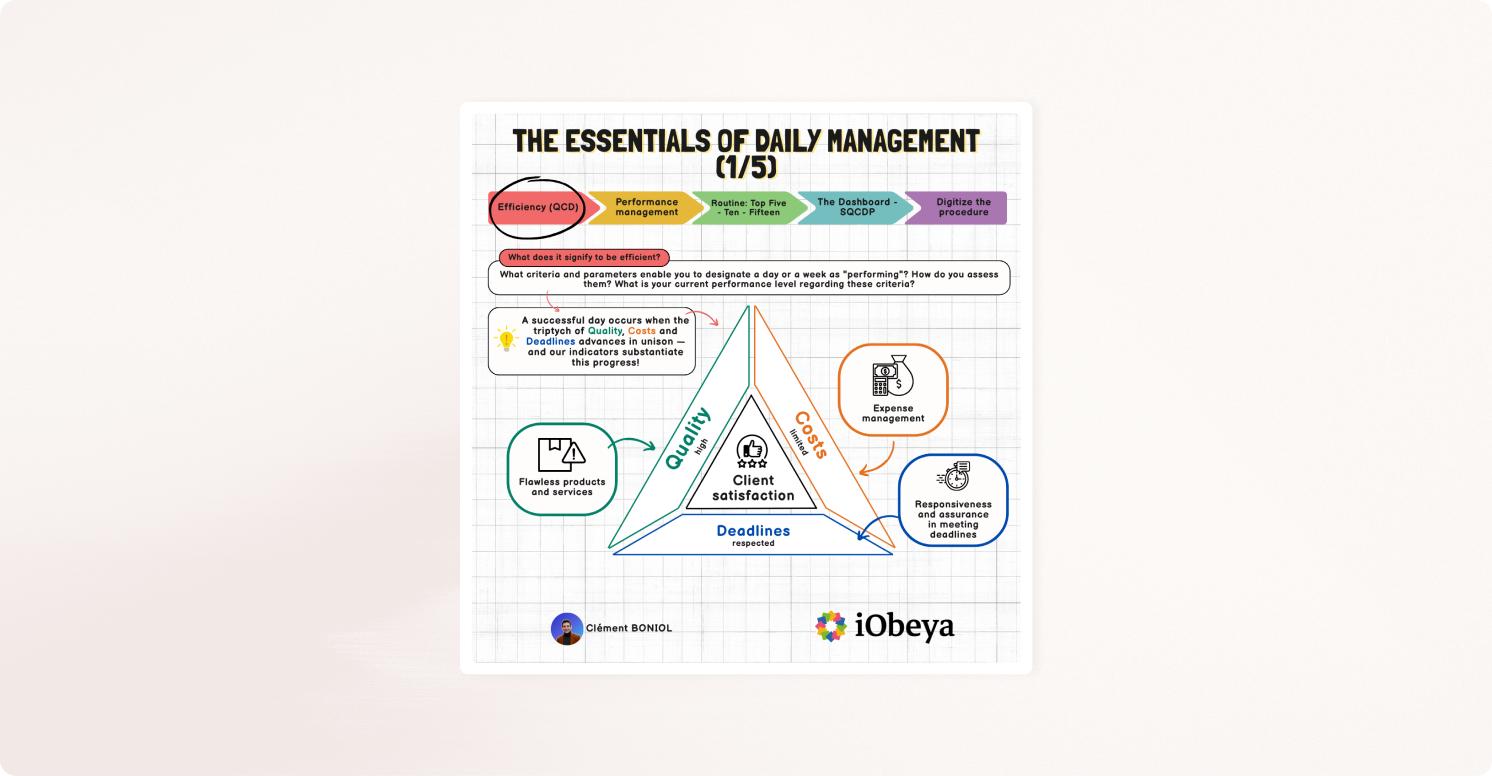
Let’s start with the basics: what does it really mean to be “high-performing”? In a Lean mindset, performance is first and foremost evaluated through customer satisfaction, which is based on three inseparable requirements: Quality (the right product), Cost (at the right price), and Delivery (at the right time). This is known as the QCD triangle. If any side fails, the customer promise is broken. Being high-performing means consistently meeting objectives across all three dimensions, every day, in every team.

But truly high-performing organizations go even further. They also commit to three other foundational pillars:

  • S for Safety :because no performance matters if it compromises people’s safety.
  • P for People: because some problems impact team workload, work conditions, and morale.
  • E for Environment: in line with expectations for sustainability, compliance, and social responsibility.


This is known as the SQCDPE dashboard.

As Deming said: “What gets measured gets improved.” A good management system should enable every level of the organization to:

  • Visualize key indicators
  • Identify deviations and problems
  • Implement corrective actions
  • Escalate alerts in a structured way

The objective is to build a clear vision, align priorities, empower teams, and accelerate decision-making.

To facilitate effective discussions, you need a clear and shared visual tool. Collaborate with your team to define a dashboard that maximizes visual management.

Pro tip: Use a standard structure. The SQCDPE dashboard (Safety – Quality – Cost – Delivery – People – Environment) is perfect for this. Here are a few examples of indicators to track:

  • S (Safety): accidents, injuries, compliance with safety protocols
  • Q (Quality): defect rate, customer satisfaction
  • C (Cost): cost control, resource optimization
  • D (Delivery): schedule adherence, flow management
  • P (People): absences, overtime, workload management
  • E (Environment): energy consumption, CO2 emissions

Once your KPIs are selected, organize them visually: use charts, color codes, smileys, and gauges. Everyone should be able to grasp the situation at a glance.

Also include a dedicated action-tracking area. The dashboard should not only highlight gaps, but show the responses in progress. Include a problem escalation area or a suggestion box to foster participation.

To implement an effective Daily Management system, you need structured routines supported by regular team meetings. Here’s a typical structure:
  • Who: Operators and team leaders
  • Purpose: Review daily performance via the SQCDP board, identify gaps, and take immediate action.
  • Who: Team leaders, supervisors, support functions
  • Purpose: Share field feedback, solve cross-functional problems, adjust priorities, escalate if needed
  • Who: Manufacturing managers, site directors, operations executives
  • Purpose: Track consolidated performance, align strategy with actions, make rapid decisions
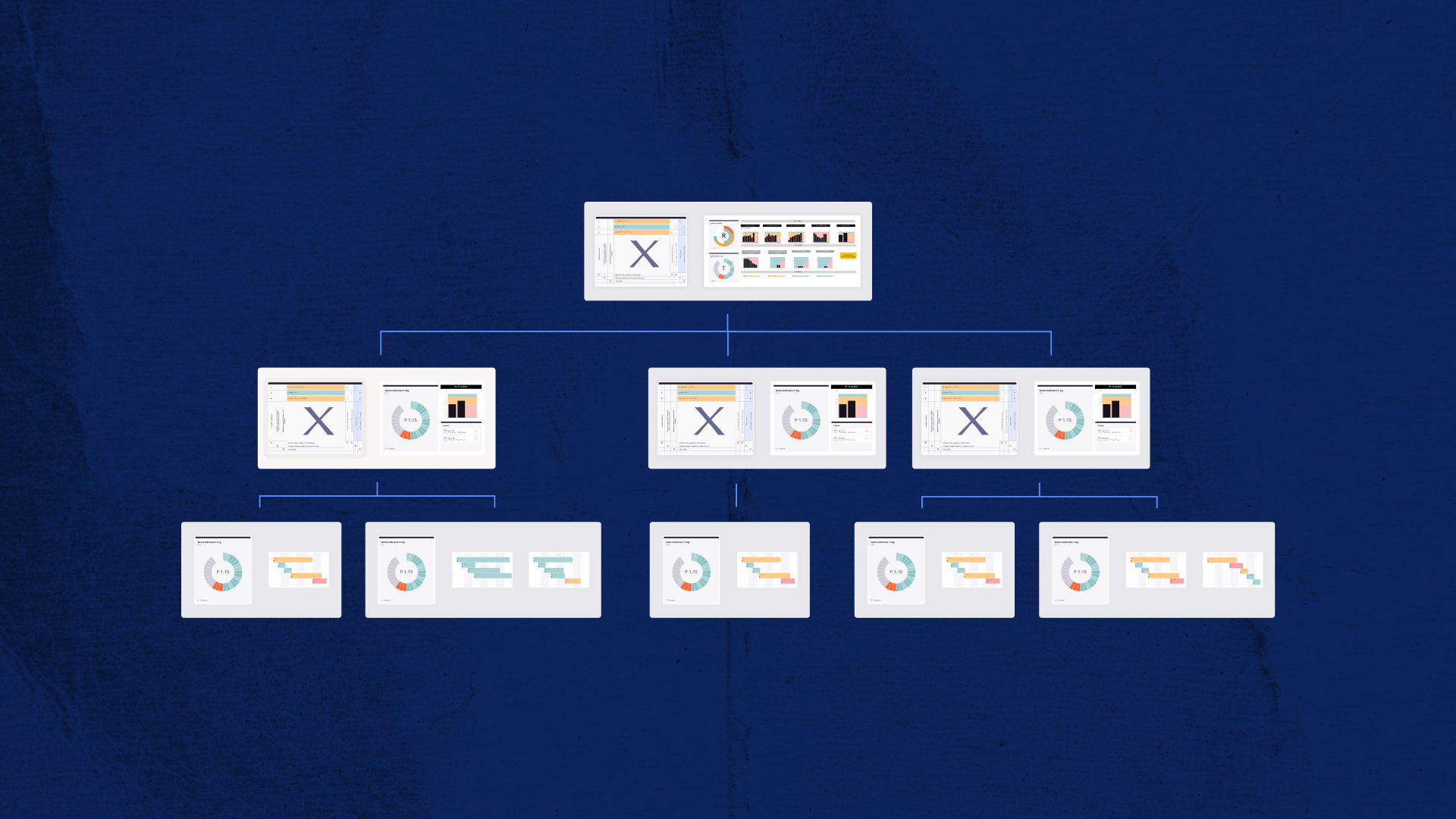
Before jumping into digital tools, starting with a physical Obeya often makes sense:
  • Encourages hands-on engagement: writing, posting, discussing around the wall
  • Helps prototype your room setup: which KPIs, which tools, which agenda?
  • Simple to deploy: accessible, low-tech, and fast.

But physical setups come with limitations:

  • Hard to track historical data
  • No remote access
  • Difficult to sync across teams/sites
  • Risk of errors/lost data
  • No link with enterprise tools

This is where digital becomes a performance enabler.

A digital Obeya enables you to:

  • Make dashboards accessible across all sites and teams
  • Update data in real time (connected to ERP, BI, MES…)
  • Create multiple rooms by level or flow
  • Ensure traceability and knowledge retention over time.

It is the natural evolution to scale your practices, enhance efficiency, and improve cross-functional visibility.

To make Daily Management truly effective, three elements must come together:

  • A visual dashboard that consolidates essential indicators and enables daily performance tracking
  • A structured action plan to guide decision-making and provide teams with visibility on progress.
  • A regular routine of short team meetings to involve everyone.

This is what makes Daily Management a key component of operational excellence.

See how ID Logistics digitized its Daily Management and Gemba Walks with iObeya, Read the success story.
Lean Corner Sheets
Lean Corner

The Daily Management Mini Guide

LeanOperational Excellence
Digitizing Shop Floor Management can propel businesses into a new era of productivity, quality, and competitiveness.
LeanOperational Excellence
Explore the 5S Framework which offers a practical and universal methodology for organizations seeking operational excellence.
Lean
Essential steps to implement Hoshin Kanri for effective strategic alignment within your organization.

See how they trusted us and achieved success with iObeya

Provide your information to download the lean corner fact sheets