

- Home
- Lean Corner
- The Complete Guide to Choosing Your Problem-Solving Method
Problem Solving – The Starting Point for Any Improvement Journey
Before launching large-scale improvement projects, it’s essential to effectively address day-to-day problems—because that’s where real opportunities for progress lie.
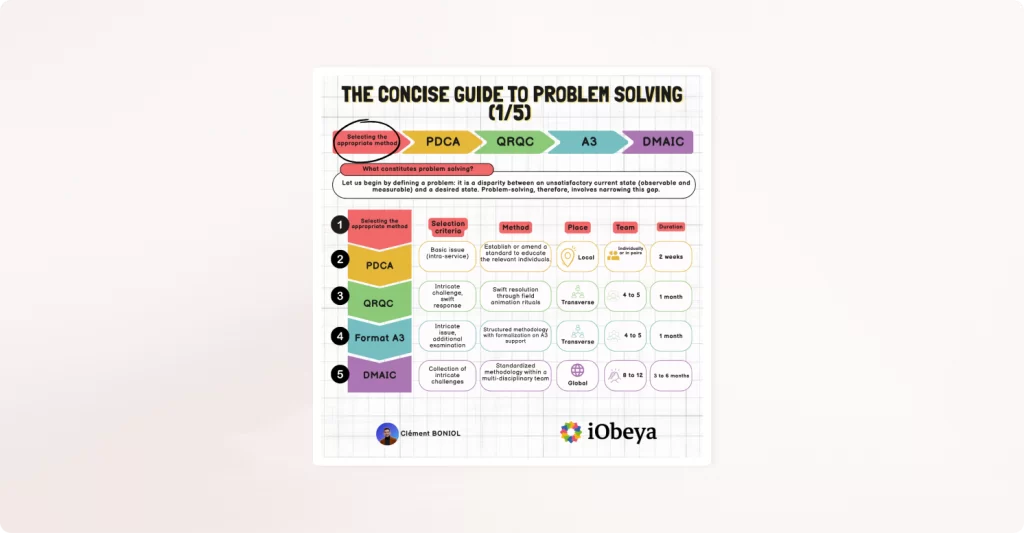
In the context of this article, a “problem” is defined as a gap between an unsatisfactory current state (observed and measurable) and a desired target state. Problem-solving consists of reducing that gap.
More than just a method, it’s a mindset: go to the field, observe the facts, understand the root causes, and engage teams in developing sustainable solutions.
The Key Steps of a Good Problem-Solving Approach
In this article, we’ll walk through four major problem-solving methods. They vary in name and timeline, but all share a common structure:
- Describe the problem: What is the deviation from the expected performance? What does the field show?
- Quantify the impact: Cost, scrap, time, customer dissatisfaction… add numbers.
- Analyze root causes: Use tools like the 5 Whys , Ishikawa , and WWWWHHW.
- Generate solutions: Brainstorming, benchmarking, solution testing.
- Implement actions: With a clear “What / Who / When” action plan.
- Measure effectiveness: Check the results and adjust if needed.
- Standardize: Document the best practice.
- Capitalize and scale: Share learnings and apply them to similar problems.
How to Choose the Right Problem-Solving Method
- Urgency – Is immediate action required, or is a longer analysis acceptable?
- Complexity – Is the problem simple, moderate, or systemic?
Here’s a closer look at four go-to approaches to help guide your choice:
PDCA: For Simple Problems Solved Locally
PDCA (Plan – Do – Check – Act) is well-suited for straightforward issues that are easy to identify and address.
It allows you to test solutions quickly, often within a single department, with a small team (1 or 2 people), in just two weeks.
Commonly used to update or correct existing standards.
Use PDCA if:
- The issue is isolated and well-defined
- No deep analysis is required
- The goal is to adjust or trial a change
QRQC: For Fast Responses to Urgent Operational Problems
QRQC (Quick Response Quality Control) is ideal in environments where time is of the essence.
It’s an effective method for solving urgent, complex issues by leveraging daily team rituals and quick cross-functional collaboration (production, maintenance…).Use QRQC if:
- The issue has immediate operational impact
- Customer or production safety must be secured fast
- Your organization already practices daily lean rituals
A3: For In-Depth, Structured Problem Analysis
The A3 method enables a clear, collaborative investigation into recurring or complex problems.
It’s built around a structured problem-solving template, useful for documenting root cause analysis (5M, Ishikawa…) and aligning the action plan. Typically carried out over a month with 4–5 cross-functional team members.Use A3 if:
- Root cause analysis is necessary
- You need to document the work and share outcomes
- Your team is trained in Lean tools (Pareto, 5 Whys…)
DMAIC: For Complex Improvement Projects at Scale
DMAIC (Define – Measure – Analyze – Improve – Control) is the most rigorous method.
Part of Lean Six Sigma, it suits systemic or cross-functional problems and requires a structured project approach.
Teams often include 8–12 people and run over 3 to 6 months.
Use DMAIC if:
- The issue is systemic with multiple causes
- Reliable data is needed to analyze and validate improvements
- Your organization is committed to a long-term transformation
Match the Right Tools to Your Approach
Whatever method you choose (PDCA, QRQC, A3, DMAIC…), success depends on using the right tools at each stage. Here are the key ones:
QQOQCCPA tool to define the problem through 7 essential questions (What, Who, Where, When, How Much, How, Why). A must-have for fact-based problem framing.
SMART ObjectivesYour goals should be Specific, Measurable, Achievable, Realistic, and Time-bound. This ensures clear direction and effective progress tracking.
Pareto ChartA great way to prioritize root causes using the 80/20 rule—focus efforts where they’ll yield the greatest impact.
Ishikawa Diagram (5M/6M)The classic “fishbone” diagram helps map all possible causes of a problem by categories: Materials, Methods, Manpower, Machines, Environment, and Management.
5 WhysA simple yet powerful method to get to the root cause by repeatedly asking “Why?”—typically five times.
Benefit/Effort MatrixPrioritizes actions based on impact and effort. Helps teams focus on quick wins and high-value improvements.
Action PlanTranslates decisions into action. Who does what, by when, and how do we follow up?
StandardizationEnsures the solution sticks by making it part of daily operations. Standards formalize new best practices.
A3 FormatA one-page summary that captures the entire problem-solving journey. A great tool for communication and knowledge sharing.
Conclusion – More Than Tools: Problem-Solving as a Culture
Problem-solving is more than a toolbox—it’s a mindset. Choosing the right method is crucial, but so is adopting a structured approach and nurturing a learning culture.
From fast field fixes (QRQC) to long-term transformations (DMAIC), each method has its place depending on your context and objectives.
Always remember: focus on defining the problem before jumping to solutions. That’s the true key to continuous improvement.