

Why iObeya
When we talk about Lean, we often think of factories, production lines, and industrial environments. And rightly so Lean was born at Toyota, at the heart of its production system, and it initially spread through the manufacturing world. That’s why we commonly refer to Lean Manufacturing.
That’s also how I started. But very quickly, companies realized that many production issues didn’t originate on the shop floor. A closer look revealed that many recurring problems actually stemmed from support functions: purchasing, maintenance, planning…
Gradually, the Lean approach expanded to other departments: HR, finance, sales, management control… and that’s how the concept of Lean Office emerged.
Whether we’re talking about finance, HR, sales, or IT, the goals remain the same:
These objectives are directly tied to the five core principles of Lean:
To manage these goals, Lean relies on a universal framework, applicable both on the shop floor and in office environments: the well-known SQDCP.
Applying Lean in office settings means facing a set of challenges quite different from those in production:
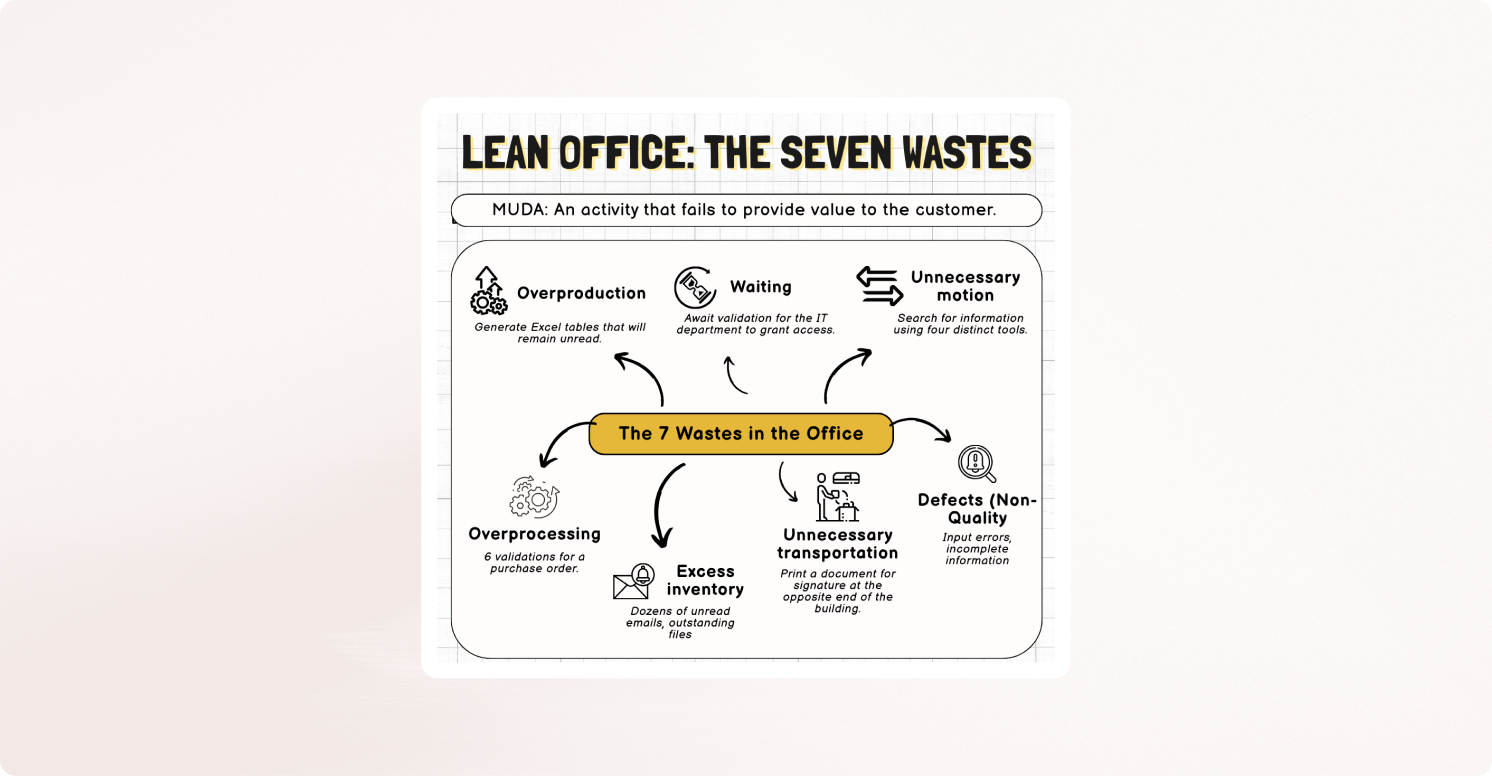
Example: Printing a document just to get it signed on the other side of the building.
Even in digital workflows, “movements” must be rethought: inefficient interfaces, tool-switching, etc.
Example: Waiting for a validation, a client reply, or IT support to unblock access.
Lean aims to reduce these delays through clear standards, real-time management, and smoother workflows.
Example: Searching for information across four different tools, endless copy-pasting in Excel.
A well-implemented digital 5S already limits this time loss.
Example: Data entry errors, incomplete info, wrong deliverables.
Each defect triggers a chain of corrections, stress, and lost time.
Example: Dozens of unanswered emails, pending files sitting idle for weeks.
Excess WIP hides actual workload, causes multitasking, and harms responsiveness.
Example: Creating Excel reports that nobody reads, preparing slides “just in case”.
Lean pushes for producing just what’s needed, when it’s needed.
Example: Six approvals for a single purchase, two meetings to say the same thing.
The more steps you have, the more delays and risks of error.
Example: A skilled employee who never shares ideas because no one ever asked.
A Lean manager brings the voice of the field into the system, fosters autonomy, and gives meaning to each role.
In a follow-up article, I’ll share actionable solutions based on these waste categories—so you can take the next step and treat them effectively within your processes.