

- Home
- Lean Corner
- Improving Service Processes: The Right Lean Tools at the Right Time
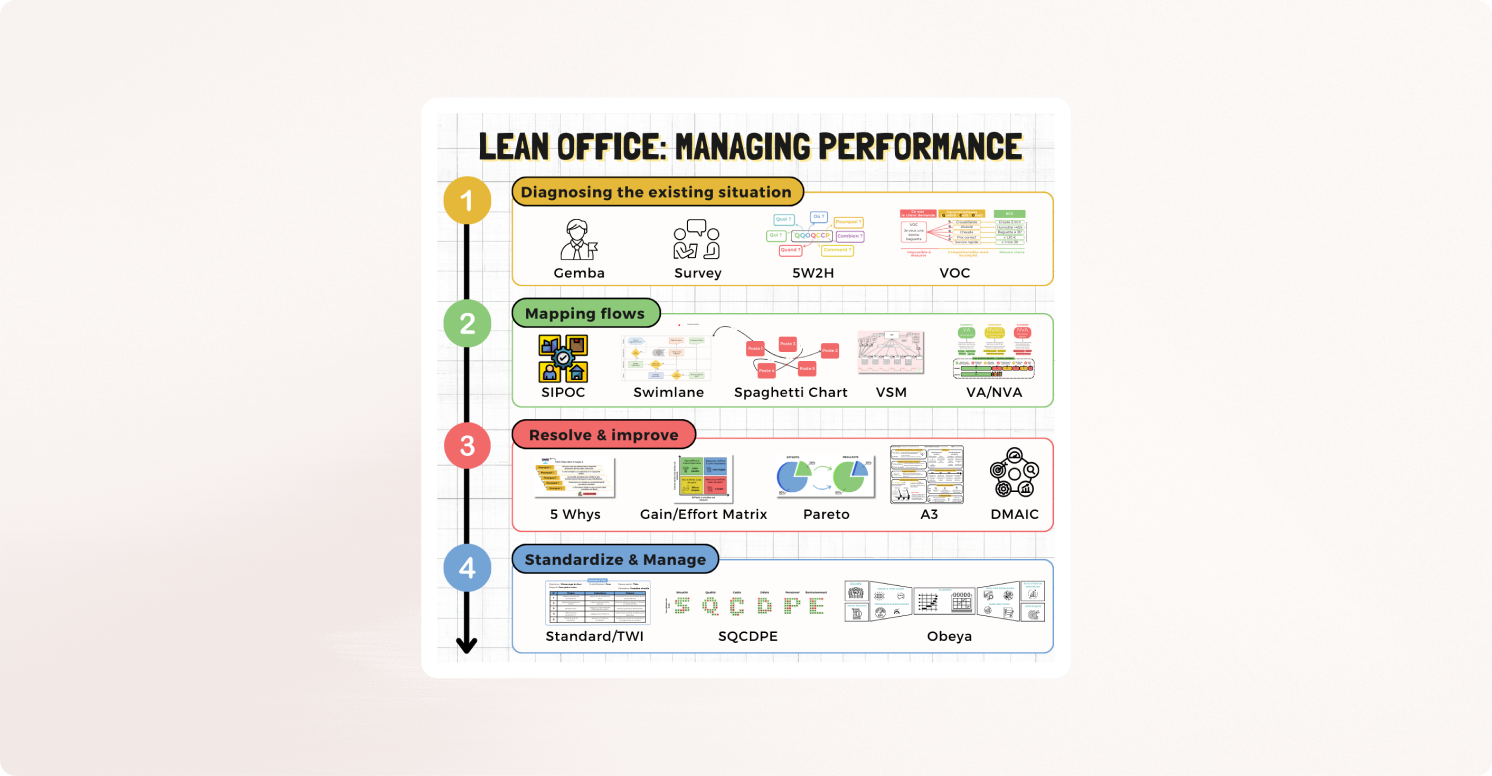
In a previous article, we explored how Lean Office helps better manage performance in service environments. But once waste has been identified, a common question remains: Where should we start to improve processes? And more importantly, which tools should we use, and when? That’s precisely what this article aims to address: moving from analysis to action, using simple, practical Lean tools tailored to the reality of office environments.
From Observation to Action
Don’t Skip the Diagnostic Phase
Before taking action, you need to understand. Many improvement initiatives fail because they skip the diagnostic stage. We often think we’re saving time by jumping straight to solutions, but without a thorough understanding of how processes truly work, we risk simply moving the problem elsewhere.
A proper diagnostic isn’t just about asking teams questions. It’s about observing the flows, measuring lead times, quantifying pain points, and especially identifying bottlenecks, redundancies, delays, and overloads.
My advice: take the time for a proper Gemba walk. Go to the field and observe actual flows, not just written procedures.
Seeing Is Good, Understanding Is Better
Just because a process is visualized doesn’t mean it’s understood. You need to know not only what’s happening, but also why it’s happening this way: who is involved? in what order? based on what information? which decisions are slowing things down?
Tools like swimlane diagrams allow you to map out actions across roles and identify handoffs, overlaps, responsibility gaps, and wait times.
My advice: don’t just draw the steps. Challenge every transition: who, what, when, why?
Mapping to Clarify
VSM – Value Stream Mapping
VSM is a powerful tool for visualizing an entire process flow, from initial request to service delivery. It clearly identifies value-added steps, waste, wait times, correction loops, and inconsistencies.
It’s an essential starting point for any cross-functional improvement initiative.
My advice: use VSM to align all stakeholders around a shared view of the real flow.
Process Mapping / Swimlane Diagram
Swimlane diagrams are especially useful for processes involving multiple actors. They reveal interfaces, back-and-forth information flows, unclear responsibilities, and validation or transfer delays.
It’s an ideal tool to break down silos and streamline coordination.
My advice: use swimlane diagrams to expose the grey zones where “someone” is assumed to be handling it, but no one actually is.
Yamazumi – Balancing the Workload
Yamazumi is a visual tool from Lean Manufacturing, but it can be easily applied in office settings. It helps visualize task distribution by role, identify workload imbalances, overload points, or areas of underutilization.
My advice: use Yamazumi to balance multi-actor processes and distribute tasks more intelligently.
Standardizing to Stabilize
Standards as the Foundation of Improvement
Standardizing doesn’t mean locking everything down. It means defining the best known way to perform a task at a given point in time, to ensure quality, ease onboarding, and detect deviations.
A good standard is clear, visual, accessible, co-created with users, and regularly updated.
My advice: don’t standardize to control people. Do it to help them work better together.
Simple but Powerful Formats
Checklists, work instructions, visual guides, annotated screenshots… In an office environment, standards don’t need to be long or heavy. They need to be visible, useful, and alive.
Don’t underestimate the power of a clear standard displayed in a shared space or embedded in a collaborative tool.
My advice: if a new employee can’t complete the task alone by reading the standard, it needs to be revised.
Managing to Anchor Practices
Daily Team Meetings in Office Environments
Just like in manufacturing, daily short-interval meetings are a powerful lever in service teams. They allow you to monitor key metrics, surface irritants, react quickly, and above all, engage the team in a shared rhythm.
You don’t need a dedicated Obeya room. A shared screen or well-structured digital board will do just fine.
My advice: make daily standups a habit. Keep them short, effective, always at the same time, with a clear agenda.
Visual Management, Even Remotely
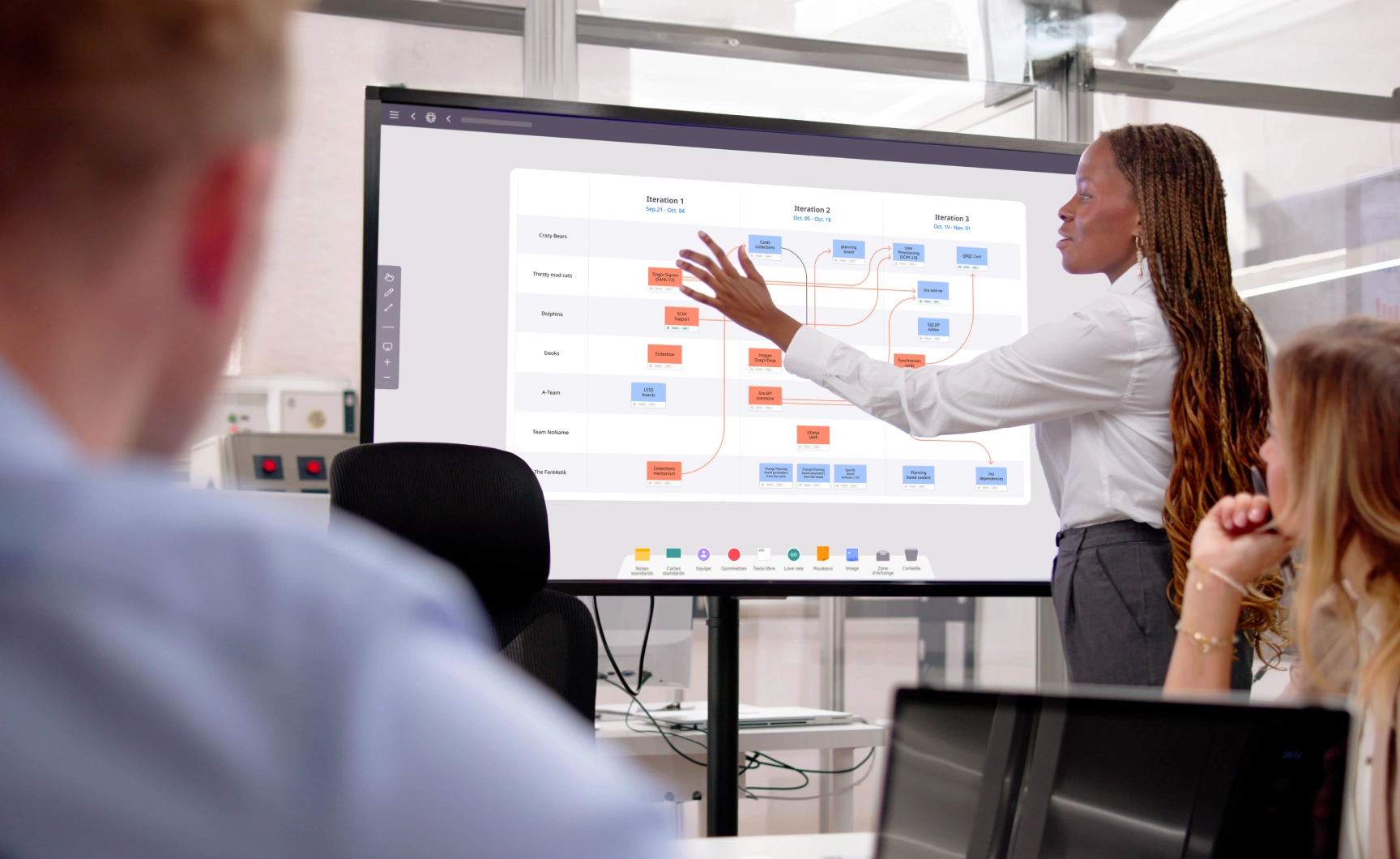
In hybrid or remote environments, digital visual management helps maintain transparency and momentum. Metrics, actions, standards, problems, all should be visible, up to date, and shared.
This fosters accountability and improves coordination, even at a distance.
My advice: a live digital board is worth more than a forgotten Excel sheet. Pick a tool that’s simple, adapted, and shared.
Solving Problems for Good
A Well-Defined Problem Is Already Half Solved
Fixing a bug or unblocking a task doesn’t mean the problem is solved. To avoid recurring issues, teams need a structured, collective approach to problem-solving.
That means gathering facts, understanding root causes, testing solutions, and checking that they hold over time.
My advice: treat problems as learning opportunities, not as failures.
Choosing the Right Approach Based on Complexity
For simple, recurring issues, PDCA (Plan-Do-Check-Act) is ideal: quick, lightweight, and iterative.
For more complex problems involving multiple causes, stakeholders, or long-term effects, the A3 method provides a clear, logical, and collaborative framework.
For the most complex cases (e.g. multi-month quality variations, unstable processing), DMAIC (Define – Measure – Analyze – Improve – Control) from Six Sigma is the most rigorous approach.
My advice: train your teams on all three levels—PDCA, A3, and DMAIC—and help them choose the right one for each situation.
Formalize, Share, and Follow Up
Problem-solving doesn’t stop once actions are implemented. You need to monitor results, capture learnings, and build the team’s collective memory.
A shared problem-solving board, regular reviews, and a continuous learning mindset help anchor improvements over time.
My advice: don’t over-document. Prioritize shared learning. A well-solved problem can become a valuable reference for other teams.
- 20 minute listen
- 7 minute read
- 8 minute read